
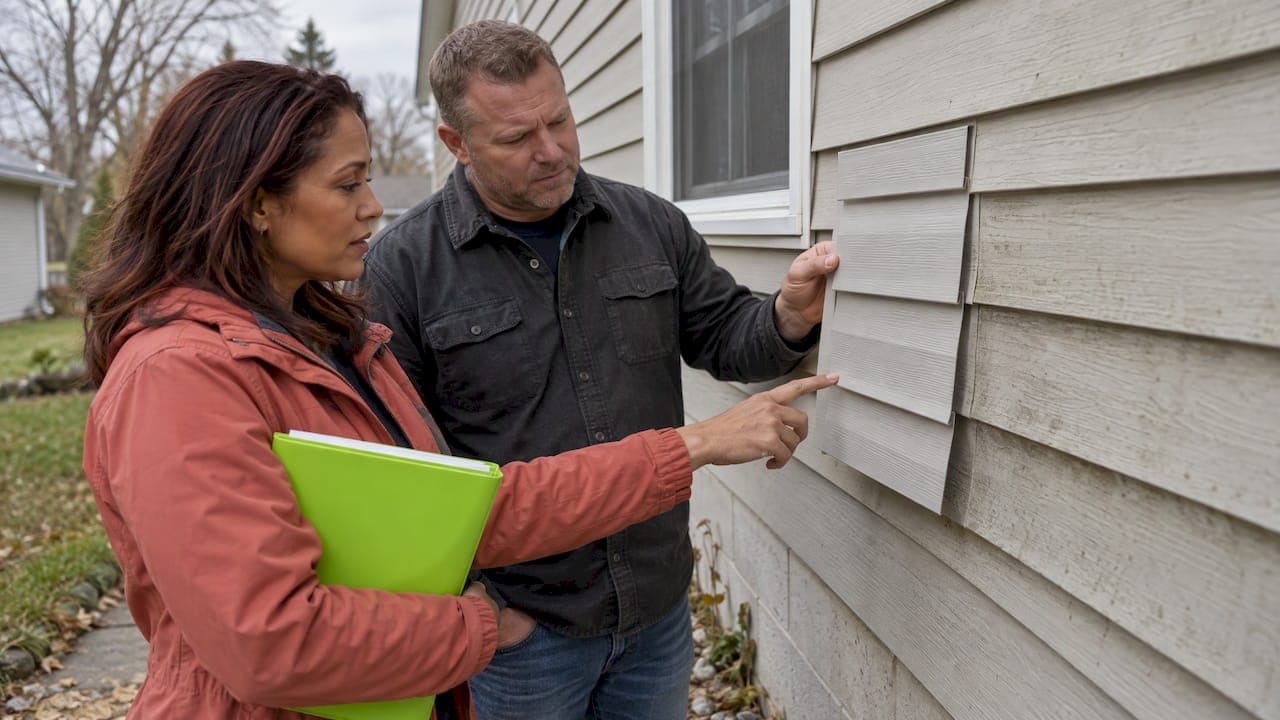
Insurance may pay to replace undamaged siding so the house matches, but only if your policy and your state's rules support it. Policy wording decides first. State matching rules come second. Evidence you collect decides the rest. Wisconsin is one of the states with matching rules on the books, so Wisconsin homeowners often have more room to push than they expect.
This guide explains how matching works, what to check in your policy, what proof to gather, and what to do if the insurer says no.
TL;DR
- Matching means replacing more siding than was damaged so the finished wall looks uniform. Insurers do not owe it automatically.
- Your policy language controls the answer. Look for a mismatch exclusion or a matching endorsement.
- Wisconsin is on a list of states with matching laws or regulations, so ask the adjuster in writing how the insurer applies them.
- Photos, material samples and a written contractor report make a matching request much stronger.
- A denial is not final. You can ask for a supervisor review, appeal in writing, use the appraisal clause, or contact the state insurance regulator.
Table of Contents
- What "matching" means in a siding claim
- Does homeowners insurance cover siding at all?
- Step 1: Read the matching language in your policy
- Step 2: Know what your state says
- Step 3: Build the evidence before the adjuster visits
- Step 4: Make the matching request in writing
- What if siding is discontinued or the damage is hidden?
- If the insurer denies matching
- How matching works with the rest of the exterior
- Perspective: why we document first
- Get help with a storm-damaged exterior
- FAQ
- Sources
What "matching" means in a siding claim
Say hail or a windstorm damages the siding on one wall. The adjuster approves that wall. The siding on the other three sides is fine. But the manufacturer no longer makes your color, or the old siding has faded for 15 years, and new panels will not look the same.
Matching is the question of whether the insurer pays for more than the damaged boards so the house looks uniform again. There are three common outcomes:
- Spot repair. The insurer pays to replace only the damaged pieces. Mismatch is your problem.
- Full elevation or full house. The insurer pays to replace whole walls or all siding so it looks consistent.
- Appearance allowance. The insurer pays a partial amount for the lost appearance. Maryland's insurance regulator says an insurer may have to offer an appearance allowance if a mismatch hurts the home's value.
No single national rule picks between these. Your policy and your state do.
Does homeowners insurance cover siding at all?
Usually yes, when the cause is a covered peril. Wind and hail are the common ones in Southeast Wisconsin. Siding damage is generally covered when the weather event is a covered peril on the policy. Wear, age and neglect are not covered perils.
Two practical points before you file:
- Check the deductible. If the repair is small, it may cost less than your deductible. Getting an independent repair estimate first tells you whether a claim is worth filing.
- Check how the policy pays. Replacement cost policies pay to replace with new materials. Actual cash value policies subtract depreciation. That difference changes every number in your claim.
Step 1: Read the matching language in your policy
Get the full policy, not the declarations page. Look at the sections on replacement cost, loss settlement and endorsements. The wording governs both sides' rights. Maryland's regulator says policies can include specific mismatch exclusions, and some insurers offer optional endorsements that cover matching costs.
Use this table when you read:
| What you find | What it usually means for you |
|---|---|
| Replacement cost coverage, no mismatch exclusion | You have a stronger argument that undamaged siding should be replaced to match |
| Mismatch or "matching" exclusion | The insurer will likely limit payment to damaged pieces. Your state's rules may still apply |
| Matching endorsement | Matching costs are covered as written. Check any dollar limit |
| Actual cash value only | Payment is reduced by depreciation, even if matching is accepted |
| Language about "like kind and quality" or restoring to a "uniform" condition | Gives you wording to cite in your request |
If you cannot tell what a clause means, ask the agent or adjuster to explain it in writing. Questions about what the policy means belong with your insurer, your agent or a licensed public adjuster. Contractors generally are not licensed to negotiate claims or advise on policy coverage unless they hold a public adjuster license. A good contractor documents the damage and the construction facts. The coverage decision stays between you and your insurer.
Step 2: Know what your state says
Matching rules differ by state. As of July 2025, states with matching laws or regulations included Alaska, California, Connecticut, Florida, Iowa, Kentucky, Louisiana, Montana, Nebraska, Ohio, Rhode Island, Tennessee, Utah, Vermont, West Virginia and Wisconsin. In general, some states require insurers to make reasonable repairs or replacements to reach a uniform appearance.
Three cautions:
- A state having a rule does not mean every claim is approved. The details of the rule, the area it covers and your policy still matter.
- Other states have no matching statute at all. A Michigan-focused guide ranking for this topic, for example, says Michigan has no specific insurance law mandating matching siding.
- Courts also weigh in. Some courts, including in Minnesota and the 7th Circuit, have held that using non-matching materials can leave a property short of its pre-storm uniform condition. That is a legal argument, not a promise, and Wisconsin is in the 7th Circuit.
For the exact current rule and how it applies to you, ask your insurer to cite its basis in writing, and call the Wisconsin Office of the Commissioner of Insurance if the answer is unclear.
Step 3: Build the evidence before the adjuster visits
Matching decisions turn on proof. Take pictures or send samples of the materials, and ask the adjuster what is needed to prove matching is required. Here is a checklist you can use:
- Wide photos of every wall. Include the damaged wall and the undamaged ones, taken in the same light.
- Close-ups of the damage. Dents, cracks, lifted panels, torn corners. Add something for scale.
- Manufacturer details. Brand, profile, color name and the year installed, if you know it. Look for paperwork from the original install.
- A sample. Hold a replacement sample next to the existing siding and photograph it. Fading and texture differences show up fast.
- Availability proof. A written note from a supplier or installer that the product or color is discontinued or no longer available.
- Written estimates. One for spot repair and one for the full elevation or house, so the gap is clear.
- A claim log. Date, name and summary of every call. Follow calls with an email.
Storm photos help too. Our guides on photographing hail damage for claims and the Wisconsin storm damage claim process walk through what to capture on the roof and the exterior.
Step 4: Make the matching request in writing
Keep the request short and factual. Name the claim number, list the walls affected, say the replacement siding does not match in color, profile or texture, attach your photos and estimates, and ask for a written decision that cites the policy provision or rule the insurer relies on. A written answer gives you something to appeal.
Do not sign off on a final payment or let work start on a scope you disagree with until you understand how the insurer handled matching. Ask whether the payment can be supplemented later if the repair uncovers more damage.
What if siding is discontinued or the damage is hidden?
Two situations come up often.
Discontinued products. Older vinyl lines and some colors get retired. If no true match exists, the argument shifts from "replace more" to "the insurer cannot restore the house to its pre-loss condition with what is on the market." Legal commentators note that when a policy requires restoring the property to a uniform or pre-loss state, unavailable matching material can itself be argued as a form of direct physical loss. Insurers push back. Many modern policies carry restrictive anti-matching language because insurers see full matching as a potential windfall for the policyholder.
Hidden damage. Hail and wind can crack siding on one side while the roof and gutters show wear that points to the same storm. Document everything on the exterior in one visit. Our article on cosmetic versus functional hail damage explains how insurers split these categories, and the hail-resistant siding guide helps you pick a material that holds up better next time.

If the insurer denies matching
A denial is a position, not the end. A homeowner can request a supervisor's review, file a formal written appeal, hire a public adjuster, or use the policy's appraisal clause. Work through them in order of cost.
- Ask for the denial in writing. It should name the policy language or rule used.
- Request a supervisor review. Send new evidence with the request.
- File a written appeal. Attach your photos, samples, estimates and the sections of the policy you rely on.
- Contact the state regulator. In Wisconsin, the Office of the Commissioner of Insurance advises policyholders to first try to resolve the issue with the insurer or agent before asking OCI for help. You can then file a complaint through OCI.
- Consider a public adjuster. They represent you in the settlement, often for a fee based on a percentage of the final settlement. Check that the person is licensed in Wisconsin.
- Use the appraisal clause. Each side picks an impartial appraiser, and the two appraisers choose an umpire. The result sets the amount of loss without necessarily going to court. Appraisal usually settles the dollar amount, not whether the policy covers something. For how a claim looks on the money side, see this explanation of replacement cost versus actual cash value.
If you are weighing a legal route, an attorney who handles first-party property claims in Wisconsin can tell you about deadlines. Policies set time limits to file suit and to sue after a denial, so check yours early. Our walkthrough of a denied roof claim lays out a 30-day plan that applies in spirit to siding.
How matching works with the rest of the exterior
Siding rarely gets damaged alone. If the same storm hurt your roof, gutters or windows, the claim should list every item. A roof claim that goes through while siding is left out is a common gap, so ask for a full exterior inspection. See our guides on wind damage to roofs and the hail damage shingle signs.

If you end up replacing more siding, you also get to choose the material. Vinyl, LP SmartSide and James Hardie fiber cement differ in cost and in how they handle hail. Our published Wisconsin ranges are $12,000 to $20,000 for vinyl siding, $18,000 to $32,000 for LP SmartSide and $25,000 to $45,000 for James Hardie. These are project ranges, and the final price depends on the house. If you replace all siding, a fresh color choice also becomes possible. Our siding color guide shows a test for picking one.
Perspective: why we document first
Most siding disputes we see are not about whether a storm did damage. They are about what the paperwork shows.
We run owner-supervised installations, and we keep detailed records of every job: photos before, during and after, product details and the scope. That record helps a homeowner explain what is on the house and what a proper repair involves. We do not decide coverage. That belongs to your policy, your insurer and, when needed, a licensed public adjuster. What we can do is give you an honest repair-versus-replace recommendation and put the construction facts in writing.
Quality installation matters here too. Most failures come from poor workmanship rather than materials, so a repair that is done well, with the right product, trim and flashing, holds up longer. If your insurer agrees to replace full elevations, we can install LP SmartSide, James Hardie or premium vinyl with the warranties those brands carry.
Start early, photograph everything and ask questions in writing.
Heather
Get help with a storm-damaged exterior
If your siding, roof or gutters took storm damage in Dodge, Washington, Fond du Lac or Ozaukee County, we can inspect, document and give you written scope and pricing you can share with your insurer. We also help homeowners work through the claim process, from the first inspection to the installation.
See our storm damage and insurance claim services or review siding replacement costs in Wisconsin. For roof work, start with our roofing services.
FAQ
Does my insurance company have to match my siding?
Not automatically. It depends on your policy wording and your state's rules. Some states have matching laws or regulations, Wisconsin among them, but a mismatch exclusion or lack of replacement cost coverage can limit payment. Ask your insurer to state in writing the policy provision or rule behind its decision.
What if my siding is discontinued?
Tell the adjuster and bring proof, such as a supplier letter, a manufacturer notice or photographed samples that do not match. Discontinued products strengthen the argument that spot repair cannot restore a uniform appearance. The insurer may still limit payment under the policy, so ask for its decision in writing.
Should I file a claim for a few damaged panels?
Compare the repair estimate to your deductible first. If the repair costs less than the deductible, a claim may not pay anything. An independent estimate before filing gives you that number.
Can my contractor argue the matching claim for me?
A contractor can document damage, supply estimates and explain the repair. But contractors generally cannot negotiate claims or advise on coverage unless licensed as public adjusters. You or a licensed public adjuster handle the coverage conversation.
Where do I complain if the insurer is unfair about matching in Wisconsin?
Try your insurer or agent first, then contact the Wisconsin Office of the Commissioner of Insurance. OCI takes complaints online and by phone. Have your policy, claim number, photos and written correspondence ready.
Sources
- Siding-Damage, Maryland Insurance Administration
- Will home insurance pay to match repairs to undamaged items? | Insurance.com
- Does Homeowners Insurance Cover Siding? | Progressive
- Matching regulations and laws affecting homeowners' property claims
- NAIC notice on contractors and insurance claims
- After a Storm Hits, Wisconsin OCI
- Filing a Complaint, Wisconsin OCI
- Appraisal, NAIC Consumer Liaison 2023