
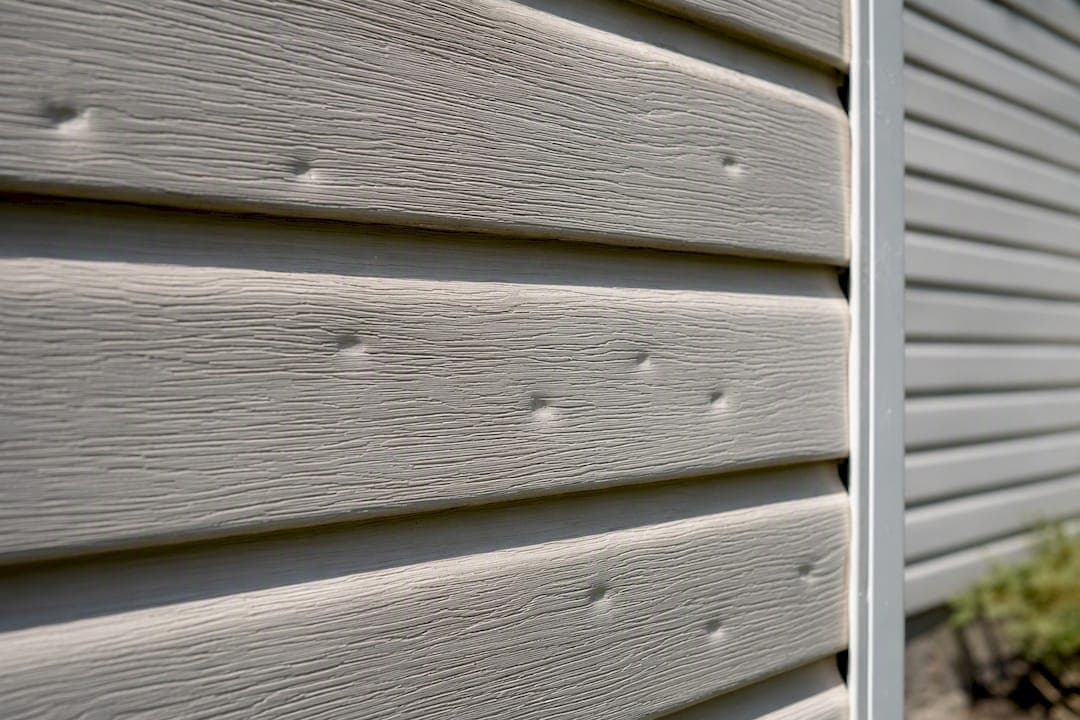
Heavy-gauge steel, engineered wood like LP SmartSide, and fiber cement from James Hardie top the list of hail resistant siding options, each handling impact differently but all outperforming standard vinyl. Vinyl cracks and fades fastest under hail; aluminum dents but rarely splits open. None of that matters much, though, if the installer skips proper sheathing or uses the wrong fasteners: workmanship decides whether any siding actually performs the way its warranty promises.
TL;DR:
- Steel siding dents rather than cracks but can rust over time if scratches are not touched up, making maintenance essential for long-term durability.
- LP SmartSide has been laboratory tested against 1.75 inch hail at 81 mph and now offers a hail damage warranty, indicating strong impact resistance.
- Fiber cement resists impact but is prone to cracking or chipping under concentrated force, increasing labor and repair complexity after severe storms.
- Vinyl siding has the highest risk of cracking or fracturing in hail, especially in cold weather, and often requires full panel replacement when damaged.
- Proper installation, including correct sheathing, fastener choice, and flashing, is more critical than material type in ensuring siding performs well under hail impact.
Table of Contents
- What Siding Material Resists Hail Best?
- How Do You Choose Siding for a Hail-Prone Area?
- Why Installation Quality Beats Small Material Differences
- What to Do After a Hail Storm Hits Your Siding
- What Does Independent Testing Actually Prove?
- Which Siding Should You Avoid in Hail Country?
- How Do You Maintain Hail Resistant Siding Over Time?
- How Long Should Hail Resistant Siding Actually Last?
- Does Siding Alone Protect Your Home From Hail?
- The Practitioner's Take: What Actually Holds Up on the Wall
- Get Hail Resistant Siding Installed Right the First Time
- Sources
What Siding Material Resists Hail Best?
Every material handles a hailstone differently, and the difference shows up the day after a storm when you're standing in your driveway counting dents. Some materials dent and move on. Others crack, chip, or shatter, and that failure mode determines whether you're looking at a cosmetic touch-up or a full tear-off.
Steel siding, particularly in 26-gauge or heavier, tends to dent rather than puncture when hail strikes. Manufacturers point to steel's resistance to hail and long-term denting as one of its biggest advantages over lighter metals and most nonmetal claddings, according to Alside's product documentation. The tradeoff is cosmetic: a scratch that breaks through the factory finish can expose bare metal to rust if it's not touched up. Steel earns its place when hail size and frequency are the top concern and a few small dents are an acceptable cost of doing business.
LP SmartSide, an engineered wood product, held up without visible impact damage after Texas Tech National Wind Institute tests fired hail of a significant size and high velocity, a result strong enough that LP now backs the product with a hail damage warranty at that size. It needs periodic repainting to maintain its finish and moisture resistance, but it repairs easily and doesn't carry the crack risk of denser materials.
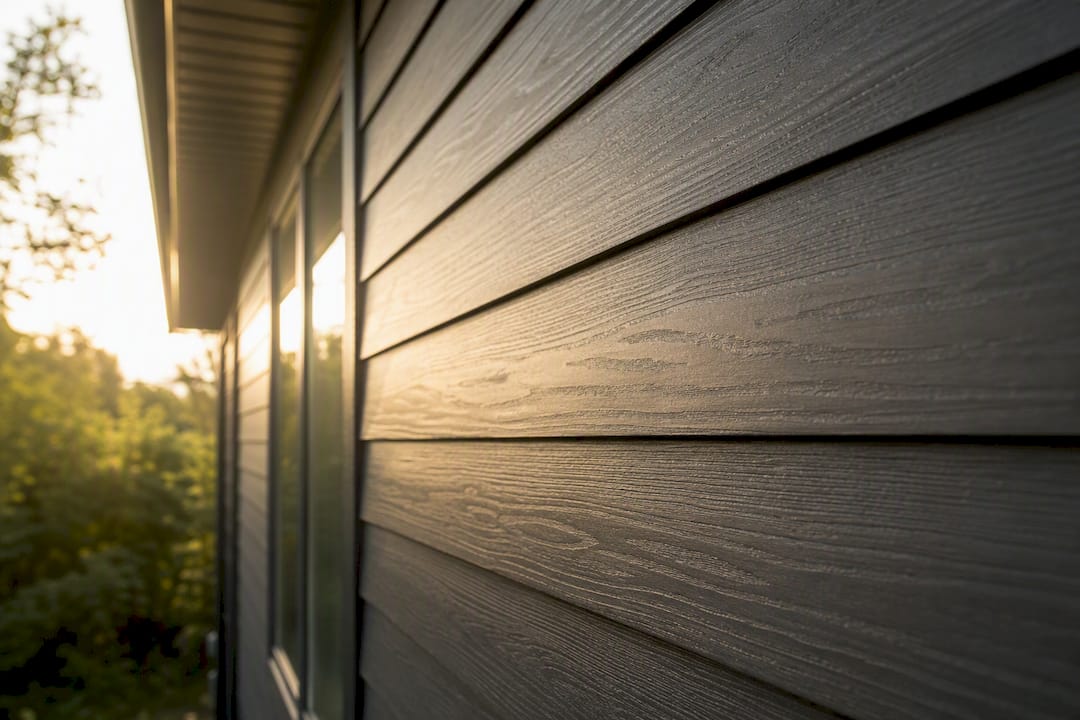
Fiber cement, the category James Hardie built its name on, resists a wide range of impacts well but behaves differently than steel or engineered wood when hail concentrates force in one spot: rather than denting, it can crack or chip, according to James Hardie's own performance documentation. It's also heavier, requiring specific tools, blades, and backing during installation, which raises labor costs and demands a crew that knows what it's doing.
Aluminum dents and chips in patterns similar to steel but at a lighter gauge, and any chip that exposes bare metal invites corrosion faster than steel does.
Vinyl is the weak link. It's the material most likely to crack, fracture, or warp under hail impact, and cold weather makes it worse by making the material more brittle right when winter hailstorms roll through. Insulated vinyl improves impact performance somewhat by adding a rigid foam backing, but it still lags behind steel, engineered wood, and fiber cement in head-to-head impact behavior.
- Steel: dents rather than cracks, but scratched finish can rust over time
- LP SmartSide: lab-tested against 1.75 inch hail at 81 mph, backed by a hail warranty
- Fiber cement: strong against general impact, but prone to cracking under concentrated force
- Aluminum: dents like steel but corrodes faster once the finish is broken
- Vinyl: highest fracture risk, especially in cold weather
How Do You Choose Siding for a Hail-Prone Area?
Picking siding for a region that sees regular hail isn't just about the material spec sheet. It's about matching that material to your actual risk, your budget over the next 20 years, and what you're willing to look at every time you pull into the driveway after a storm.
- Check your local hail history first. NOAA's NCEI storm event data tracks hail frequency and damage costs nationwide, and a quick look at your region's pattern tells you whether you're planning for an occasional nuisance storm or a near-annual event.
- Read the warranty fine print, not just the headline. Ask what hail diameter is actually covered, whether labor is included in a claim, and whether coverage prorates as the siding ages. A hail warranty that only kicks in above 2 inches doesn't help much if your area typically sees quarter-sized stones.
- Factor in lifecycle cost, not just sticker price. Fiber cement and wood-based siding need repainting on a cycle; steel generally doesn't, but touch-up paint after a scratch is a maintenance line item you should budget for anyway.
- Think about repairability. A dented steel panel can sometimes be replaced individually; a cracked fiber cement board often means matching color across a wider section, since production runs shift shade over time.
- Match the finish to how visible damage will be. Lighter colors and glossier finishes tend to show dents and scratches more than matte, darker tones, which matters if a few cosmetic dents would bother you more than the actual performance loss.
- Ask contractors for manufacturer training credentials. A crew that's certified by LP or James Hardie has typically been through installation training specific to that product, not just general siding experience.
Pro Tip: Ask any contractor bidding your job to name the exact hail diameter their recommended product is warrantied against, then ask if they've filed a hail claim on that product before. If they can't answer either question specifically, keep shopping.
Why Installation Quality Beats Small Material Differences
The siding material gets all the attention, but the wall behind it does most of the real work. Solid sheathing, usually OSB or plywood, gives hail impact somewhere to distribute force instead of concentrating it on a thin, unsupported panel. Building science research from the Building America Solution Center backs this up directly: siding performance depends as much on the wall assembly behind it as on the cladding itself, and moisture intrusion after impact is one of the most common failure points homeowners overlook.
Fastener choice and spacing matter more than most homeowners realize. Manufacturers specify exact nail types, spacing, and expansion gaps for a reason: get it wrong and panels can buckle, crack at fastener points, or fail to shed water correctly. Flashing around windows, doors, and seams needs to direct water out and away, not trap it behind the siding where it can rot sheathing you can't see from the curb.
Red flags to watch for during a bid or a walkthrough:
- A contractor who can't explain what backing or sheathing they're installing behind the siding
- Fasteners that don't match manufacturer spec, or no mention of expansion allowance at all
- No installation warranty separate from the manufacturer's material warranty
- No documented training with the specific product they're recommending, like LP SmartSide or James Hardie
What to Do After a Hail Storm Hits Your Siding
Once the storm passes, resist the urge to climb a ladder immediately. Wait for safe conditions, then walk the perimeter from the ground first.
- Photograph everything before you touch anything. Take wide shots of each wall, then close-ups of individual dents or cracks with something for scale, like a tape measure or a coin, next to the damage.
- Separate cosmetic dents from moisture risks. A shallow dent in steel is usually cosmetic. A crack or chip in fiber cement or vinyl that exposes the substrate underneath is a moisture entry point that needs attention before the next rain.
- Avoid the common insurance pitfalls. Homeowners often delay getting a contractor estimate, assume adjusters will catch everything on their own, or don't understand how depreciation and matching rules affect a payout.
- Get a professional estimate before or during the claims process. A qualified inspection gives you documentation an adjuster can't argue with and helps you understand whether you're looking at spot repair or full-side replacement.
What Does Independent Testing Actually Prove?
Lab testing is where marketing claims either hold up or fall apart, and the Texas Tech National Wind Institute has become the reference point the siding industry points to most often. Its debris-impact testing simulates hailstones at specific sizes and speeds, giving manufacturers a controlled way to back up durability claims instead of just asserting them.
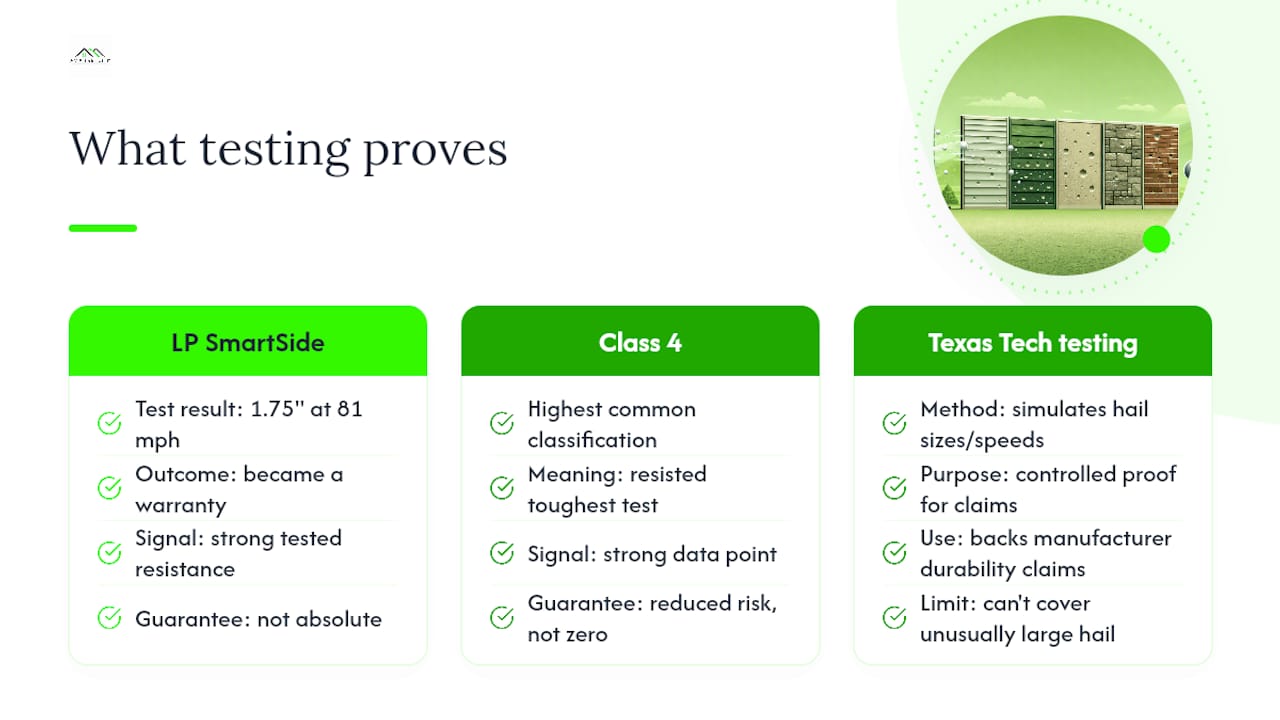
LP's 1.75 inch hail at 81 miles per hour result is the most cited example in this category, and it's specific enough that LP turned it into an actual warranty commitment rather than a marketing line, per LP's own release. Class 4 impact ratings, the highest classification widely used in the siding and roofing industry, indicate a product resisted the toughest standardized test available. That's a meaningful signal, but it's not a guarantee.
Even Class 4 rated products can still take damage from unusually large hail or wind-driven debris, and industry summaries are consistent on this point: reduced risk isn't the same as zero risk. Treat a Class 4 rating or a hail-specific warranty as a strong data point in your decision, not as proof that your siding is invincible once it's up.
Which Siding Should You Avoid in Hail Country?
Standard vinyl is the material to be most cautious about if you live somewhere hail shows up more than once every few years. It's the most prone to cracking and fracturing on impact, and cold temperatures make it worse, since vinyl becomes more brittle exactly when winter storms are most likely to hit. Once vinyl cracks, you're not touching up a scratch. You're replacing a panel, and matching decades-old faded vinyl to a new piece is close to impossible.
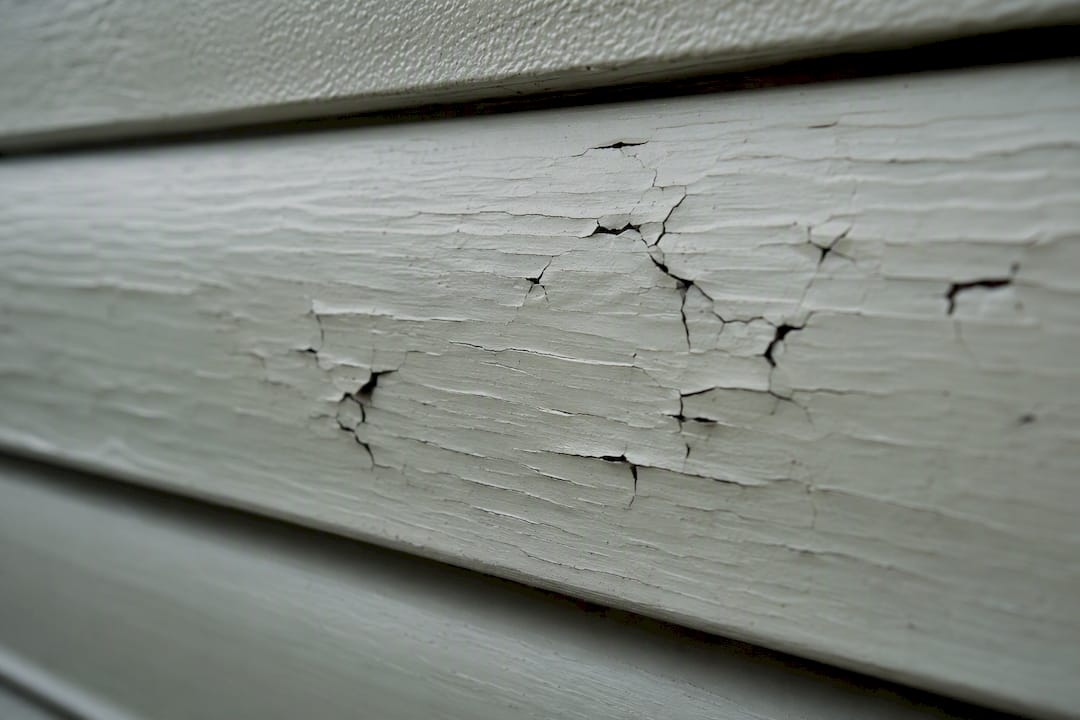
Insulated vinyl closes some of that gap by backing the panel with rigid foam, which adds a little impact absorption, but it still doesn't match steel, engineered wood, or fiber cement in real-world hail performance.
Untreated or poorly maintained wood siding carries a different problem. It's not necessarily worse at surviving the initial impact, but any crack or split that opens the surface invites moisture, and moisture in wood siding means rot, warping, and eventually a much bigger repair than the original hail damage. If you already have wood siding and it's not engineered or properly sealed, a hail event is the moment cosmetic neglect turns into a structural problem.
The pattern across both materials is the same: it's rarely the initial hail strike that costs you the most. It's what gets into the wall assembly after the surface fails.
How Do You Maintain Hail Resistant Siding Over Time?
Hail resistance isn't a one-time property baked in at installation. It degrades if you ignore basic upkeep, and it holds up if you don't.
Inspect your siding at least once a year, ideally in spring after winter freeze-thaw cycles and before hail season ramps up. Look specifically for small cracks, chipped finish, or loose panels, since these are the weak points a future storm will exploit first. Fiber cement and engineered wood need repainting or resealing on a regular cycle, typically every several years depending on climate and sun exposure. Skipping that maintenance doesn't just hurt curb appeal; it leaves the substrate exposed the next time hail hits that same spot.
Steel and aluminum need less frequent attention, but any scratch that breaks through the factory coating should get touch-up paint promptly, since exposed metal starts corroding faster than most homeowners expect. Keep gutters and downspouts clear too. Water that backs up behind siding because of clogged drainage causes the kind of hidden rot that has nothing to do with hail directly but gets blamed on it anyway when a wall finally shows damage.
Trim back trees and branches that hang over the roofline. Wind-driven debris during a hailstorm does more damage to weak siding than the hail itself in a lot of cases, and a falling branch can crack even a well-rated panel.
How Long Should Hail Resistant Siding Actually Last?
Warranty length and real-world durability aren't always the same number, and that gap is where a lot of homeowners get surprised years down the road. Read the difference between a lifetime limited warranty and a straightforward hail damage warranty. The first usually covers manufacturing defects over decades; the second covers a specific impact size for a specific period, and it's the one that actually matters after a storm.
CertainTeed's CERTAplank PRO composite siding illustrates this well: it's built with reinforced construction specifically for impact and moisture resistance, and the company backs it with a Lifetime Limited Warranty, positioning it as a premium alternative to standard fiber cement or vinyl in the same price range.
Warranty coverage on hail damage varies enormously between brands, and the fine print determines whether a claim actually pays out. Repairability factors into long-term value too: dented metal can often be pulled and re-set, while cracked fiber cement or fractured vinyl usually means replacing full sections and dealing with color mismatch from aging and sun exposure.
Does Siding Alone Protect Your Home From Hail?
Siding handles one exposure point on your home, but hail hits windows, roofing, and any exposed trim at the same time, which is why a single-material strategy leaves gaps. Impact-resistant windows use laminated glass designed to resist cracking on impact the same way Class 4 shingles or hail-rated siding do, and they close a vulnerability that no amount of good siding addresses.
Storm panels and shutters add a removable layer of protection for windows specifically, useful in regions where hail arrives alongside high wind events, though they require action before a storm hits rather than passive, year-round protection. Hail resistant siding, by comparison, works continuously without homeowner intervention, which is part of why it's usually the higher-priority investment for most homes.
The strongest approach treats these as complementary rather than either/or. A house with steel or engineered wood siding and standard windows is still exposed at the glass. A house with impact-rated windows and old vinyl siding is still exposed at the walls. Homeowners weighing where to spend first should look at which exposure has failed before, and which repair would be more disruptive and expensive to redo.
The Practitioner's Take: What Actually Holds Up on the Wall
Twenty-five years of watching hail damage claims come through has taught the team at Am-exteriors one consistent lesson: the material rarely fails on its own. It's almost always an installation shortcut that turns a manageable hail event into a full siding replacement.
On every job, that means checking for solid sheathing behind the cladding, confirming fasteners match manufacturer spec instead of whatever was in the truck that day, and handling panels carefully during installation so a dropped sheet doesn't create a weak point before the first storm even arrives. Flashing and drainage details get the same scrutiny, since a hail-resistant panel installed over a poor drainage plane still lets water in once the surface is compromised.
- Confirm sheathing type and condition before new siding goes up
- Verify fastener spec and spacing against manufacturer documentation
- Ask for photo documentation of flashing and drainage details before they're covered
- Request written confirmation of manufacturer training on the specific product installed
— Heather
Get Hail Resistant Siding Installed Right the First Time
Am-exteriors installs LP SmartSide, James Hardie fiber cement, and premium vinyl siding across Southeast Wisconsin, backed by more than 25 years of hands-on installation experience and direct manufacturer partnerships rather than a generic subcontractor crew.
That partnership status matters because it means the crew on your roofline has been trained on the exact fastening, spacing, and flashing details each manufacturer specifies, not a one-size-fits-all approach applied to every product. If you're comparing quotes after a storm or planning ahead of the next hail season, start with a look at Am-exteriors's siding services to see which material fits your home, your budget, and your region's hail risk, or request a siding repair estimate if you're already dealing with storm damage. Either way, get a written estimate that names the exact product, fastener spec, and warranty terms before signing anything.
Sources
- LP Now Warrants Its Engineered Wood Siding For Hail Damage
- Satinwood Select steel siding with Kynar coating technology | Alside
- Siding performance & durability | James Hardie
- CERTAplank® PRO | CertainTeed
- Billion-Dollar Weather and Climate Disasters | NOAA NCEI