
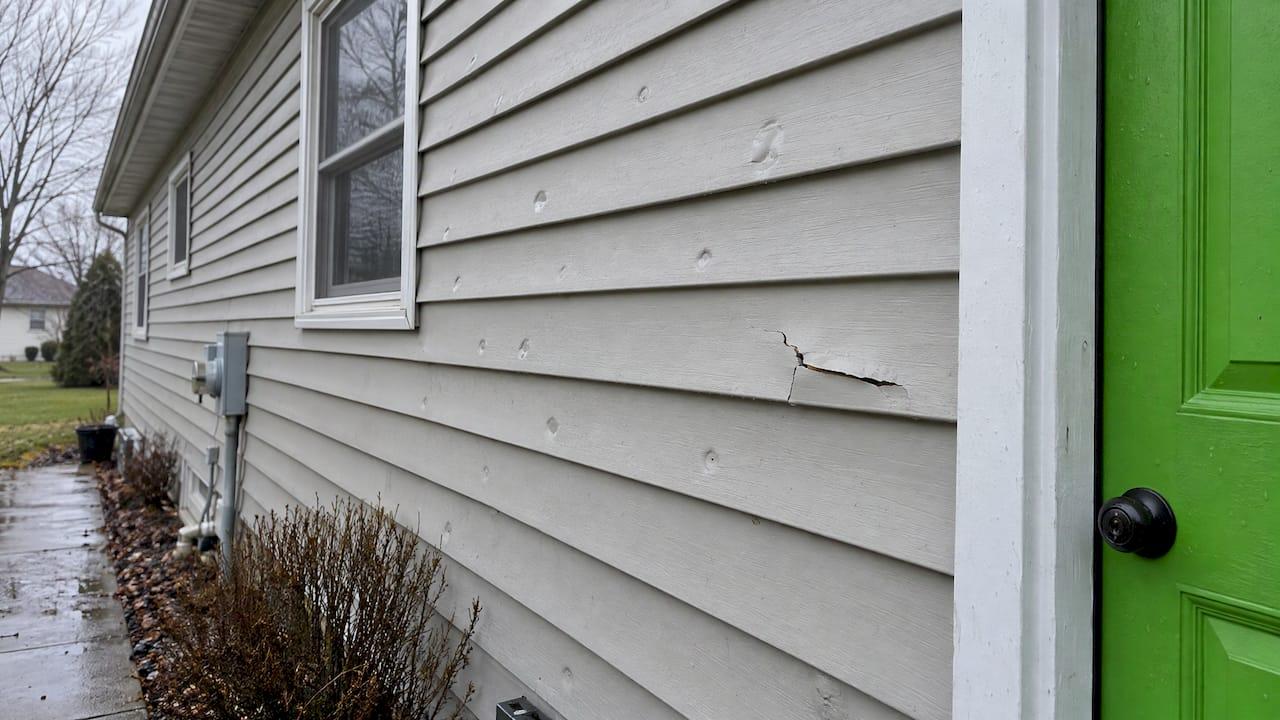
Hail damage on siding shows up as cracks, holes, chips, dents, loose panels and spatter marks. Most of it is hard to see from the ground. Check the walls that faced the storm, photograph everything with a date and a size reference, and have the siding inspected before you decide on a repair or a claim.
This guide covers the signs for each siding type, a safe way to check, and how to tell damage that lets water in from damage that only changes the look. We install and repair siding for homeowners in Southeast Wisconsin, and we use this checklist on every storm call.
TL;DR
- Look for cracks, holes, chips, loose panels, dents and spatter marks. Start with the walls that faced the storm.
- Check soft items first: gutters, window screens, garage doors, fences. Dents there confirm hail size and direction.
- Photograph before you clean up or repair. Use wide shots, close-ups, a coin for scale, and keep the original files.
- Breaks that let water in are functional damage. Cosmetic marks may not be covered by your policy.
- Check your deductible before you file. Many policies set a percentage for wind and hail.
Table of Contents
- Signs of hail damage by siding type
- Check the soft items first
- How to inspect your siding after a storm
- Cosmetic damage vs. functional damage
- Repair or replace: matching and coverage
- What siding replacement costs in Southeast Wisconsin
- Common mistakes after a hailstorm
- Get the siding inspected
- Our view on hail and siding
- FAQ
- Sources
Signs of hail damage by siding type
Hail leaves different marks on different materials. Know what your wall is made of first.
Vinyl siding
Vinyl cracks, splits and chips. Hail can also punch round holes. According to the Farmers' Almanac hail damage guide, vinyl shows hairline cracks, holes and chipped areas, mostly on the windward side of the house.
Signs to look for:
- Round or irregular holes
- Hairline cracks, often short and radiating from a point
- Chipped edges or small missing pieces
- Panels that have come loose from the wall
Flip a loose panel and look at the back. CapOut's siding damage glossary lists impact holes and loosened panels as vinyl hail patterns and suggests checking the backside.
Vinyl is built as a rainscreen. NACHI's exterior inspection guide says it is water-resistant, not waterproof. It sheds most water and relies on the barrier behind it. A crack in the panel can compromise that system, so small cracks count.
Aluminum and steel siding
Metal siding dents. NACHI's hail inspection guide says aluminum is the siding type most easily damaged by hail, and the damage appears as indentations.
Also look for spatter marks. These are bright or clean-looking spots where the hail removed surface oxidation. NACHI notes they re-oxidize and fade over time, so photograph them early.
Hail damage is random. Marks differ in size and sit at uneven distances. Straight scratches or slice-like marks are not hail.
LP SmartSide and other engineered wood
Engineered wood siding is built to take impact. When it is damaged, look for chips in the coating, bruised or swollen edges, and bubbling. CapOut's glossary also lists moisture at seams and delamination as signs on LP SmartSide. Water getting into the edge is the issue to catch.
Fiber cement (James Hardie)
Fiber cement is dense. Large hail can still chip the paint and expose the material under it, or leave hairline cracks. Look for small chips with a bare, gray or tan center. Photograph them close up and from a distance.
Wood and cedar
Wood shows broken grain, bruised spots and exposed bare wood. Bare spots take on water, so decay can start sooner than on a painted wall.
Quick reference table
| Siding type | What hail leaves | Where to look |
|---|---|---|
| Vinyl | Cracks, holes, chips, loose panels | Windward walls, panel edges, backs of loose panels |
| Aluminum | Dents, spatter marks | Open flat areas, near corners facing the storm |
| Steel | Dents in the coating | Flat panels on the storm side |
| LP SmartSide | Chipped coating, swollen edges, bubbling | Seams, lower edges, near trim |
| Fiber cement | Chipped paint, hairline cracks | Flat boards on storm-facing walls |
| Wood or cedar | Broken grain, exposed wood | Bare spots, board ends |
Check the soft items first
Hail that damages siding usually marks other things too. The Nebraska Department of Insurance says hail strong enough to damage a roof will also damage nearby cars, wood fences, shutters and exterior siding. It advises checking ground-level evidence before calling your insurer or going up a ladder.
Walk the property and look at:
- Gutters and downspouts for dents
- Window screens for tears or dimples
- Fences, mailboxes and deck rails
- Car hoods and roofs
- Granules from shingles at the ends of downspouts
- The garage door, which is a large flat panel facing the weather
A garage door is a useful test panel. Round, random dents on it, in the same pattern as on your gutters, point to hail. If you need a guide to what dent repair looks like, see this page on dented garage door repair. Dents on a door can also come from a ball, a bike or a bumper. Only a spread of random marks on several surfaces facing the same direction points to hail.
The Nebraska guidance also gives hail sizes. Hail generally needs to reach 1¼ inches (half-dollar size) to damage heavy composite shingles or wood shakes. Lightweight composite shingles can show damage from 1-inch (quarter-size) hail. For siding, use the same idea: the larger the stones, the more likely you have damage. Our page on hail size and roof damage goes deeper on sizes.
How to inspect your siding after a storm
Stay on the ground. Do not climb onto a roof or a ladder in wet or windy conditions. Use binoculars for upper walls.
- Note the storm date and time. Rate.com advises noting this before you contact your insurer.
- Start with the storm-facing walls. In Wisconsin, storms often track from the west or southwest, but use your gutters and screens to confirm the direction.
- Use raking light. Look along the wall at a low angle, in morning or evening light. SidingWise recommends this to reveal dents.
- Look for breaks, not just dents. A dent can be cosmetic. A crack, hole or split is a path for water.
- Wet metal siding. NACHI says soaking siding with a hose makes impressions easier to see before you photograph them. Visible impressions do not always mean functional damage, but they are worth recording.
- Check seams, corners and trim. Water enters at joints first.
- Photograph everything. See below.
What to photograph and how
The Farmers' Almanac advises date-stamped photos and video before any cleanup. Take wide shots, close-ups, and photos of hailstones beside a ruler or coin. It also suggests saving a hailstone in a bag in the freezer as part of the claim.
StormAdvocate's evidence checklist adds useful habits:
- Take photos as soon as it is safe, because damage can change.
- Keep the original, unedited files.
- Label photos by date and location, and group them by area of the house.
- Store copies in more than one place: phone, computer, cloud.
- Keep a short log of what you did and when.
Its common mistakes list is short: waiting too long, taking only close-ups with no wider context, and throwing away damaged materials before photographing them.
Our own roof guide, 5 hail damage roof signs to photograph for claims, uses the same method for the roof.
Clean up after you document
Storms leave branches, broken pieces and loose siding. Photograph them where they lie, then clear them. If you need help hauling away storm debris, a storm debris removal service can handle bulk cleanup once your photos are done. Keep any damaged siding pieces your adjuster may want to see.
You are also responsible for stopping further damage. The Nebraska guidance says that if repairs must happen before the adjuster arrives, take good photos or video first and keep the damaged items.
Cosmetic damage vs. functional damage
This difference decides many claims.
- Cosmetic damage changes how the siding looks. A small dent in aluminum is an example.
- Functional damage lets water in or shortens the life of the siding. Cracks, holes, splits and broken panels are examples.
SidingWise says breaks that let water in are functional damage, while cosmetic dents may not be covered. Policies differ, so read the wording on cosmetic damage in your own policy. Our article on cosmetic vs. functional hail damage explains the difference in claim terms.
In practice, treat every crack as functional until an inspection says otherwise. A hairline crack on a north-facing wall today can let water behind the panel through a winter of freeze and thaw.
Repair or replace: matching and coverage
A few panels may be enough, or a whole wall may be needed. Three things decide it.
1. How much of the wall is damaged. Scattered damage across a wall often means replacing that wall, not patching panels one by one.
2. Whether new panels will match. Siding fades. New panels can look different from 15-year-old panels. The Maryland Insurance Administration explains that many policies contain exclusions for color mismatch, and that without one an insurer may have to offer an appearance allowance if the mismatch hurts home value. That is Maryland's rule. Wisconsin policies and rules can differ, so read your own policy. Our guide to siding matching and insurance covers what a claim can cover.
3. What your policy pays for. The same Maryland page says that under most policies the insurer pays for the direct physical loss. If hail hit only one side of the house, the insurer is generally responsible for that side.

Check your deductible before you file
Many wind and hail deductibles are a percentage of your insured home value. HailScore says these run 1% to 5%. On a $400,000 home at 2%, that is $8,000. If your damage is near or under that amount, a claim may not make financial sense. Look at the declarations page of your policy for the exact number.
HailScore also points out that radar data shows hail exposure near your address. Only a physical inspection confirms damage.
What siding replacement costs in Southeast Wisconsin
Cost depends on material and house size. Our published 2026 ranges for full siding projects are:
| Siding | Published range |
|---|---|
| Vinyl siding | $12,000 to $20,000 |
| LP SmartSide | $18,000 to $32,000 |
| James Hardie | $25,000 to $45,000 |
See our siding replacement cost page for Wisconsin for what moves each number. If hail may hit your area again, our article on which siding holds up to hail compares materials.
Check the windows and trim in the same walk-around. Broken window screens, dented sills and cracked trim often go with siding damage. Our window replacement cost page lists per-window ranges if a window was hit.
Common mistakes after a hailstorm
- Waiting weeks to look. Marks fade and weather changes the evidence.
- Taking only close-ups. Adjusters need to see where on the house the damage is.
- Pressure-washing or repairing before photographing.
- Throwing away broken pieces.
- Signing a contract the same day, before you know what your policy covers.
- Judging only from the ground. Upper walls and the roof need a closer look.
Get the siding inspected
We inspect siding and roofs for homeowners in Dodge, Washington, Fond du Lac and Ozaukee Counties. Hail often hits both at once, so we look at both. Our free hail damage roof inspection page explains how to book. For siding work after a storm, see our siding repair in Dodge County page.
We give honest repair or replace recommendations. We document the work in detail and help with insurance claims. Our installers work under owner supervision, with 25 years of owner-operated experience behind each project. We install LP SmartSide, James Hardie fiber cement, and insulated and premium vinyl siding.

Start at am-exteriors.com to request an inspection.
Our view on hail and siding
Most siding failures we see come from poor installation, not from the material. Hail shows this fast. A wall installed tight, with sound flashing and proper nailing, takes a hit better and is easier to assess afterward.
We tell homeowners the same thing every time: document first, decide second. Take your photos. Know your deductible. Then get the wall looked at by someone who will tell you plainly whether it needs a repair or a replacement.
We supervise the work ourselves. We write down what we find and what we do. When a claim is involved, that record helps. It shows the adjuster what was found, where, and why it matters.
If your siding needs replacing, choose the product for the house and the weather. LP SmartSide and James Hardie are options we install and stand behind, and insulated vinyl is another.
Heather
FAQ
How do I know if hail damaged my siding?
Look for cracks, holes, chips, loose panels, dents and spatter marks on the walls that faced the storm. Check gutters, screens and the garage door too. Random marks on several surfaces point to hail. An inspection confirms it.
Does homeowners insurance cover hail damage to siding?
Wind and hail damage is generally covered by most homeowners policies, according to the Maryland Insurance Administration. Terms differ by policy and state. Check your deductible, which may be a percentage of your home's insured value, and your policy's wording on cosmetic damage and matching.
How soon should I check after a hailstorm?
As soon as it is safe. Damage and evidence can change, and spatter marks on aluminum fade. Photograph first, then clean up, and keep damaged pieces.
Can small dents in siding be ignored?
Cosmetic dents may not be covered, but cracks and holes should not be ignored because they let water in. Have a crack looked at before winter. Our siding repair page shows how we handle it.
Should I check the roof too?
Yes. Hail that marks siding usually reaches the roof. Stay on the ground, look for granules at the downspouts, and read our hail damage shingles guide for what to look for.
Sources
- Hail Damage: How to Identify It, What It Costs (Farmers' Almanac)
- Mastering Roof Inspections: Hail Damage, Part 10 (NACHI)
- How to Inspect the Exterior (NACHI)
- Siding Damage glossary (CapOut)
- Hail Damage (Nebraska Department of Insurance)
- What to know about hail damage and your insurance (Rate.com)
- Hail Damage to Siding (SidingWise)
- Storm Damage Evidence Checklist (StormAdvocate)
- Siding Damage (Maryland Insurance Administration)
- When to File a Hail Damage Insurance Claim (HailScore)
- Dented garage door repair
- Storm debris removal