
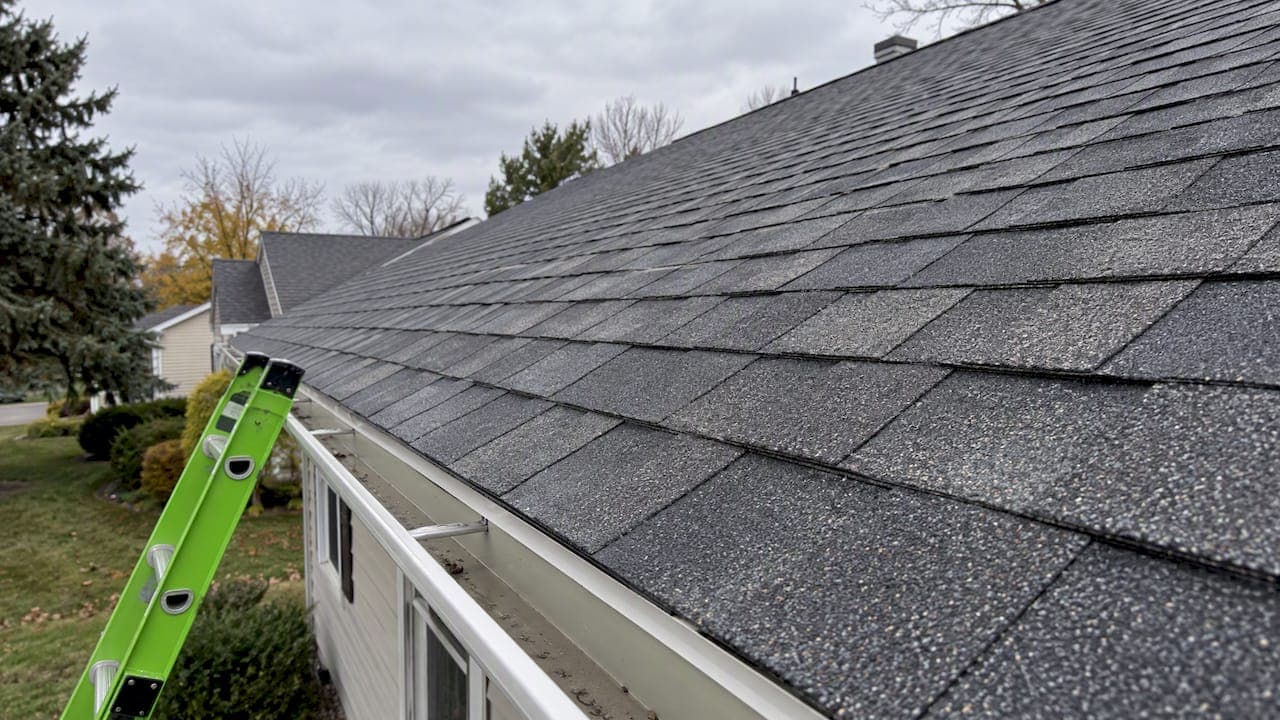
A shingle wind rating is a lab result. It tells you how a product performed in a test, not how your roof will perform in a storm. Two standards matter: ASTM D3161 (Class A, D, F) and ASTM D7158 (Class D, G, H). Class F and Class H are the top classes. Installation, nailing, deck condition and sealing decide whether the rating holds up on your house.
This guide explains each class, what the mph numbers mean, which "high wind" shingles are worth paying for, and what to ask your roofer in Wisconsin.
TL;DR
- Look for ASTM D3161 Class F (tested at 110 mph) or ASTM D7158 Class H (tested up to 150 mph) on the wrapper.
- The mph on the box is a test speed and a warranty term. It is not a promise about your roof in a real storm.
- Seal strength, nail placement and a secure roof deck matter as much as the shingle.
- Cold-weather installs can leave shingles unsealed for weeks. Ask how your roofer handles that.
- Wind damage is often covered by homeowners insurance, but deductibles and terms vary. Read your policy.
Table of Contents
- What a shingle wind rating actually measures
- ASTM D3161 classes: A, D and F
- ASTM D7158 classes: D, G and H
- Why two tests give different numbers
- Test class vs. warranted wind speed
- What the code says
- Why a 130 mph rating does not mean 130 mph protection
- Seal strength: the factor most people miss
- Nailing and decking: the roof is a system
- High wind shingles: what to look for
- Our perspective
- What wind damage looks like
- Insurance and wind damage
- Questions to ask a roofer before you sign
- Roof replacement with AM Exteriors
- FAQ
- Sources
What a shingle wind rating actually measures
A wind rating comes from a lab test. A manufacturer sends a product to a test lab. The lab runs it under a standard method. If it passes at a set level, the shingle gets a class.
There are two main test methods, and they work differently.
- ASTM D3161 uses a fan to blow air across installed shingles. It is the fan-induced method.
- ASTM D7158 measures uplift force on sealed shingles. It is the uplift resistance method.
Both are described on the Building America Solution Center's asphalt shingle guide, which also notes that the rating is printed on the product wrapper and should match the wind requirements of your local code.
The key point: the mph figure is the test condition. It is not the speed of wind your roof will survive.
ASTM D3161 classes: A, D and F
This test has three classes. Owens Corning's wind resistance guide lists them as:
| Class | Test speed |
|---|---|
| Class A | 60 mph |
| Class D | 90 mph |
| Class F | 110 mph |
Class F is the highest class in this test. If a shingle is only Class A, it was tested at the lowest speed. Most roofing in cold climates should not stop there.
ASTM D7158 classes: D, G and H
This test also has three classes, according to the same Owens Corning guide:
| Class | Resists uplift up to |
|---|---|
| Class D | 90 mph |
| Class G | 120 mph |
| Class H | 150 mph |
The Building America Solution Center notes that, depending on test parameters, Class H is described as reaching 150 to 190 mph. The numbers differ by source because the test parameters differ. Use the class letter as your anchor, not the highest number you see in an ad.
Why two tests give different numbers
A Class F shingle at 110 mph and a Class H shingle at 150 mph do not mean one is 40 mph "stronger" in a simple way. The tests measure different things with different setups. Compare class to class within the same test. Do not compare mph across tests.

Many shingles on the market carry both Class F and Class H. Owens Corning notes that asphalt shingles on the market generally carry the same classifications, while warranted wind coverage varies by product. That is why the warranty page matters more than the wrapper headline.
Test class vs. warranted wind speed
These are two separate things.
- Test class: a lab result under a standard method.
- Warranted wind speed: the limit a manufacturer will cover, if the roof was installed to its rules.
The warranty may require a specific number of nails, a specific nail location, or a special pattern. If your roofer does not follow the instructions, the warranty can be void. The International Residential Code material cited in our research says shingles must be installed per manufacturer instructions, and that failing to follow those patterns can void warranties and code compliance.
Before you sign, ask for the warranty document for the exact shingle line. Read the wind section. Check the installation requirements for any "enhanced" wind coverage.
What the code says
Building codes tie wind class to design wind speed. In the 2021 International Building Code as adopted in Wisconsin, asphalt shingles must be tested to ASTM D7158 and meet the class listed for the maximum basic wind speed. Packaging must carry a label showing compliance.
For the lower design wind speeds in that table, such as 110 and 116 mph, Class D, G or H qualifies. At higher design speeds, only Class G or H is allowed for D7158, and Class F for D3161.
This is a commercial-building chapter, and residential rules can differ. Your local building department confirms what applies to your house. Ask your contractor which code applies and who pulls the permit.
Why a 130 mph rating does not mean 130 mph protection
This is the question most homeowners ask after a storm. "My shingles were rated for 130. Why did they blow off?"
There are several reasons.
- The test is idealized. It uses a flat test deck and controlled conditions. Real wind hits edges, corners and ridges harder.
- Roof shape and height change the pressure. Eaves, rakes and ridges see much higher uplift than the middle of a slope.
- The seal may not have formed. More on that below.
- Installation errors. Nails placed too high, too few nails, or overdriven nails reduce holding power.
- The deck may be weak. Shingles can hold while the sheathing under them lets go.
The point is not that ratings are useless. They are a baseline. The roof as a system is what holds.
Seal strength: the factor most people miss
IBHS wind testing found that the most important factor in high-wind performance for self-sealing asphalt shingles is the strength of the seal between shingles. A shingle is held by nails and by a factory adhesive strip. If the strip never bonds, the shingle depends on nails alone.

The adhesive is heat-activated. According to IBHS, it works best in warm conditions, roughly 70°F to 80°F. In cold installs, below about 40°F, or on very steep slopes, shingles can fail to seal properly unless the contractor hand-seals them. Unsealed shingles stay vulnerable until they seal, which can take a month or two or longer when conditions are poor.
This matters in Wisconsin. Fall and early spring installs often happen at temperatures that do not activate the strip well. It does not mean you should avoid those months. It means you should ask:
- Will the shingles be hand-sealed if the weather is cold?
- How long do you expect sealing to take on my roof?
- What is the plan if a wind event comes before the roof seals?
Sealing against weather is a detail-level job on the whole house. The same thinking applies to doors, as in this guide to weatherstripping wood doors without losing historic character.
Nailing and decking: the roof is a system
A high-rated shingle on a poorly fastened deck can still fail. IBHS promotes its FORTIFIED Roof standard, which calls for tighter nailing patterns with ring-shank nails and a sealed roof deck. IBHS research on that standard suggests it can reduce losses more than choosing a higher-rated shingle alone, in some scenarios (30 to 50% in some cases, per the context we reviewed).
IBHS also updated its resilient construction standards in November 2024. Under the update, FORTIFIED Roof requirements in inland areas become more consistent with hurricane-prone areas, and all FORTIFIED roof decks get the tighter nailing pattern.
You do not need a FORTIFIED designation to learn from it. Ask your roofer these questions:
- What nail type and length do you use?
- How many nails per shingle, and where do they go?
- Do you inspect and re-nail loose deck sheathing during tear-off?
- How do you treat the eaves and rakes?
High wind shingles: what to look for
If you search for high wind shingles, here is a practical filter.
- Class F or Class H on the wrapper. Check both test methods.
- A warranty that states a wind speed. Read the fine print for the installation requirements.
- Architectural over 3-tab. Architectural (laminated) shingles are heavier and generally rated higher than basic 3-tab products. The ranges in published guides vary, so rely on the specific product data sheet.
- Impact rating if hail is a concern. Industry guidance recommends looking at Class 4 (UL 2218) in addition to wind class. Wind ratings address blow-off. Impact ratings address debris and hail. Some insurers discount premiums for qualifying roofs. Our guide on the impact resistant roof discount covers how to qualify.
When shingles are not the answer
If your home sits in an exposed spot, a different roof material may fit better. Options we install include standing seam metal and DaVinci synthetic slate and shake. Both have their own wind ratings and installation rules. Ask for the product data, as you would for shingles.
Our perspective
We have owned and run this company for over 25 years. We see the same thing on storm calls. Most failures trace back to workmanship, not the material.
A shingle with a strong rating can still peel at an edge if the nails sit high or the strip never sealed. So we put the work first. We supervise installations as owners. We document the work so you can see what went on your roof.
We install premium products, including Malarkey shingles, and we match the install to the manufacturer's instructions so the warranty stays valid. Our advice on ratings is simple.
- Pick a Class F or Class H product.
- Read the warranty wind terms.
- Ask how the roof will be fastened and sealed.
- Ask for photos of the deck and nailing before the shingles go on.
We also give honest repair or replacement advice. Sometimes a few lifted shingles need a repair, not a new roof. If the roof is at the end of its life, we say so.
— Heather
What wind damage looks like
After a storm, check from the ground first. Do not climb on a wet or damaged roof.
- Missing shingles or bare patches
- Creased shingles, with a horizontal fold line
- Lifted tabs that no longer lie flat
- Shingle pieces in the yard or gutters
- Exposed underlayment or nails
- Water stains on ceilings
Read Wind Damage Roof: What to Do After a Storm for next steps, including temporary protection and documentation. For hail signs, see how to spot hail damage on shingles.
Insurance and wind damage
Standard homeowners policies often cover wind and hail damage. Coverage varies by location and policy terms, according to the National Association of Insurance Commissioners. Policies often have a separate, higher wind or hail deductible. Insurers generally pay for actual covered damage. There is no universal legal requirement to match undamaged materials.
Take these steps:
- Read your policy for the wind and hail deductible.
- Photograph the damage before any repair.
- Make temporary repairs only to prevent more damage. Keep receipts.
- File the claim.
- Get a roof inspection before you accept a settlement.
NAIC material also advises caution with storm-chasing contractors: verify licenses, never sign blank paperwork and never pay in full before work is done. Do not rush to settle before you know the real repair cost. Replacement cost and actual cash value pay out differently.
Be careful with an Assignment of Benefits. It is a legal contract that transfers your rights to the contractor. You may lose control over claim decisions. Talk to your insurer or an attorney before you sign one.
For Wisconsin specifics, see our storm damage insurance claim guide. If a claim was denied, see the 30 day plan for a denied roof claim.
Questions to ask a roofer before you sign
- Which shingle line do you recommend, and what is its ASTM class?
- What does the warranty say about wind speed and installation?
- How many nails per shingle? What type?
- Will you hand-seal if it is cold?
- How do you check the roof deck?
- Will you give me photos of the work?
- Who is on site, and who supervises?
- Will you pull the permit?
For more on picking a contractor, read How to Choose a Roofing Contractor in Wisconsin.
Roof replacement with AM Exteriors
We replace roofs for homeowners in Southeast Wisconsin, including Dodge, Washington, Fond du Lac and Ozaukee counties. Roof replacement is published at $7,500 to $18,000, depending on the roof. See the roof replacement cost guide for what drives the price.
Need storm help? We handle hail and wind storm damage repair and help with insurance claims. You can also request a free hail damage roof inspection. For all options, see our roofing services.
FAQ
What is the best wind rating for shingles?
Look for ASTM D3161 Class F or ASTM D7158 Class H. These are the top classes in their tests. Then check the manufacturer's warranty for the wind speed it covers and the installation rules.
Are Class F and Class H the same?
No. Class F belongs to the ASTM D3161 fan test, with a 110 mph test speed. Class H belongs to the ASTM D7158 uplift test and is described at 150 mph or higher, depending on parameters. Many shingles carry both.
Will insurance cover shingles damaged by wind?
Often yes, but it depends on your policy. Check for a separate wind or hail deductible and for exclusions. File promptly and document the damage.
Does a higher wind rating mean my roof will not blow off?
No. The rating is a lab result. Seal strength, nailing, deck condition and roof shape all affect real-world performance. Good installation matters as much as the label.
Sources
- Asphalt Shingle Roofs, Building America Solution Center
- Asphalt Roofing Shingles & Wind Resistance, Owens Corning
- Chapter 15 Roof Assemblies, Wisconsin Building Code 2021
- International Residential Code wind resistance, ICC
- Wind Uplift of Asphalt Shingles, IBHS
- FORTIFIED, IBHS
- IBHS updated resilient construction standards
- What to do before and after a storm, NAIC
- Wind and Hail tip, Office of Superintendent of Insurance, NAIC