
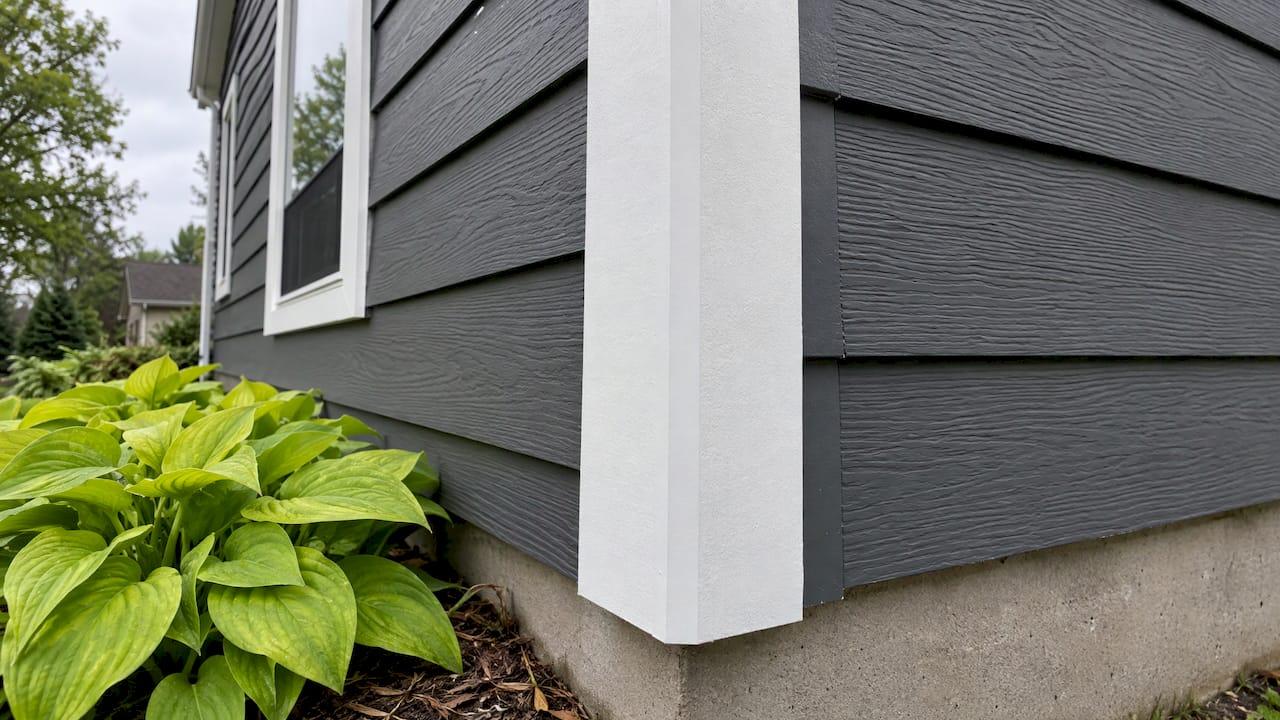
Corner trim comes in five main types: vinyl corner posts, wood or engineered-wood corner boards, fiber cement boards, cellular PVC boards and formed metal. The right one depends on your siding system, not on looks alone. In Wisconsin, where corners take snow, wind-driven rain and freeze-thaw cycles, the trim you pick and how it is installed decide whether the corner lasts or leaks. We install siding and trim across Southeast Wisconsin, and our Trim, Soffit & Fascia Packages are built around that match.
TL;DR
- Corner trim covers the joint where two walls meet and keeps water and impact damage away from siding edges.
- Main options: vinyl corner posts, wood or engineered-wood boards, fiber cement, cellular PVC and formed metal.
- Match trim to the siding system. Each manufacturer sets its own clearances, fasteners and sealants.
- Installation matters as much as material: flashing, clearances and fastening decide the result.
- Soft, stained or spongy corner boards are a repair signal. Check them before they reach the sheathing.
Table of Contents
- What corner trim does
- Siding corner trim options by material
- How to choose corner trim for your house
- Read the product instructions before you buy
- Installation details that keep corners dry
- Check your existing corners
- What corner trim costs
- Corner trim from AM Exteriors
- Our view on corners
- FAQ
- Sources
What corner trim does
Corner trim is the vertical piece at the point where two sides of a house meet. It goes by several names: corner post, corner board or outside corner. This Old House describes corner boards as vertical trim that covers the joint, usually running from foundation to roofline. On a traditional wood corner, a wider board overlaps a narrower one to make a tight joint.
It does two jobs:
- Protection. It shields the cut ends of siding from water and from bumps by mowers, ladders and snow shovels.
- Appearance. It frames the house. A thick, contrasting board gives a crisp, traditional look. A slim or concealed corner gives a cleaner, modern one.
There are two corner types:
- Outside corner: the wall projects toward you, like the corner of a box.
- Inside corner: two walls meet in a recess, like the corner of a room.
Most trim questions are about outside corners, because they are the most visible and the most exposed.
Siding corner trim options by material
Vinyl corner posts
Vinyl siding uses molded posts with channels. The siding panels slide into the channels. Posts come in different widths, profiles and colors. They are the standard pairing with vinyl siding because the channel lets panels expand and contract with temperature.
CertainTeed's vinyl installation guide says to leave 1/4 inch of clearance in the receiving channels above 40°F, and 3/8 inch below 40°F (CertainTeed installation guide). That gap is why vinyl must not be pinned tight.
Wood and engineered-wood corner boards
These are flat boards that sit over the corner. Siding butts into them. Solid wood gives the classic framed look and can be painted any color. Engineered wood is made to resist decay and is easier to cut and handle. Fine Homebuilding reports that engineered wood and cellular PVC have taken a larger share of the trim market because engineered trim resists decay, is easy to work with and tends to outperform new-growth lumber.
One engineered option is the one-piece, pre-assembled and prefinished corner. LP describes its SmartSide ExpertFinish outside corners as factory-assembled, so there is no measuring and joining of two boards on site. They can go over wood structural panel sheathing or directly over wood, wood composite or fiber cement siding. We install LP SmartSide, so this is a corner we work with. Our engineered wood siding guide explains why installation errors can put warranty coverage at risk.
Fiber cement trim
Fiber cement trim boards or formed corners pair with fiber cement siding. The material is dense and stable. Manufacturer instructions set the cuts, clearances, fasteners and joint treatments, and those must be followed exactly. Cutting fiber cement also creates silica dust, so crews need dust controls. We cover this in our fiber cement siding guide. We install James Hardie fiber cement siding.
Cellular PVC trim
PVC trim is plastic, so it does not rot or absorb water. AZEK's cornerboard page states that its one-piece PVC cornerboards have seams that will not open. They resist moisture, mold and mildew, will not cup, rot or split, and carry a Lifetime Limited Warranty. They come in white, with square or rabbeted corners.
Formed metal trim
Aluminum and steel corners suit metal panel systems and some modern designs. Specifications are exact. One aluminum corner system calls for 6063 T-5 extruded aluminum at .050 inch wall thickness (Tamlyn spec sheet). It recommends stainless steel fasteners and requires sealant at butt joints. Metals, fasteners and coatings must be compatible, or corrosion follows.
Side-by-side
| Option | Best with | Look | Watch for |
|---|---|---|---|
| Vinyl corner post | Vinyl siding | Slim, uniform, many colors | Leave room for expansion in the channels |
| Wood corner boards | Wood, fiber cement, engineered siding | Traditional, framed | Sealed end grain, regular paint or stain |
| Engineered wood (incl. one-piece corners) | LP SmartSide and similar | Wood-grain or smooth | Follow the maker's clearances and sealants |
| Fiber cement | Fiber cement siding | Crisp, painted | Exact cuts, fasteners and dust control |
| Cellular PVC | Many siding types | Smooth, white or painted | Use the manufacturer's fastening method |
| Formed metal | Metal panels, modern designs | Sharp, minimal | Compatible metals and fasteners |
How to choose corner trim for your house
Start with the siding. The trim and the siding act as one system, so choose in this order.
1. Siding type. Vinyl siding needs a vinyl post. Fiber cement and engineered-wood siding are usually finished with matching boards. A trim material that moves differently from the siding, in heat or moisture, opens gaps over time.
2. Look. Wide boards with a contrasting color make a strong frame. Narrow or same-color corners blend in. If you are still choosing a siding style, our curb appeal siding ideas for Wisconsin homes show how trim width and color change a house. Shake accents have their own trim logic, covered in our shake siding accents guide.
3. Exposure. Corners near driveways, walkways and snow piles take hits. A tough or prefinished corner reduces repainting and repair. Corners that face weather need a flawless seal.
4. Maintenance. Painted wood needs recoating on a schedule. Vinyl, PVC and prefinished products ask for less. Pick what you will actually keep up.
5. Warranty. Read the warranty terms. Most manufacturers tie coverage to following their installation instructions.

Read the product instructions before you buy
Every trim product has installation rules, and they differ. Take LP's accessory instructions as an example. They call for at least 3/16 inch of space where trim edges meet siding, windows, doors or other openings, filled with sealant. They also call for at least 1 inch of clearance above horizontal surfaces like porches (3/8 inch for covered, sloped surfaces) and at least 6 inches between the trim and the finish grade. The sealant must be an exterior-quality, non-hardening, paintable type meeting ASTM C920 Class 25 or higher.
When you compare options, check these items for each:
- Approved uses and the siding it is made for
- Fastener type and spacing
- Joint and sealant details
- Clearances at grade, roofs and openings
- Paint or finish requirements
The corner that looks best in a showroom can fail on the wall if one of these is missed. This is where the installer matters most.
Installation details that keep corners dry
Trim is the visible layer. Water protection sits behind it. Three details do most of the work.
Flashing and wrap first. CertainTeed's guide tells installers to flash inside and outside corners at least 10 inches on each side with water-resistive material before installing corner posts. Tamlyn's metal trim guidance goes further: trim profiles are not a moisture management system. It recommends a continuous housewrap strip plus 12-inch self-adhesive membrane tape running vertically at corners. Our article on house wrap under siding lists six contractor rules for this layer.

Position and fastening. For vinyl, CertainTeed places the outside corner post 1/4 inch below the eave underside. The post extends 3/4 inch below the starter strip. Nails go in the center of the nail slots every 8 to 12 inches. Leave 1/8 to 1/16 inch between nail head and post so the post can move.
Sealing and joints. Metal trim needs sealant at butt joints. Wood needs protected end grain. Engineered trim needs the sealant gap the maker specifies. Skipped caulk and unsealed cuts are the usual start of a leaking corner.
This is why one trim product can perform very differently from one house to the next. The same post, installed with and without corner flashing, does not give the same result. Our installations are owner-supervised, and we document the work so you can see what was done.
Check your existing corners
If your corners are already up, look at them once a year, ideally in spring after the snow is gone. Look for:
- Paint that peels or bubbles near the bottom of the board
- Gaps between the trim and the siding
- Soft or dark spots, especially near grade
- Loose or cracked vinyl posts
- Insect holes or stains running down from the corner
This Old House suggests a simple probe test: press a flathead screwdriver into the board. If it sinks in easily, the wood is rotting, and the depth tells you how far the damage goes. Rot often hides in the narrow board under the wide one.
A small home repairs checklist is a useful way to list what to look at and note photos before you ask anyone to quote repairs. Photos of each corner help a contractor scope the job.
Bad corners are often a sign of a wider problem. If water has reached the sheathing, replacing trim alone will not fix it. Our siding repair service in Dodge County covers vinyl, LP SmartSide and hail damage. If a storm caused the damage, the claim may cover more than you expect. Our guide to siding matching and insurance explains what a claim can include.
What corner trim costs
Corner trim is rarely bought alone. It is part of a siding project, and the siding material sets most of the price. Our published ranges for Southeast Wisconsin homes:
| Siding project | Published range |
|---|---|
| Vinyl siding | $12,000 to $20,000 |
| LP SmartSide | $18,000 to $32,000 |
| James Hardie | $25,000 to $45,000 |
The full breakdown is on our siding replacement cost page. For a comparison of the three materials on Wisconsin homes, read LP SmartSide vs. premium vinyl vs. James Hardie.
Trim is easiest to change while siding is off the wall. Redoing corners later means removing siding next to them. If a replacement is on the horizon, choose the trim at the same time.
Corner trim from AM Exteriors
AM Exteriors LLC is an owner-operated exterior contractor with more than 25 years of experience. We install roofing, siding, windows and gutters across Southeast Wisconsin, including Dodge, Washington, Fond du Lac and Ozaukee counties. Our Trim, Soffit & Fascia Packages go with LP SmartSide, James Hardie and premium vinyl siding. You get trim chosen for your siding system, installed under owner supervision, with communication and documentation at each stage.

To plan corners with your siding, start on our siding page. Soffit, fascia and gutter work can be done in the same visit; see soffit, fascia and gutter repair. To book a visit, use am-exteriors.com.
Our view on corners
Corners are small, and they decide a lot. When we look at a failed siding job, the problem is rarely the material. It is the workmanship: a missing flashing strip, a joint with no sealant, a post nailed tight. That is why we put an owner on every installation.
Our advice is to treat the corner as part of the wall, not an accessory. Choose the trim that your siding maker designed the system around, whether that is LP SmartSide with its matching trim, James Hardie fiber cement or premium vinyl. Then have it installed to the manufacturer's instructions. Those instructions protect your warranty as well as your house.
We also tell homeowners honestly when a repair is enough and when a replacement makes sense. A corner board with a small soft spot may need a repair. A corner with water behind it needs the siding opened up. We document what we find, so you see the same thing we do.
If hail or wind did the damage, we walk you through the insurance claim as well. Corners are often missed in a storm scope. Ask for them to be checked.
Heather
FAQ
What is the corner trim on siding called?
The most common names are corner post, corner board and outside corner. Vinyl siding uses a molded corner post. Wood, fiber cement and engineered-wood siding usually use corner boards. Inside corners have their own, narrower trim.
What is the cheapest siding corner trim?
Vinyl corner posts are typically the lowest-cost trim, and they go with vinyl siding. The siding project is the larger cost. Our published range for vinyl siding is $12,000 to $20,000. Trim is a smaller part of that total.
Can I use any corner trim with any siding?
No. Each siding system has trim designed for it, with its own fasteners, clearances and sealants. Vinyl needs channels that allow movement. Engineered wood and fiber cement need the gaps and sealants named in the maker's instructions. Using the matching trim also keeps warranty terms intact.
How do I know if a corner board needs replacing?
Look for peeling paint, soft or dark spots, gaps and stains at the base. Press a flathead screwdriver into the board. If it sinks in easily, the wood is rotting. If the damage is deep or water has reached the sheathing, the siding beside it needs to be opened up and the wall repaired.
Sources
- How to Replace Corner Boards, This Old House
- Siding & Exterior Trim, Fine Homebuilding
- A Guide to Siding Corners, LP Corporation
- LP SmartSide ExpertFinish Accessory Products installation instructions
- CertainTeed vinyl siding installation guide
- AZEK Exteriors cornerboard product page
- XtremeTrim Low Profile Outside Corner spec sheet, Tamlyn
- Small home repairs checklist