
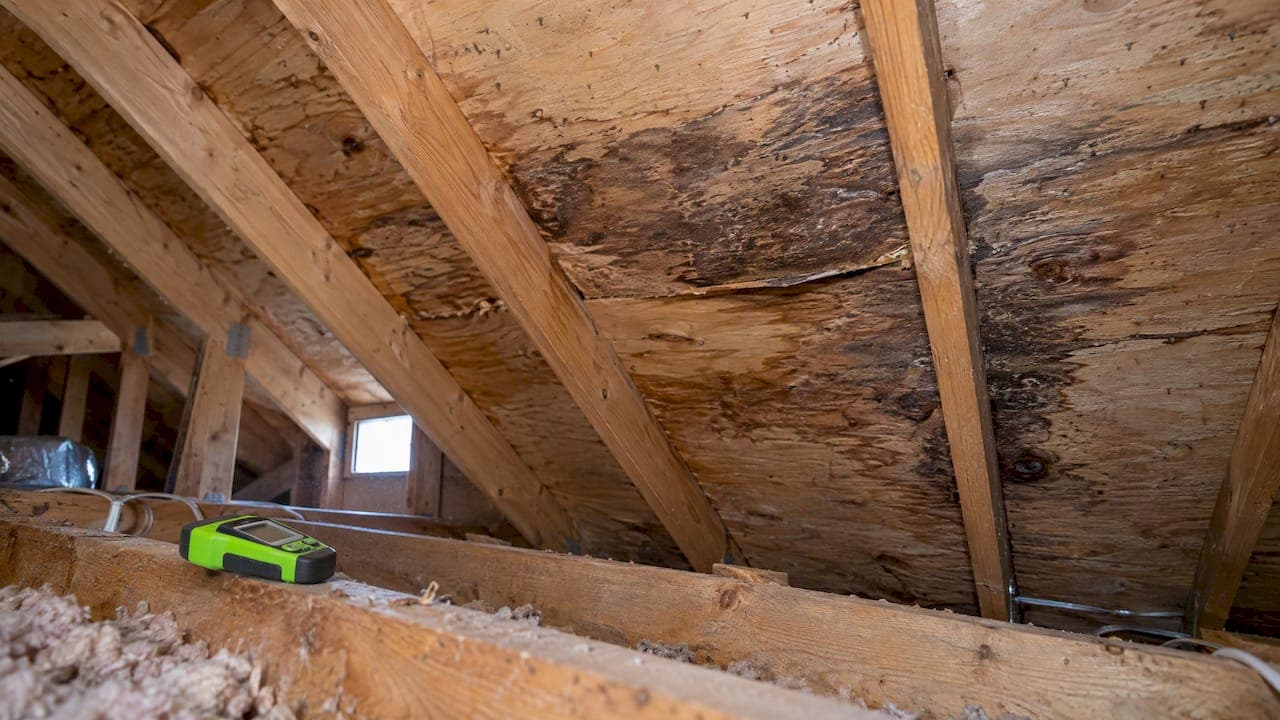
Roof decking needs replacing when it is soft, sagging, rotted, delaminated, stained from repeated leaks, or too weak to hold nails. Most of these signs show up inside the attic or as a roof that looks wavy from the street. New shingles do not fix a damaged deck. The deck has to be repaired first.
This guide lists the signs, shows how to tell deck damage from ordinary shingle wear, explains what happens when a roofer finds bad decking mid-job, and covers cost.
TL;DR
- Soft or spongy spots, sagging between rafters, dark stains, and nails backing out are the main signs of failing decking.
- Many signs show on the attic side of the roof. Check there first, from the floor.
- Shingle problems alone (curling, granule loss) point to the shingles. Sagging, musty smells, and ceiling stains point to the deck.
- Damaged decking is replaced sheet by sheet before the new roof goes on. The moisture source has to be fixed too.
- Published ranges for decking repair run from $2 to $15+ per square foot, depending on scope. A roofer sets the real number after the old roof is off.
Table of Contents
- What roof decking is and why it matters
- Signs your roof decking needs replacing
- Deck damage or worn shingles?
- What you can check yourself, safely
- What causes decking to fail
- Repair or replace the decking?
- What happens when decking is replaced
- Cost of roof decking replacement
- Our perspective
- Get the deck checked before the roof goes on
- When to call a roofer right away
- FAQ
- Sources
What roof decking is and why it matters
Roof decking, also called sheathing, is the layer of plywood, OSB, or boards nailed to the rafters. Shingles, underlayment, and flashing all attach to it. It carries the roof's weight, snow load, and the people who work on it.
When decking weakens, nails lose their grip. The roof covering can lift, shift, or fail in wind. The National Roofing Contractors Association (NRCA) warns that a deteriorated deck should not be covered with a new roof system, because deterioration can significantly reduce fastener-holding and load capacity.
Signs your roof decking needs replacing
No single sign proves it. Two or three together are a strong signal. Here are the ones roofing bodies and manufacturers list.

Soft or spongy spots
Soft decking gives under pressure. GAF describes rot in roof decking as showing up as a soft or spongy texture, sagging, cracking or crumbling, discoloration, and a musty odor. NRCA's deck assessment tool also flags deflection, bounce, soft spots, and roof movement for evaluation.
Do not walk the roof to test this. A soft spot is where a fall happens. If you feel bounce on a ladder or see a dip from the ground, stop and call a roofer.
Sagging between rafters
Look at the roof line from across the street. A straight roof has straight planes. Dips between rafters, or a wavy look under the shingles, suggest the deck has weakened or the framing below has a problem. Sagging is one of the signs SageSure lists, along with soft spots, nails pulling out, and stained or damaged attic areas.
Dark stains and water marks in the attic
Go into the attic with a flashlight. Look at the underside of the deck. NRCA's guidance says underside stains, rust, mold, and degradation generally indicate moisture migration or leakage.
What to look for:
- Dark patches or rings on the wood
- Color variation from one panel to the next
- Wet or compressed insulation
- Rusted nail tips
- White or black growth on the wood
The NRCA tool lists wet insulation, water damage or discoloration to interior surfaces, and underside color variation among the conditions to assess.
Mold, powder, or a musty smell
A musty odor in the attic points to long-term moisture. Crumbling wood fibers, a powdery surface, or fuzzy growth on the underside of the deck are all signs of decay. Mold alone does not always mean the wood is gone. Probing and a roofer's inspection settle that.
Delaminated plywood and cupped boards
Plywood is made of glued layers. When it stays wet, the layers separate and the panel loses strength. Older roofs with plank decking can cup, with board edges curling up. NRCA flags delaminated plywood, cupping of dimensional lumber, rotted deck components or framing, and inadequate panel support as conditions to assess before relying on the deck.

Nails backing out or pulling through
In the attic, look for nail tips along the sides of rafters. The Texas Department of Insurance notes that visible nail tips may indicate the deck is not securely fastened. On the roof, nail pops that keep returning can point the same way. They can also come from normal wood movement, so look for other signs nearby.
Ceiling stains and repeated leaks
A ceiling stain that grows after each rain or snowmelt means water is getting in. If the same area leaks again after a shingle repair, the deck under it may be wet or rotted. Valley and flashing leaks are common causes. Our roof valley leak guide shows how to trace them.
Deck damage or worn shingles?
The two overlap, but they look different.
| What you see | Likely cause |
|---|---|
| Curled, cracked, brittle shingles; bare patches; granules in gutters | Shingle wear or age |
| Sagging roof plane, soft feel underfoot | Deck or framing problem |
| Ceiling stains, leaks, missing patches | Could be either; check the attic |
| Dark, damp, crumbling wood from below | Deck damage |
| Nail pops, one or two spots | Often minor; check for others |
GAF makes this distinction: sagging ceilings, leaks, broken gutters, or missing shingle patches may indicate damaged sheathing, while shingles at end of life more typically crack, turn brittle, curl, or fall off.
If your roof is old and the shingles are failing, the deck may be fine. If the shingles look decent but the roof sags or leaks, look at the deck. Our guide on repair or replace decisions for Wisconsin roofs covers the shingle side.
What you can check yourself, safely
Stay on the ground and in the attic.
- Look from the street. Check for dips, waves, or uneven lines. Binoculars help.
- Look at the ceilings. Note any stains, bubbling paint, or cracks near outside walls.
- Go into the attic on a dry day. Use a flashlight. Walk only on joists or planks, not on insulation.
- Check the underside of the deck. Note stains, rust, mold, and crumbling.
- Check the insulation. Wet, matted, or discolored insulation under a stain is a warning.
- Take photos. Date them. They help a roofer and any insurance claim.
Do not climb on the roof to press on the deck. Replacing decking is not a simple DIY project. It involves working at heights with heavy equipment and safety gear.
Professionals may use more than touch. Western Colloid lists ponding areas, underside leak evidence, and moisture testing or core samples as ways to confirm deck damage, especially around drains and penetrations. That is more common on low-slope roofs.
What causes decking to fail
Water is the cause in nearly every case. GAF notes that moisture commonly comes from roof leaks or attic condensation.
Common sources:
- Failing flashing. Water enters at chimneys, walls, vents, and valleys. See our notes on kickout flashing checks.
- Poor attic ventilation. Warm, moist air condenses on cold wood. We cover this in our post on how attic ventilation affects Wisconsin roof lifespan.
- Clogged or damaged gutters. Water backs up at the edge of the roof.
- Long-neglected shingle damage. Wind and hail can open the roof to water. After a storm, see our guide to wind damage on a roof.
- Bathroom or kitchen fans venting into the attic. Humid air ends up on the deck.
This matters because patching alone does not last. Sources reviewed by roofing educators say that replacing a section of sheathing only resets the clock if the cause of moisture, such as poor ventilation, clogged gutters, or failing flashing, is not addressed at the same time. The same logic applies at the eaves: fixing the cause, not just the surface, is the point of eaves repair and repaint work. For roof edges, our soffit, fascia and gutter repair service covers the same ground.
Repair or replace the decking?
Replace, do not patch over. Damaged boards or sheets come out. The rule is simple: bad wood does not hold nails.
The FORTIFIED standards say that after old roofing is removed, the deck should be inspected and damaged or deteriorated decking replaced. They also call for removing the entire damaged sheet or board, inspecting the framing below, and adding a minimum 2×4 scab along the edges of new decking so it can be fastened.
The Texas Department of Insurance gives homeowners the same advice: inspect the deck when the covering comes off and replace deteriorated or damaged decking before installing the new roof covering.
Small, local damage may mean replacing a few sheets. Widespread rot, or damage across many panels, points to a bigger scope. Framing damage adds more.
What happens when decking is replaced
GAF's recommended sequence for repairing rotted decking runs like this:
- Remove shingles and underlayment to expose the area.
- Determine the extent of the damage.
- Cut out the rotted sheathing.
- Install new plywood or OSB, secured to the rafters.
- Correct the roof system so moisture cannot get back in.
The details are in GAF's guidance on replacing sheathing. On a full roof replacement, the same checks happen when the old roof is torn off. Many problems cannot be seen until then. That is why a good estimate explains how decking is handled before work starts.
For more on this process, read our post on roof decking replacement for homeowners.
Cost of roof decking replacement
There is no fixed price. Scope drives it. IKO publishes these ranges:
| Scope | Published range per square foot |
|---|---|
| Minor patching | $2 to $5 |
| Moderate repairs | $5 to $10 |
| Extensive structural work | $10 to $15+ |
Source: IKO, 2023. Treat these as a guide, not a quote. Labor, local rates, roof pitch, access, and framing repairs all change the final figure.
A roofer can only set the scope by assessing the damage. GAF says the roofer first removes shingles and underlayment, and affected flashing, to see what is there. That is why many contractors cover decking as a per-sheet line item on the estimate. Ask how it will be priced and documented.
For the roof as a whole, we publish a range: roof replacement runs $7,500 to $18,000 on our site. See our Wisconsin roof replacement cost guide for what moves a job within that range.
Our perspective
We have worked on Wisconsin roofs for over 25 years. Our view is simple: most roof failures come from poor workmanship, not poor materials. Decking is a clear example.
A new shingle system on a weak deck is a short-lived roof. The shingles may be premium. The warranty may be long. If the nails hold in wet or crumbling wood, the roof will not perform.
So we want the deck looked at when the old roof comes off, with an owner supervising the job. We also want you to see what we found. Detailed documentation of the work, with photos, means you are not asked to trust a line on an invoice.
We also give honest repair or replace advice. If your deck is sound and a shingle repair solves the problem, we say so. If the deck is the problem, we say that too, and we explain why.
If storm damage opened the roof, we help homeowners work through the insurance claim.
— Heather
Get the deck checked before the roof goes on
If you see sagging, stains, soft spots, or nails backing out, call early. Water damage spreads. A small area now can become a larger one after another winter.
AM Exteriors handles roof replacement, roof repair, and storm damage roofing across Southeast Wisconsin, including Dodge, Washington, Fond du Lac, and Ozaukee counties. See our roofing services or ask about a free hail damage roof inspection if a storm may be the cause.
When to call a roofer right away
Call promptly if you see:
- A visible dip or sag in the roof
- Active leaks or growing ceiling stains
- Wet insulation or dripping in the attic
- Daylight through the deck
- Damage after a hail or wind storm
After a storm, photograph everything before repairs. Our guides on hail damage signs to photograph and storm damage roof repair explain what to record.
FAQ
How do I know if my roof sheathing is rotten?
Look in the attic for dark stains, crumbling wood, mold, and a musty smell. From outside, look for sagging or soft spots. A roofer confirms by inspecting the deck once shingles are off or by testing it from above and below.
When should roof sheathing be replaced?
Replace it when it is rotted, delaminated, sagging, or too weak to hold nails. Damaged sheets are removed whole, not patched over. Sheathing is usually checked and replaced during a roof replacement, when the deck is exposed.
Can I put new shingles over bad decking?
No. NRCA guidance says a deteriorated deck should not be covered with a new roof system. Weak wood reduces how well fasteners hold, and shingles on it can fail early.
How much does roof decking replacement cost?
IKO publishes ranges of $2 to $5 per square foot for minor patching, $5 to $10 for moderate repairs, and $10 to $15+ for extensive structural work. Your cost depends on how much of the deck is damaged. A roofer sets the figure after the old roof is off.
Can I check the decking myself?
You can check from the ground and from the attic floor. Do not walk on the roof to test for soft spots. Leave the repair itself to a roofer.
Sources
- NRCA Roof Deck Integrity Assessment Tool
- NRCA reroofing guidelines
- GAF: roof deck wood rot
- GAF: how to identify roof damage
- SageSure Roofing Guide
- Western Colloid: identifying roof deck damage
- FORTIFIED hurricane standards
- Texas Department of Insurance: questions to ask your contractor
- Texas Department of Insurance: repairing my roof after a storm
- IKO: rotted roof deck and sheathing
- ArchitectureCourses: replacing roof sheathing