
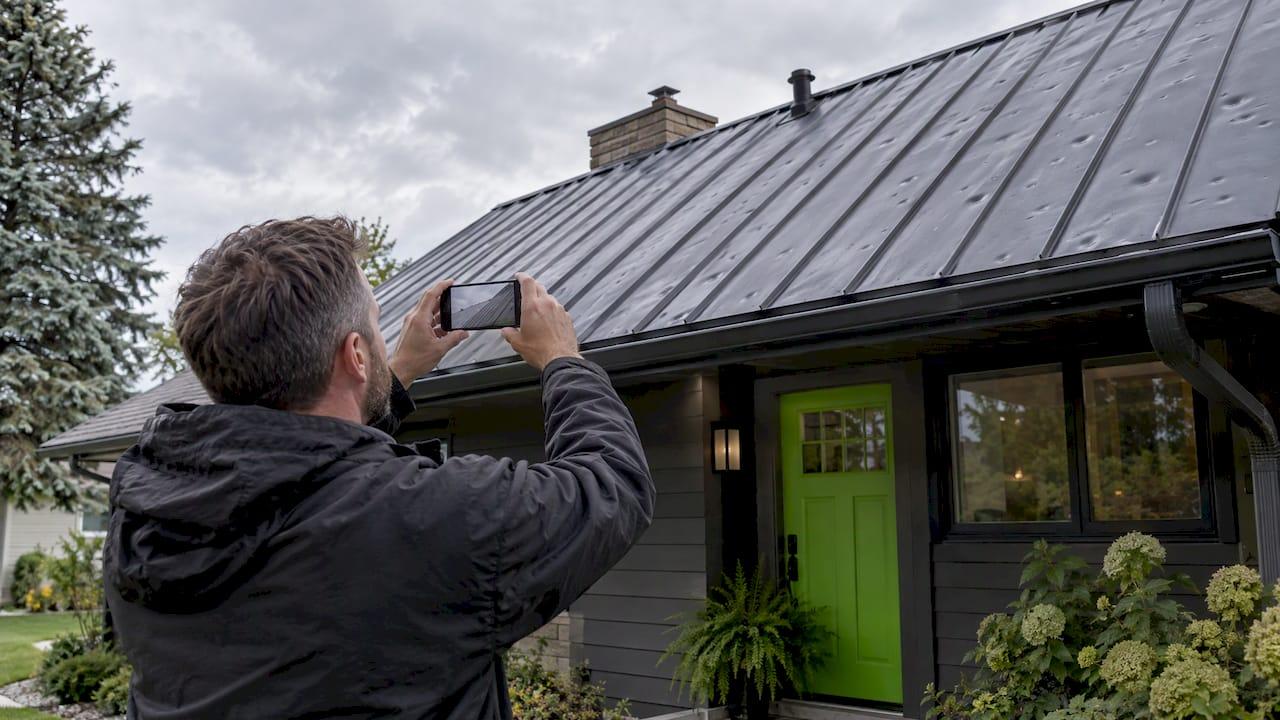
Hail often dents a metal roof. It seldom makes it leak. Repair is needed when hail damages seams, trim, flashing or the paint coating. Dents alone are usually cosmetic. This guide shows you how to tell the difference, how repair works, when replacement makes sense and what to do about insurance.
TL;DR
- Dents in the flat part of a metal panel are usually cosmetic. Damage to seams, ridge caps, edge trim and penetrations is what lets water in.
- Chipped or cracked paint that exposes bare metal can lead to rust. Treat it as damage.
- Do not climb the roof alone. Photograph from the ground, cover openings and call a roofer.
- Repair fits limited, local damage. Replacement fits widespread damage or repeated failed repairs.
- Insurers often treat cosmetic damage differently from functional damage. Read your policy before you file.
Table of Contents
- Does hail damage a metal roof?
- Cosmetic damage vs. functional damage
- How to inspect safely after a hailstorm
- How hail damage to a metal roof is repaired
- Repair or replace?
- What does metal roof hail repair cost?
- Insurance claims for hail on metal roofs
- Perspective
- Get a roof inspection in Southeast Wisconsin
- FAQ
- Sources
Does hail damage a metal roof?
Yes, but metal handles hail better than most roofing. The Metal Roofing Alliance says metal roofing performed best in IBHS hail studies and held up against golf ball-sized hail. It also notes that many insurers offer discounts for impact-resistant metal roofs.
There are limits. An engineering analysis of Haag research puts the typical size needed to rupture metal panels in good to fair condition at at least 2.5 inches. That is well above what most Wisconsin storms drop.
Most hail damage on metal is smaller than a puncture. It falls into three groups:
- Dents and dimples. They change how the roof looks.
- Coating damage. Chips, cracks or peeling paint expose the metal.
- Damage to seams and trim. These parts can open a path for water.
InterNACHI explains that metal panels are well supported by the substrate, so hail may dent them but seldom causes functional damage. When it does, the damage is often at a seam or trim piece.
Cosmetic damage vs. functional damage
This is the question that decides your repair and your claim.
Engineers define cosmetic damage as damage that affects appearance but not function: denting, marring, scratching, pitting or discoloration. Functional damage reduces the roof's ability to shed water or shortens its expected service life. One engineering firm states that hail dents in metal are not typically considered functional damage.
Another engineering review adds that denting alone does not prove the roof lost its water-shedding ability. Functional damage generally needs a physical change that creates an opening or disrupts a part that sheds water.
| What you see | Usually cosmetic or functional | Why it matters |
|---|---|---|
| Shallow dents in flat panel areas | Cosmetic | Panels stay attached and watertight |
| Chipped, cracked or peeling paint with bare metal showing | Functional | Exposed metal can corrode and shorten roof life |
| Dented or bent ridge cap, hip cap or drip edge | Often functional | Trim guards the most exposed edges |
| Opened or distorted seams | Functional | Seams and sealant carry the water-shedding job |
| Damaged vent, pipe boot or skylight flashing | Functional | Penetrations are common leak points |
| Dented gutters | Depends on the damage | Check that water still flows and the gutter is attached |
Engineers describe functional coating damage in two ways. The factory or field coating is compromised, which cuts long-term service life. Or water-shedding drops, often at overlapping seams where sealant sits. A published test standard for panels says they should show no chipping, peeling, blistering, cracking or crazing under 10X magnification. You cannot check that from the ground. A roofer can.
Even deep-looking dents may not shorten roof life if the coating stays bonded. Judge the coating and the corrosion risk, not only the depth of the dent.

Our own guide on cosmetic vs. functional hail damage covers how this split plays out in claims.
How to inspect safely after a hailstorm
Start from the ground. Do not walk a wet, dented metal roof. Metal is slick, and the NRCA says inspections should not be attempted alone.
- Confirm the hail. Weather reports can help show that hail fell at your address. The NRCA notes that thin aluminum items, such as vents or fixtures, can help verify impact.
- Walk the property. Look at gutters, downspouts, window trim, siding, AC units and decks. Dents on these show the size and direction of the hail.
- Scan the roof from the ground. Use binoculars. Look at the ridge, hips, eaves, gable ends and anything that sticks through the roof.
- Check the attic. Look for daylight, damp insulation, stains or drips near seams and penetrations.
- Photograph everything. Wide shots first, then close-ups with something for scale. Date them.
- Cover openings. The NRCA advises temporary tarps over roof openings. It cautions homeowners against attempting repairs except in extreme situations.
- Book a professional inspection. The NRCA says hail assessment is a roof-system inspection, usually done several days to several months after the event.
Watch for contractors who knock on doors after a storm. The NRCA also warns about unprofessional contractors that follow disasters. Ask for a local address, proof of insurance and references before you sign anything.
These pages help with documentation: the hail storm roof inspection checklist, the roof damage photo checklist and the guide to hail damage roof signs to photograph.
How hail damage to a metal roof is repaired
The repair matches the damage. A roofer works from the trim and seams inward.
- Seams and laps. The roofer cleans and reseals, fastens or caps the seam. If a panel edge is bent, it may need to be reformed or replaced.
- Trim and flashing. Bent ridge caps, drip edges and gable trim are usually replaced, not straightened. They are cheap compared with the panels.
- Penetrations. Damaged pipe boots, vent flashings and skylight curbs are replaced and resealed.
- Chipped coating. Small spots can be cleaned and touched up with a compatible coating. Ask the installer and the panel maker which products suit your panel finish and keep the warranty valid.
- Damaged panels. A single panel that is punctured or deeply deformed can be cut out and replaced. A panel match matters: profile, gauge and color.
- Gutters and downspouts. Hail often bends these first. If they are damaged, see our soffit, fascia and gutter repair work.
Can a metal roof be refinished? Often, yes, when the panels are sound and the problem is the coating. Refinishing does not fix opened seams, loose fasteners or deformed panels, so repair those first. Dents are not removed by repainting. If you want to know whether recoating is an option on your roof, ask the installer and the panel manufacturer about compatible products and what it does to the warranty.
Repair or replace?
Repair is the right call when the damage is limited and the surrounding panels and substrate are sound. A compatible repair then restores drainage, attachment and weather resistance. Replacement makes sense when corrosion, deformation, leaks or loose attachment are widespread, or when repairs keep failing.
Use these questions:
- Is the damage confined to trim, a few seams or a few penetrations? Repair.
- Are bare-metal chips spread across many panels? A roofer should evaluate the corrosion risk across the roof.
- Do leaks return after repair? The underlying problem is not fixed, so look at replacement.
- Are dents the only issue? Roofing is working. Repair is optional and the choice is about looks and your insurance policy.
We give you an honest repair or replacement call. If the roof needs only trim and seam work, we say so. For a full system, we install standing seam metal roofing in Wisconsin.
What does metal roof hail repair cost?
Cost depends on the type of damage, the panel profile and finish, access and how many areas are affected. A trim and seam repair costs far less than panel replacement. Matching a specific panel color can add cost.
We do not publish a price for roof repair or standing seam metal roofing. You get a written estimate after an inspection. For reference, our published range for a full roof replacement is $7,500 to $18,000. Your inspection result tells you which side of repair or replacement you are on.
Insurance claims for hail on metal roofs
Metal roof claims turn on the cosmetic vs. functional split.
InterNACHI says insurers generally do not pay for cosmetic damage, though exceptions vary by insurer and policy language. The claims adjuster makes the final decision. It advises homeowners to photograph hail damage that looks cosmetic and to say it "appears to be" hail damage, since you cannot be sure without a trained eye.
Some policies include a cosmetic damage exclusion. Texas is an example: a state bulletin adopted an optional endorsement that can exclude cosmetic hail damage for roofs that receive impact-resistant premium credits. That is Texas rules and not a Wisconsin rule. Check your own policy wording for terms like "cosmetic damage" or "metal roof surfacing."
Steps to follow:
- Read the policy. Find the deductible, any hail or wind deductible and any cosmetic exclusion.
- Photograph the damage before you tarp or repair.
- Get a roofer's written inspection report.
- Call your insurer promptly. Ask about the filing time limit in your policy.
- Be present when the adjuster inspects the roof, and share your documentation.
- Keep receipts for temporary repairs.
For storm and claim support, see our hail and wind storm damage roof repair page.
Perspective
Most roof failures we see come from workmanship, not materials. Hail is no different. A metal roof can take a hit and still leak if the seams, flashings and trim were installed poorly.
That is why we look at the details first. We check the seams, the ridge, the edges and every penetration before we talk about panels. We tell homeowners plainly when repair is enough and when it is not.
We also document the work. Photos, notes and a clear written scope help you with the repair and help your insurance claim. Owner-supervised installation means the same people who plan your job check it.
Heather
Get a roof inspection in Southeast Wisconsin
We repair and replace roofs for homeowners in Dodge, Washington, Fond du Lac and Ozaukee counties. We handle storm damage roofing and help you work through the insurance claim. Start with an inspection of your roof, trim and seams.
Book a free hail damage roof inspection, or see all roofing services. For smaller jobs, see our roof repair page.
FAQ
Does hail hurt a metal roof?
Usually only on the surface. Hail dents metal panels but seldom punctures them. The risk is damage to seams, trim and coatings, which can allow moisture in or lead to corrosion over time.
Can a metal roof be refinished?
Often, if the panels are sound and the issue is the coating. Refinishing does not remove dents or fix open seams. Ask your installer and the panel manufacturer which coating to use so the warranty stays intact.
Will insurance pay for hail dents on a metal roof?
It depends on your policy. Insurers generally do not pay for cosmetic damage, but exceptions exist and the adjuster decides. Functional damage, such as damaged seams or exposed bare metal, is more likely to be covered. Read your policy and document everything.
How do I know if my metal roof has hail damage?
Look from the ground for dented trim, chipped paint, damaged vents and bent gutters. Check the attic for stains. Then have a roofer inspect the seams, flashings and coating. Do not climb the roof yourself.
Should I repair or replace a hail-damaged metal roof?
Repair when damage is limited and nearby panels are sound. Replace when damage is widespread or leaks return after repair. An inspection report gives you the facts to decide.
Sources
- Hail | Metal Roofing Alliance
- Testing Your Mettle | CLM Magazine
- Mastering Roof Inspections: Metal Roofs, Part 10 | InterNACHI
- Multi-Discipline Approach to Investigation of Hail Damage to Metal Roofs | Engsys
- Hail Damage to Metal Roofs | KPE
- Assessment of the Effects of Hail to Metal Roof Panels | EDT Engineers
- Roof Repair After a Hailstorm | NRCA
- Bulletin B-0030-98 | Texas Department of Insurance