
Stay off the roof. Walk the ground first. Photograph everything. Call your insurer. Then have a roofer inspect it. This checklist covers each step in order, with what to look for on the roof, gutters, siding, windows and inside the house.
It is written for Wisconsin homeowners, including those in Dodge, Washington, Fond du Lac and Ozaukee counties. Insurance rules and deadlines vary by policy, so check yours.
TL;DR
- Make sure it is safe first. Do not climb onto a wet, damaged or icy roof. Inspect from the ground.
- Write down the storm date and time. Photograph the roof, gutters, siding, windows and yard before any cleanup.
- Notify your insurer right away. Wisconsin OCI advises photographing damage and keeping receipts.
- Check your policy for the hail deductible and whether the roof pays at replacement cost or actual cash value.
- Get a written inspection before you sign any contract. Walk away from pressure to sign fast.
Table of Contents
- Before you inspect: safety and timing
- Ground-level checklist: walk the full perimeter
- Roof checklist: what to look for from the ground
- Inside the house
- What to do right after the storm
- How to document the damage
- Insurance: what to check in your policy
- Should you get the roof inspected?
- How to choose who works on your roof
- Our perspective
- Next step with AM Exteriors
- FAQ
- Sources
Before you inspect: safety and timing
Safety comes first. Hail leaves loose granules, wet shingles and sometimes broken branches. A roof in that state is slippery.
- Wait until the storm has fully passed.
- Check for downed power lines. Stay away from them and call the utility.
- Look for sagging ceilings or active leaks inside. Move people and valuables away.
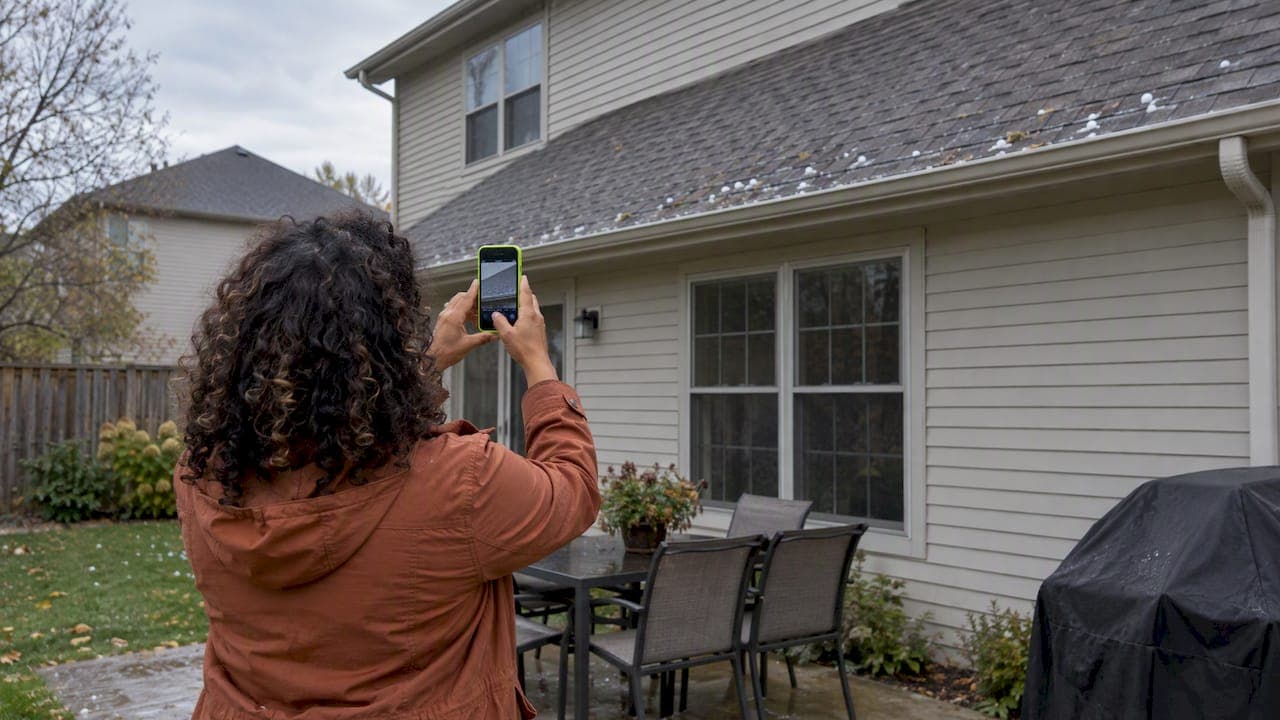
- Stay on the ground. Use binoculars or a phone zoom for the roof.
- Write down the storm date, time and the largest hail size you saw.
The storm date matters. Insurers ask for it, and it helps separate new damage from old wear. Note whether neighbors have damage too. Keep a short log in your phone.
Time matters as well. Wisconsin policies often carry a limit on how long you have to sue over a claim. One Wisconsin law firm explains that the state's model policy language allows a limit as short as one year. Read your own policy for its exact deadlines. Do not wait to report.
Ground-level checklist: walk the full perimeter
Walk around the house slowly. Do this in daylight. Take photos as you go.
Yard and neighboring clues
Hail leaves marks on things that are softer than your roof. Check these first.
- Trees, shrubs and garden plants stripped of leaves. Colorado's emergency management office notes that stripped foliage can point to roof damage.
- Dented patio covers, grills, mailboxes and soft aluminum items.
- Damaged screens on windows and doors.
- Dents on cars parked outside.
- Shingle pieces or granules on the driveway, walkways and lawn.
Gutters and downspouts
Gutters and downspouts are soft metal. They show hail hits clearly.
- Look for dents along the gutter face and top edge.
- Look at downspout bottoms for a pile of dark granules. Granules are the gritty coating on asphalt shingles.
- Check for loose or bent sections.
- Note which side of the house has the most dents. Hail is often driven by wind and hits one side harder.
Siding, trim and windows
- Look for chips, cracks, dimples or small round holes in siding. Vinyl can crack. Fiber cement and wood products can chip or mark.
- Check fascia, soffit and trim for dents or splits.
- Check window frames, glass seals and screens. Look for cracked panes and fogging between panes.
- Check garage doors, vents and flashing, which are also soft metal.
Siding and window damage belongs in the same claim as roof damage. Photograph it all. Ask your adjuster to record every affected side of the house.
Roof checklist: what to look for from the ground
Use a zoom lens or binoculars. Look at each slope.
| What you see | What it can mean | What to do |
|---|---|---|
| Dark, bare spots on shingles | Granule loss from hail impact | Photograph close and wide. Note the slope |
| Cracked or split shingles | Direct impact damage | Photograph and flag for the roofer |
| Missing or displaced shingles | Wind, hail or both | Tarp if a leak is possible |
| Dented vents, flashing, ridge caps | Hail hit soft metal | Photograph each one |
| Granules in gutters | Shingle surface wear | Photograph and keep a sample |
| Dents or dings in metal panels | Hail impact | Photograph with a coin for scale |
Our own guides go deeper on each sign. See five hail damage roof signs to photograph for claims and how to spot hail damage on shingles.
Does hail size matter?
Yes. Larger hail causes more damage, but small hail can still cause problems on an older roof. Do not rule out damage because the stones looked small. Read our guide to hail size and roof damage for when to inspect.
Cosmetic or functional?
Some marks change how a roof looks. Others change how it performs. Insurers treat the two differently, and policies differ. Learn the difference in cosmetic vs. functional hail damage. Ask your roofer to explain which marks they found and why.

Inside the house
Water from hail damage may show up days later. Check inside within the first week and again after the next rain or snowmelt.
- Ceilings: stains, bubbling paint, sagging drywall.
- Walls: damp spots or streaks, especially below roof edges.
- Light fixtures: water or discoloration around them.
- Attic: damp insulation, daylight through the deck, dark wet wood.
- Windows: drips, wet sills, damaged seals.
Photograph every stain with a date. If you see a stain, mark its outline with a pencil and the date. That shows whether it grows.
If you want a general inspection list for the rest of the house, a home inspection checklist can help you cover rooms you might skip.
What to do right after the storm
- Protect the home. Cover openings or leaks with a tarp or board. Keep receipts. Temporary repairs are usually part of a claim, so ask your insurer.
- Document before cleanup. Photos and video of the damage, before anyone moves or throws anything away.
- Notify your insurer. Wisconsin OCI says to notify your agent or company right away, make a list of damaged items and keep damaged property until the adjuster agrees it can go.
- Keep samples. Save damaged materials such as loose shingle pieces.
- Clear debris safely. Broken branches and damaged materials add up fast. If you need hauling help, see this guide on storm debris removal. Take photos before anything leaves the property.
- Book a roof inspection. Do it before you sign anything.
How to document the damage
Good records make a claim easier to review. Use this list.
- Date and time of the storm.
- Wide photos of each side of the house, then close-ups of each damage point.
- Video walk-around with narration.
- A coin or ruler in close-ups for scale.
- Photos of gutters, siding, windows, screens and yard items.
- Photos of interior stains with dates.
- Receipts for tarps, repairs and lodging.
- Roof age, if known, and any prior repairs.
- A written list of what you have not yet checked.
OCI also notes that photos taken right after severe weather matter, and that you should avoid moving things until the adjuster has seen them. See the OCI storm press release.
Insurance: what to check in your policy
Windstorm and hail are generally covered perils on common homeowners forms. The Insurance Information Institute says an HO-3 policy generally covers hail and wind. Coverage, deductibles, limits and exclusions still depend on your policy.
Check these items on your declarations page:
- Hail or wind deductible. It may be a percentage rather than a flat amount. The III notes that areas prone to hailstorms may have a specific hail deductible.
- Roof payment basis. Replacement cost pays to replace. Actual cash value deducts depreciation.
- Limits and exclusions. Some policies limit coverage for older roofs or cosmetic damage.
- Claim deadlines. See the note above on time limits.
This is why two neighbors with similar damage can get different payments. Your policy decides. Call your agent with questions.
Talking to the adjuster
Be present for the visit. Give facts. Texas insurance regulators advise recording accurate damage lists, photos and receipts rather than scripted statements. The advice applies in any state.
- Say: the storm date, what you saw, any leaks, prior repairs and areas you have not checked.
- Do not say: that the roof is definitely destroyed, that the damage is definitely unrelated to maintenance, or the dollar amount you want.
- Ask the adjuster to record every roof slope, every elevation, gutters, siding, windows, interior water damage and temporary protection costs.
If your claim is denied or you disagree with the amount, see our 30-day plan to reverse a denied roof claim. For the full process, read our Wisconsin guide to filing a storm damage insurance claim.
Should you get the roof inspected?
Yes, in most cases. Hail damage is often not visible from the ground. A trained inspector checks each slope, flashing, vents and the attic.
Get an inspection if any of these apply:
- Hail fell at your address, even if small.
- Neighbors have damage.
- You see dents on gutters, vents or siding.
- You see granules in the gutters.
- You see any leak or stain.
- The roof is older.
What an inspection costs
Prices vary. A 2021 Angi guide reported hail-damage roof inspections at $75 to $800. Treat that as a broad national estimate. Some contractors inspect at no separate charge. Engineering, documentation or emergency work may cost more. Before you schedule, ask three questions:
- What is the fee?
- What does the inspection cover?
- Is the fee credited toward work?
We offer a free hail damage roof inspection in Wisconsin.
What a good inspection report includes
- Photos of each slope and each damage point.
- Notes on roof age, material and condition.
- A clear statement of repair or replacement, with the reason.
- Findings for gutters, siding, windows and soft metals.
- Any interior or attic findings.
Ask for it in writing. Share it with your adjuster.
How to choose who works on your roof
After a big storm, door-to-door contractors appear. Some are good. Some are not. Screen them.
- Wisconsin OCI advises taking time to investigate contractors and stepping back if anyone pressures you to sign quickly.
- Ask for local references and a local address.
- Get the scope, materials, warranty and price in writing.
- Do not sign over your insurance payment or sign before the claim is understood.
- Do not pay in full up front.
For a longer list, read how to choose a roofing contractor in Wisconsin.
Our perspective
We have been owner-operated for over 25 years. Here is what we see after hail in southeast Wisconsin.
Most roof failures come from poor workmanship, not materials. That is why we supervise installations ourselves. It is also why we tell you honestly whether you need a repair or a replacement. Some roofs need only a repair. Some need a full replacement. We say which, and why.

Homeowners often do the right things at the wrong time. They clean up first and photograph later. They sign with the first contractor at the door. They tell the adjuster the roof is destroyed. Each of these makes the claim harder.
Our advice is simple. Photograph first. Call your insurer. Get a written inspection. Compare. Then decide. We handle the documentation and help you through the insurance claim, so you know what is covered and what is not.
— Heather
Next step with AM Exteriors
We inspect roofs after hail in Dodge, Washington, Fond du Lac and Ozaukee counties and across southeast Wisconsin. Start with our free hail damage roof inspection. If you need storm repairs, see our hail and wind storm damage roof repair page. If your roof needs replacing, see our roofing services. Roof replacement is listed at $7,500 to $18,000.
We also install siding, windows and gutters, so the whole storm claim can go through one contractor.
FAQ
Should I get my roof inspected after a hail storm?
Yes. Hail damage is often hard to see from the ground, and leaks may show up weeks later. A written inspection also gives you records for your insurer. Do it before you sign any repair contract.
What should I do first after hail hits my roof?
Check that everyone is safe, then stay off the roof. Photograph damage before cleanup. Cover any openings with a tarp and keep receipts. Then call your insurer right away, as Wisconsin OCI advises.
What should I not say to an insurance adjuster?
Do not say the roof is definitely destroyed, that the damage is definitely unrelated to maintenance, or the payment amount you want. Give facts: the storm date, what you saw, leaks and prior repairs. Ask the adjuster to record every affected area.
How much does a roof inspection usually cost?
A 2021 national estimate from Angi put it at $75 to $800. Some contractors inspect without a separate charge. Confirm the fee, scope and any credit toward work before you book.
How long do I have to file a hail claim in Wisconsin?
It depends on your policy. Wisconsin's model policy language allows a limit as short as one year to sue. Report the claim right away and read the deadlines in your policy.
Sources
- After a Storm Hits, Wisconsin Office of the Commissioner of Insurance
- Wisconsin Insurance Commissioner storm guidance, July 24, 2019
- Which disasters are covered by homeowners insurance? Triple-I
- Am I Covered? Triple-I
- Hail damage to your home or car? Texas Department of Insurance
- What to Do After Hail Damages Your Roof, Angi
- Wisconsin Hail Claim Deadlines, Beckmann Law Firm
- What to do after a hail storm, Colorado Division of Homeland Security and Emergency Management