
Homeowners comparing flat roof options should weigh several families: single-ply membranes (EPDM, TPO, PVC), asphaltic multi-ply systems (built-up roofing and modified bitumen), standing-seam metal, and specialty systems such as spray foam. Pick by climate, roof use, and budget. Then put installer quality and drainage first, because maintenance and water management decide how long any flat roof lasts.
TL;DR:
- Choose EPDM for low cost and easy repairs on roofs without foot traffic, but its black surface absorbs heat and adhesive seams need careful installation.
- White TPO reflects sunlight and suits warm climates, while PVC costs more but resists grease, chemicals, and fire; welded seams still depend on skilled installation.
- Choose layered asphalt systems such as BUR or modified bitumen for foot traffic; gravel or pavers protect the surface, though they add weight and labor.
- Inspect flat roofs at least twice yearly and after severe weather, and keep drains, scuppers, and gutters clear to limit ponding and premature wear.
- Typical costs are $7 to $13 per square foot; deck repairs, insulation, access, and drainage work can raise bids, so compare itemized estimates.
Table of Contents
- What are the main flat roof materials, and who is each best for?
- How do EPDM, TPO, and PVC compare?
- When do built-up roofing and modified bitumen make sense?
- What about metal, spray foam, liquid-applied, and green roofs?
- Why do installer skill and drainage matter more than the material?
- How should you maintain a flat roof, and how long will it last?
- What do flat roofs cost, and what do warranties cover?
- How do you compare estimates and choose a flat roof system?
- What most flat roof advice gets wrong
- A flat roof done right starts with a free inspection
- FAQ
- Sources
What are the main flat roof materials, and who is each best for?
Every flat roof is really a low-slope roof, pitched to let water drain away. That small slope is the reason material choice and drainage have to be considered together. Here is how the families sort out.
Single-ply membranes are factory-made sheets rolled across the deck and sealed at the seams. EPDM is rubber, TPO and PVC are thermoplastics. They are lightweight and quick to install. The trade-off is that performance depends heavily on how well the seams are made.
Built-up roofing (BUR) and modified bitumen are asphalt-based systems built from layers. They have been used on residential and commercial roofs for decades and offer redundancy because one layer backs up another.
Metal and specialty systems cover standing-seam metal panels, spray polyurethane foam (SPF), liquid-applied coatings, and green (vegetative) roofs. IKO's residential guide lists these alongside BUR, single-ply, and modified bitumen, and notes that the best system depends on budget, climate, installer availability, and expected use.
Use this quick guide to narrow your list:
- EPDM: Best for budget-conscious homeowners who want easy repairs and a simple, non-walkable roof over an addition or porch.
- TPO: Best for warm climates and for homeowners who want a reflective white roof at a moderate price.
- PVC: Best for roofs near kitchen exhaust, grease, or chemicals, and for anyone who wants the strongest seams.
- BUR: Best for roofs that see foot traffic or need gravel or paver surfacing for protection.
- Modified bitumen: Best for homeowners who want multi-layer protection with more flexibility than traditional BUR.
- Standing-seam metal: Best for long-term owners who value longevity and recycled content.
- SPF and liquid-applied systems: Best for odd shapes, many penetrations, or roofs where seamless insulation matters.
- Green roofs: Best for homes with a structure built or reinforced to carry the added weight.
If you are replacing an existing roof and want a side-by-side look at replacement routes, our guide on flat roof replacement options walks through them. Underlayment and substrate choices also affect the finished roof, and we cover those in our post on roof underlayment types.
One more point before the details. Material comparisons make the most sense once you have decided how the roof will be used. A roof you walk on, a roof that holds solar panels, and a roof nobody touches after installation each push you toward a different family. Keep that use in mind as you read the next sections.
How do EPDM, TPO, and PVC compare?
These three single-ply membranes look similar from the street. Their differences show up in seams, heat behavior, and chemical resistance.
EPDM: rubber with simple repairs
EPDM is a thermoset rubber membrane. It is among the lower-cost options and is easy to patch. This Old House lists EPDM among the common flat-roof families and notes it can last up to 50 years in some cases. Treat that as a best-case outcome, not a promise.
Two things matter with EPDM. First, the standard black membrane absorbs heat, which can help in cold climates and add to cooling loads in hot ones. Second, because it is a thermoset, it cannot be heat-welded. Seams are joined with adhesives or tapes, so seam adhesion is where installer care counts most.
TPO: reflective and economical
TPO is a thermoplastic membrane, usually white, with hot-air-welded seams. White TPO reflects sunlight and releases absorbed heat, which lowers cooling demand in warm climates. It is also recyclable.
The risk with TPO is inconsistent quality. Thickness, measured in mils, and installation workmanship both affect how it performs. For residential work we hold a firm standard, laid out in our post on residential TPO and seam testing. If you want a neutral primer on the membrane itself, this guide to TPO roofing membrane covers its properties and installation details.
PVC: chemical and fire resistance
PVC is also thermoplastic with welded seams. Roofing Contractor reports that PVC membranes offer superior chemical and fire resistance compared with TPO and EPDM, and that heat-welded PVC seams form continuous seals stronger than the membrane itself. A premium variant, PVC-KEE, is built for long-term flexibility, though you should confirm product details with the manufacturer.
The thermoplastic advantage is real but conditional. Roofing Contractor practitioner guidance explains that thermoplastic membranes can be re-heated to form monolithic seams, unlike thermosets. It also stresses that seam welding and flashing quality by the installer determine long-term performance more than the material brand.
Here is how the three line up at a glance:
- EPDM: Lowest cost of the three, easy to repair, dark color absorbs heat, seams rely on adhesive.
- TPO: Economical, white versions reflect heat, welded seams, quality varies with mil thickness and installation.
- PVC: Best chemical and fire resistance of the three, strongest welded seams, usually the premium choice.
Why white matters: The Department of Energy names high solar reflectance, endurance of reflectance over time, and high emittance as the three properties to look for in a cool roof product. Savings are greatest in hot climates, and a cool roof may raise heating costs in cold ones.
That last point matters for a cold-winter home. A reflective white membrane is not automatically the smarter pick everywhere. Match the color and material to your climate and energy goals instead of following the trend.
When do built-up roofing and modified bitumen make sense?
Asphaltic multi-ply systems build protection in layers. If one layer is compromised, the others keep working. That redundancy is the main reason some homeowners still prefer them.
Built-up roofing (BUR)
BUR stacks multiple plies of reinforcing fabric bonded with asphalt, then finishes with a surfacing. Gravel is the classic surfacing, and pavers are used where people walk on the roof. The surfacing shields the plies from sun and physical wear. BUR has a long track record, which counts for something when you want a system with decades of field history behind it.

Modified bitumen
Modified bitumen uses asphalt blended with polymers, which adds flexibility. Sheets are made in a factory, so quality control is generally easier than with BUR assembled on site. This Old House groups flat roofs into BUR, modified bitumen, and rubber membrane, and recommends that most homeowners hire professional installers for complex flat roofing.
For smaller residential jobs, Roofing Contractor notes that peel-and-stick products such as Peel & Seal and IKO Roof-Fast offer self-adhering options, often with 10-year manufacturer warranties.
When asphaltic multi-ply is the better fit
Consider these systems in situations like these:
- Heavy-use roofs: A roof deck or rooftop terrace where people walk regularly benefits from a surfacing layer.
- Need for surfacing protection: Gravel or pavers protect the plies below from UV and wear.
- Desire for proven redundancy: Multiple layers mean a single flaw is less likely to become a leak.
- Retrofit comfort: Many contractors know these systems well, which can make bids easier to compare.
The trade-off is that these systems are heavier and more labor-intensive than single-ply, and the surfacing can hide small problems until they grow. If you pick this route, plan your inspections around that. You want a contractor who documents each layer as it goes down.
What about metal, spray foam, liquid-applied, and green roofs?
Not every flat roof is a membrane or a stack of asphalt plies. These options suit particular situations.
Standing-seam metal
Standing-seam metal panels have raised seams that keep fasteners out of the weather. The appeal is longevity and recycled content. Paint color and emittance affect heat performance, so a light, high-emittance finish behaves differently from a dark one. Metal is typically used on roofs with a bit more slope than a truly flat deck, so confirm that your pitch suits it. We install standing-seam systems, and you can see what that involves on our standing seam metal roofing page.
Spray polyurethane foam (SPF)
SPF is sprayed in place, forming a seamless layer that insulates and waterproofs at the same time. It conforms well to odd shapes and many penetrations. It needs a protective coating to survive sun exposure, and the result depends heavily on the skill of the crew applying it. Weather during application also matters, so ask how the installer handles wind and moisture.
Liquid-applied systems
Liquid-applied coatings are rolled or sprayed on and cure into a continuous membrane. They are useful for restoring a sound roof or for details around penetrations. The substrate underneath must be in good condition, because a coating cannot fix a failing deck.
Green (vegetative) roofs
A green roof adds soil and plants over a waterproofing layer. Benefits include extra insulation and stormwater absorption. The costs are structural and practical: the roof must carry the added load, and the installation has more parts that must work together.
Quick reminders for this group:
- Metal: Check the pitch and finish before committing.
- SPF: Budget for the protective coating and hire experienced applicators.
- Liquid-applied: Confirm the existing roof is sound first.
- Green roofs: Have a structural review before you plan anything else.
Each of these is a legitimate choice when the situation fits, and each rewards careful installation more than a bargain price.
Why do installer skill and drainage matter more than the material?
If you remember one section, make it this one. A well-installed average membrane usually outlasts a poorly installed premium one. Roofing Contractor practitioner guidance emphasizes that seam welding and flashing quality often matter more to lifespan than the specific material brand. In our experience, the same holds in the field. Most failures trace back to workmanship, not the product.
Here are the installation items you should confirm before signing:
- Seam method: Ask whether seams are heat-welded or adhered, and how they are checked.
- Seam testing: Ask how the crew probes or tests seams after welding or bonding.
- Flashing details: Walls, curbs, vents, and drains are the usual leak points, so ask how each will be flashed and terminated.
- Fasteners and edge retainers: Confirm the right fasteners and edge metal are specified for your deck and membrane.
- Slope and drainage fixes: Ask exactly how ponding areas will be corrected, whether by tapered insulation, added drains, or scuppers.
- Documentation: Ask for photos of each stage so you can see what is under the finished surface.
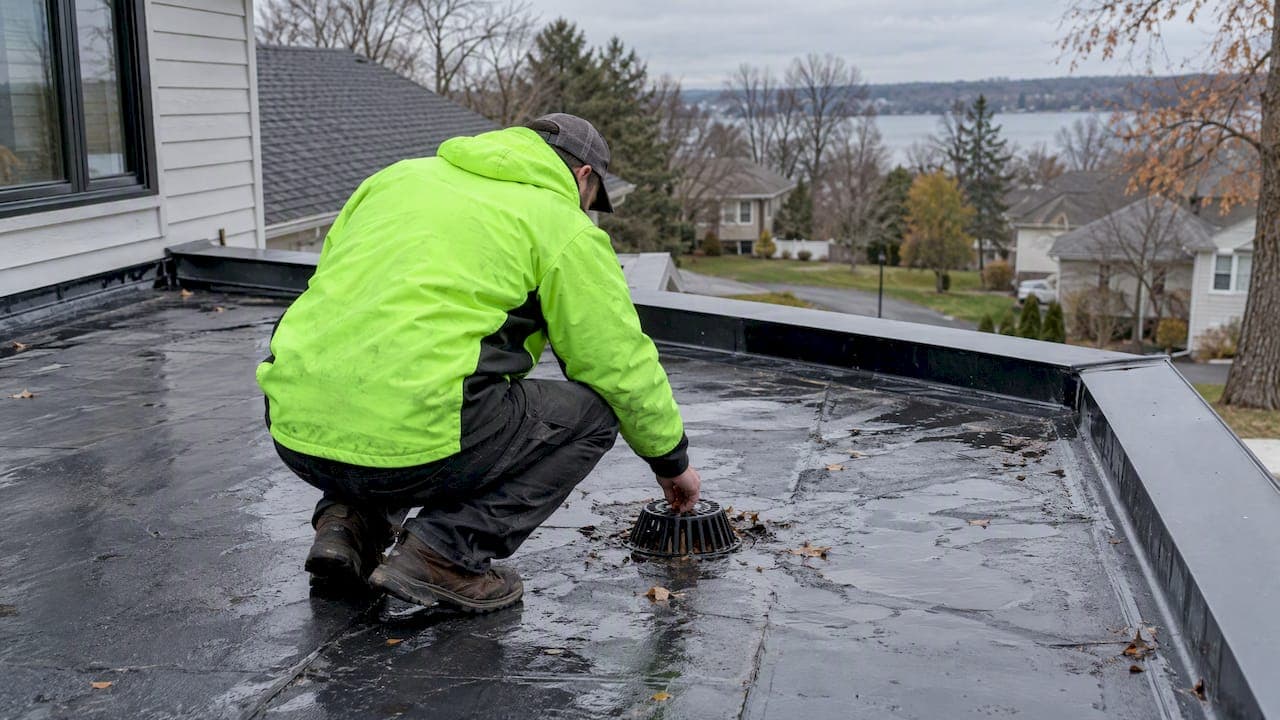
Drainage deserves its own emphasis. ARMA advises inspecting low-slope roofs at least twice a year and keeping drains, scuppers, and gutters clear to prevent ponding and premature membrane degradation. Standing water adds weight, speeds up wear, and finds every weak seam. Our owner's guide to flat roof drainage goes deeper on drains, scuppers, and slope.
Contractor selection comes down to evidence. Look for owner supervision on the job, documented flashings, seam testing, and references you can call. A contractor who answers these questions easily has probably done the work many times.
Pro Tip: Ask each contractor for photos of seam welding or pull tests from a past job. If they cannot show any, treat that as a warning.
How should you maintain a flat roof, and how long will it last?
A flat roof rewards routine attention. Most of the work takes minutes, and skipping it is how small issues become expensive ones.
Build these tasks into your routine:
- Clear drains, scuppers, and gutters so water leaves the roof instead of sitting on it.
- Remove debris such as leaves, branches, and loose gravel.
- Spot-check seams and flashings for lifting, cracking, or gaps.
- Inspect after heavy storms, since wind and hail can damage a roof without obvious signs from below.
- Limit foot traffic on membranes that are not rated as walkable.
On schedule, ARMA's guidance is to inspect at least twice a year, in spring and fall, and the agency identifies keeping drains, scuppers, and gutters clear as the single most critical maintenance task for low-slope roofs. This Old House also emphasizes regular maintenance and professional inspections.
Plan your calendar: ARMA recommends inspecting low-slope roofs at least twice a year, spring and fall, and keeping drains, scuppers, and gutters clear to prevent ponding and membrane degradation.
On lifespan, no neutral source in our research gives a clean, universal range for each material, and real life varies with climate, workmanship, and upkeep. So treat any number you hear as conditional. We can say what shortens a roof's life: ponding water, poor seams, and unnecessary foot traffic. We can also say what the sources support: EPDM can last up to 50 years in some cases per This Old House, which is the best case, not the norm. For TPO specifically, our post on TPO roof lifespan and tests homeowners can use explains what to look for as the roof ages. For every other material, ask your contractor for the manufacturer's stated service life and warranty term in writing.
What do flat roofs cost, and what do warranties cover?
Cost per square foot varies a lot, so use ranges as a starting point, not a quote. This Old House gives typical flat-roof costs of $7–$13 per square foot depending on material. Your own number can land outside that range because of the factors below.
What moves the price:
- Substrate preparation: A damaged or wet deck must be repaired or replaced first.
- Insulation: Adding or upgrading insulation raises the cost and the energy benefit.
- Roof complexity: Many penetrations, curbs, and transitions mean more flashing labor.
- Access: Hard-to-reach roofs take longer and cost more.
- Drainage corrections: Tapered insulation, new drains, or scuppers add to the bill but protect the roof.
On warranties, there are two kinds, and you want both. A manufacturer warranty covers the material, and terms vary by product. For example, Roofing Contractor notes that self-adhering peel-and-stick options often come with 10-year manufacturer warranties. A workmanship warranty comes from the installer and covers the installation itself. Since installation drives most failures, the workmanship warranty is often the more useful one in practice.
Protect yourself with these steps:
- Get itemized estimates that separate materials, labor, insulation, and drainage work.
- Get warranty documents in writing, including scope, duration, and any maintenance requirements that keep coverage valid.
- Document the existing condition with dated photos before work starts, which also helps if an insurance claim comes up later.
For a sense of what our own projects cost, our published roof replacement range is $7,500–$18,000 one-off, and you can read more on our roofing services page.
How do you compare estimates and choose a flat roof system?
Turn everything above into a short sequence you can follow.
- Define the roof's use. Decide whether it will be walkable, a deck, or home to solar panels, since that shapes which materials work.
- Shortlist materials for your climate and use. Use the overview earlier in this article to narrow to two or three families.
- Collect two or three detailed estimates. Each should name the seam method, the flashing approach, and the drainage fixes, not just a total.
- Ask the hard questions. Request proof of seam welding or pull tests, the exact warranty scope and duration, who supervises the work, and how drainage will be corrected.
- Compare documentation, not just price. The estimate that explains its method and shows past work is usually the safer one.
When two bids differ sharply, find out why. A low number often means a missing drainage fix, thinner material, or no seam testing. If the roof is a replacement, revisit our flat roof replacement options guide before you decide.
Pro Tip: Prioritize documented workmanship and drainage corrections over the lowest bid. A cheap roof that ponds water costs more over time than a well-built one.
What most flat roof advice gets wrong
The usual advice treats this as a shopping decision: pick a material, pick a color, pick a price. That framing leaves out the factor that does the most damage when ignored. In my experience, homeowners spend weeks comparing membranes and minutes asking how the seams will be made or where the water will go. Reverse that ratio. A reasonable material installed with care, drained properly, and inspected twice a year will serve you better than a premium material installed in a hurry. We run owner-supervised installations and document our work for exactly this reason, and our experience as an owner-operated company points to the same lesson on every job. If you want company-authored detail, start with our posts on TPO requirements, flat roof drainage, and replacement options.
— Heather
A flat roof done right starts with a free inspection
If your flat roof is leaking, ponding, or aging, we can help you sort out whether a repair or a replacement makes sense. We install and repair flat and low-slope roofs, including TPO and standing-seam metal, and we handle emergency leak repair and storm damage inspections. Because our installations are owner-supervised and documented, you can see what went under the finished surface, which supports warranty and insurance outcomes. Schedule your free inspection or estimate and we will walk the roof with you.
FAQ
What are the different types of flat roofs available?
Homeowners typically choose among single-ply membranes (EPDM, TPO, PVC), asphaltic multi-ply systems (built-up roofing and modified bitumen), metal, and specialty systems such as spray foam, liquid-applied coatings, and green roofs. IKO's guide lists these same families. The right one depends on climate, roof use, and budget.
What are the differences between modified bitumen and EPDM roofing systems?
Modified bitumen is a multi-layer, asphalt-based system with polymers added for flexibility. EPDM is a single-ply rubber membrane that is simpler to install and repair. Both appear among the common families described by This Old House, and installation quality matters for each.
Are flat roofs cheap?
Flat roofs can cost less than some other roof styles, but price depends on material, roof complexity, and the prep work needed. This Old House cites typical costs of $7–$13 per square foot depending on material. Drainage corrections and insulation can raise that figure.
What are two common types of metal roofing?
Standing-seam panels, with raised seams that keep fasteners out of the weather, are a common choice for low-slope homes. Corrugated or ribbed exposed-fastener panels are another widely used type. Pitch and finish affect which one suits your roof, so confirm both with your installer.
How often should I inspect a flat roof?
Inspect at least twice a year, in spring and fall, and after severe weather. ARMA also stresses keeping drains, scuppers, and gutters clear to prevent ponding.
Sources
- Low-Slope Inspection & Maintenance – Asphalt Roofing Manufacturers Association (ARMA)
- PVC Popularity | Roofing Contractor
- Some Commonsense Rules for Maintaining a Flat Roof - This Old House