
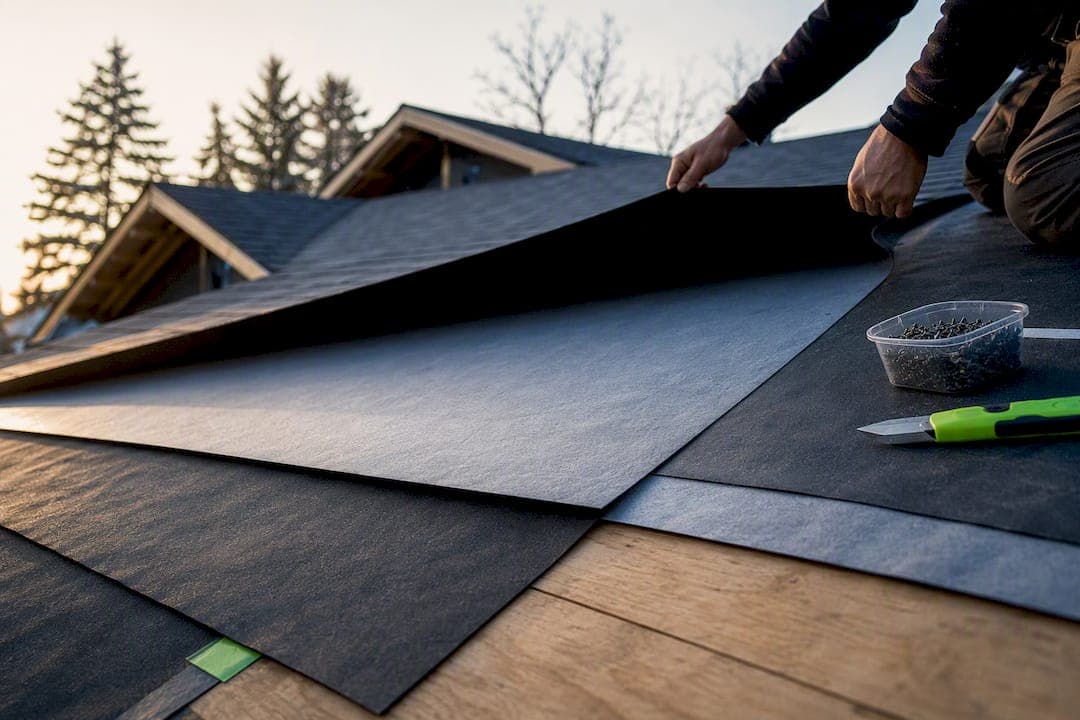
The three underlayment types you'll be choosing between are asphalt-saturated felt, synthetic sheets, and self-adhered rubberized membranes. Most professional roofers now default to synthetic underlayment across the entire roof deck, with self-adhered membrane reserved for eaves and valleys. Felt still works for tight budgets or same-day jobs, but code requirements and workmanship decide whether any of these hold up.
TL;DR:
- Synthetic underlayment is now the standard choice for most roofs due to its higher tear resistance and longer exposure tolerance compared to felt.
- Self-adhered membranes are essential for vulnerable roof zones like eaves and valleys because they offer full waterproofing and seal around penetrations.
- Local building codes require self-adhered ice barriers in cold climates and specific ASTM labels to ensure proper performance and warranty coverage.
- Proper installation, including correct overlap and fastening, is critical to prevent leaks and failure, regardless of underlayment type.
- Costs and lifespan vary widely: felt is cheapest but short-lived, synthetic costs more but lasts longer, and self-adhered membranes are the most expensive but offer the best protection.
Table of Contents
- What Are the Different Roof Underlayment Types?
- Roof Underlayment Comparison: Cost, Waterproofing, and Durability
- What Do Building Codes Require for Roof Underlayment?
- How to Choose the Right Underlayment for Your Roof
- Installation Mistakes That Undermine Even the Best Underlayment
- What Does Roof Underlayment Cost and How Long Does It Last?
- Why Workmanship Decides More Than the Underlayment Label
- Get Your Underlayment Specified and Installed Correctly
- Sources
What Are the Different Roof Underlayment Types?
Each underlayment type is built from a different material, and that material dictates where it belongs on your roof.
Asphalt-saturated felt is the traditional choice: paper or fiberglass mat soaked in asphalt. It comes in two weights, 15-pound and 30-pound, referencing older measurement standards rather than actual pound weight. Felt carries ASTM D226 and D4869 labels, and both versions have strict exposure limits. Leave it uncovered too long in the sun and it dries out, curls, and tears.
Synthetic underlayment replaced felt on most modern roofs for good reason. Made from woven polypropylene or polyethylene, it's lighter, tears less easily, and resists fungal growth in ways felt simply can't. Synthetic sheets typically fall under ASTM D6757 and tolerate weeks of sun exposure without degrading, which matters when weather delays the shingle install.
Self-adhered membranes, also called peel-and-stick or ice-and-water shield, are rubberized asphalt or modified bitumen with an adhesive backing under ASTM D1970. They bond directly to the deck and self-seal around nail penetrations, making them the closest thing to a fully waterproof layer available for residential roofs. This is why they're the standard choice for eaves, valleys, and any spot where water tends to pool or backflow.
A few specialty variants matter depending on your roof covering:
- Breathable synthetic underlayments let moisture escape under wood shakes, preventing deck rot.
- High-temperature, non-asphaltic underlayments are often required under standing seam metal roofing, since standard asphaltic products can soften against hot panels.
- Self-adhered membranes double as the ice barrier code requires in cold climates.
Roof Underlayment Comparison: Cost, Waterproofing, and Durability
Felt, synthetic, and self-adhered membranes trade off cost against protection in predictable ways, and that trade-off is really the whole decision.
Felt is the cheapest option but the least forgiving. It resists water rather than blocking it outright, and it can't sit exposed on the deck for more than a few days before UV and weather start breaking it down. Synthetic underlayment costs more per square but tolerates weeks of exposure, resists tearing underfoot, and shrugs off wind uplift better during construction. Self-adhered membrane sits at the top of the price range and the top of the performance range: fully waterproof, self-sealing at fastener holes, and built for the roof's most vulnerable seams.
Quick comparison:
- Water resistance: Felt is water-resistant; synthetic is water-resistant to highly water-resistant; self-adhered is fully waterproof.
- Exposure tolerance: Felt lasts days in sun exposure; synthetic can last weeks; self-adhered varies by product but is generally installed and covered quickly at targeted zones.
- Tear strength: Felt tears easily when walked on; synthetic resists tearing significantly better, a difference the InterNACHI underlayment guide attributes directly to its woven polymer structure.
- Durability in wet zones: Felt can degrade under standing water; synthetic performs better but isn't waterproof; self-adhered handles standing water and ice dams without failing.
The pattern is consistent across every category: felt is the budget option, synthetic is the durable all-rounder, and self-adhered is the specialist for water-prone areas.
What Do Building Codes Require for Roof Underlayment?
Your local building department, not personal preference, sets the floor for underlayment requirements. IRC Section R905.1.1 governs how underlayment is applied based on roof slope, and it's the single most important reference to bring up with any contractor.
Here's what that code section actually controls:
- Slope thresholds determine whether you need a single layer or a double layer of underlayment, and steeper roofs generally allow lighter coverage than low-slope sections.
- Ice barrier zones in cold climates require self-adhered membrane extending a set distance up from the eave, specifically to stop ice dams from forcing water under the shingles.
- ASTM labels matter beyond the code minimum: D226 and D4869 cover felt products, D6757 covers most synthetics, and D1970 covers self-adhered membranes. A product without the right label isn't code-compliant for that application, regardless of how it looks or performs.
Manufacturer shingle warranties frequently demand more than code minimums. Some voided warranties trace back to using the wrong underlayment class, not a defective shingle. Always check warranty fine print before assuming code compliance is enough.
How to Choose the Right Underlayment for Your Roof
Start with three facts about your house: roof slope, climate exposure, and the covering you're installing. A steep asphalt shingle roof in a moderate climate has different needs than a low-slope section prone to ice damming or a metal roof that needs heat-tolerant material.
- Match the field product to your climate. Synthetic underlayment is the sensible default for most of the roof deck in nearly every region.
- Identify vulnerable zones first. Valleys, eaves in ice-dam-prone areas, skylights, chimneys, and low-slope transitions all call for self-adhered membrane, regardless of what covers the rest of the field.
- Ask for the ASTM label and product name in writing. A verbal promise of "synthetic underlayment" means nothing if the invoice doesn't specify the product.
- Confirm exposure rating and installation timeline. If your project might sit exposed for more than a few days, felt is the wrong choice.
- Check warranty language before signing. Some shingle manufacturers require a specific underlayment class to keep the warranty valid.
Pro Tip: Ask your contractor to put the installation sequence and flashing details in writing before the crew starts. A one-page spec sheet showing where self-adhered membrane goes versus synthetic costs nothing and settles disputes before they happen.
Installation Mistakes That Undermine Even the Best Underlayment
The material matters less than most homeowners assume. Installation sequencing, fastening, and overlap decide whether any underlayment performs as designed.
Exposure tolerance differences explain why synthetic dominates modern roofs: it can sit uncovered for weeks without failing, giving crews flexibility when weather or scheduling delays the shingle install. Felt doesn't offer that grace period. Proper installation calls for consistent overlap at every seam, correct fastening patterns, and self-adhered membrane pressed firmly enough to seal fully around every nail penetration.
Common failure points include:
- Leaving felt exposed too long, causing it to curl and tear before shingles ever go on.
- Skipping or shorting the overlap at seams, which creates a direct path for wind-driven rain.
- Using standard asphaltic underlayment under metal panels, where heat can cause softening or off-gassing.
- Skipping breathable underlayment under wood shakes, trapping moisture against the deck.
Pro Tip: Low-slope sections, valleys, and any roof-to-wall transition deserve extra scrutiny during a roof inspection. These are the spots where a rushed installation shows up as a leak within the first year, not the tenth.
What Does Roof Underlayment Cost and How Long Does It Last?
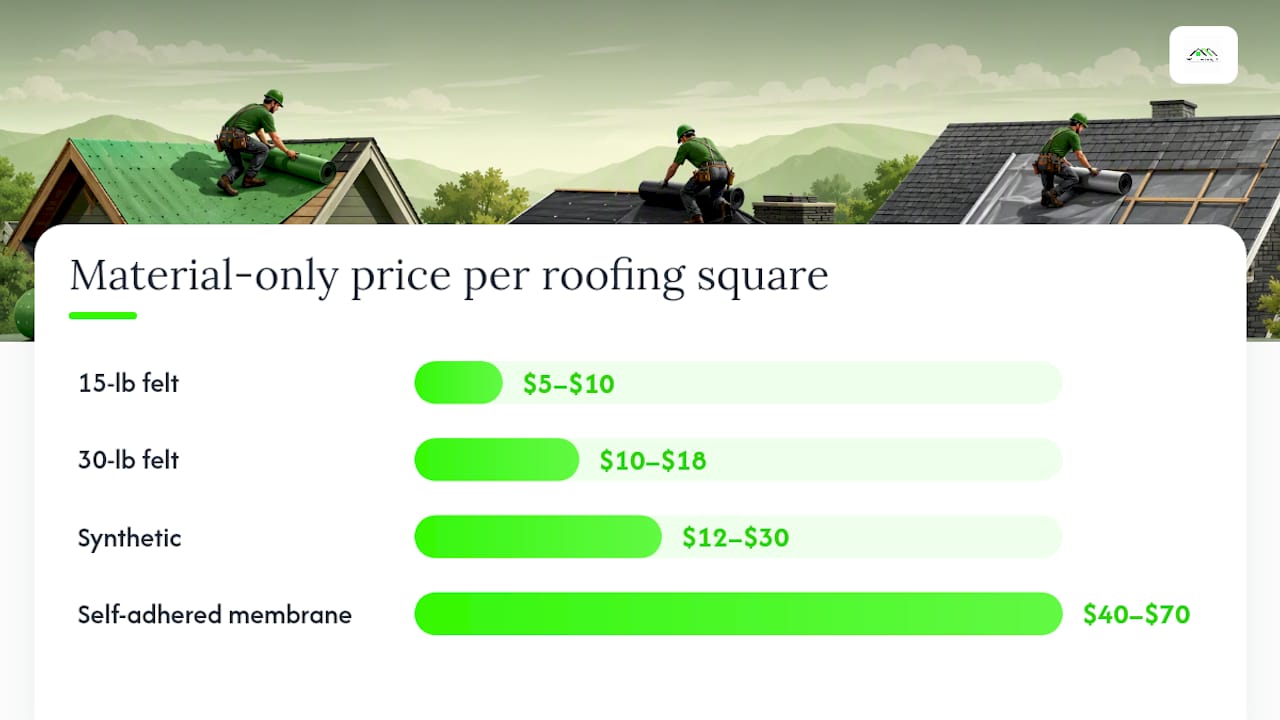
Material-only pricing per roofing square (100 square feet) varies substantially by type. The Roofing Brief's 2026 pricing data puts 15-pound felt at $5 to $10, 30-pound felt at $10 to $18, synthetic underlayment at $12 to $30, and self-adhered membrane at $40 to $70.
Installed costs run higher once labor, roof complexity, and low-slope premiums enter the picture. Steep, cut-up roofs with multiple valleys and penetrations take longer to install correctly and cost more in labor than a simple gable roof, regardless of which underlayment goes down.
Lifespan tracks closely with material quality and installation care. Felt underlayment often needs replacement alongside the shingles it sits under, sometimes sooner if it was exposed too long during installation. Synthetic underlayment generally outlasts felt by a wide margin, and self-adhered membrane, when installed correctly, can last as long as the roofing system itself.
Why Workmanship Decides More Than the Underlayment Label
Most roof failures diagnosed by experienced roofers over many years trace back to installation shortcuts, not underlayment quality. A correctly sequenced install, synthetic in the field, self-adhered at every valley and eave, outperforms a premium product installed carelessly. That's the real lesson behind every code requirement and ASTM label. For related guidance, check the asphalt shingle lifespan breakdown on the Am-exteriors blog.
— Heather
Get Your Underlayment Specified and Installed Correctly
Reading about ASTM labels and exposure ratings only gets you so far. What actually protects your home is a crew that specifies the right product for each part of your roof and installs it the way the code and the manufacturer warranty require. Am-exteriors has spent over 25 years doing exactly that across Southeast Wisconsin roofs facing hail, high wind, and heavy snow.
When Am-exteriors handles a roof replacement, that means synthetic underlayment across the field, self-adhered membrane at every eave and valley, and documentation showing exactly what went into your roof before the shingles covered it. If storm damage is part of the picture, experienced roofers often assist with insurance claims to help homeowners understand adjuster language. Request an inspection and get a written spec for your roof before your next reroof or repair.