
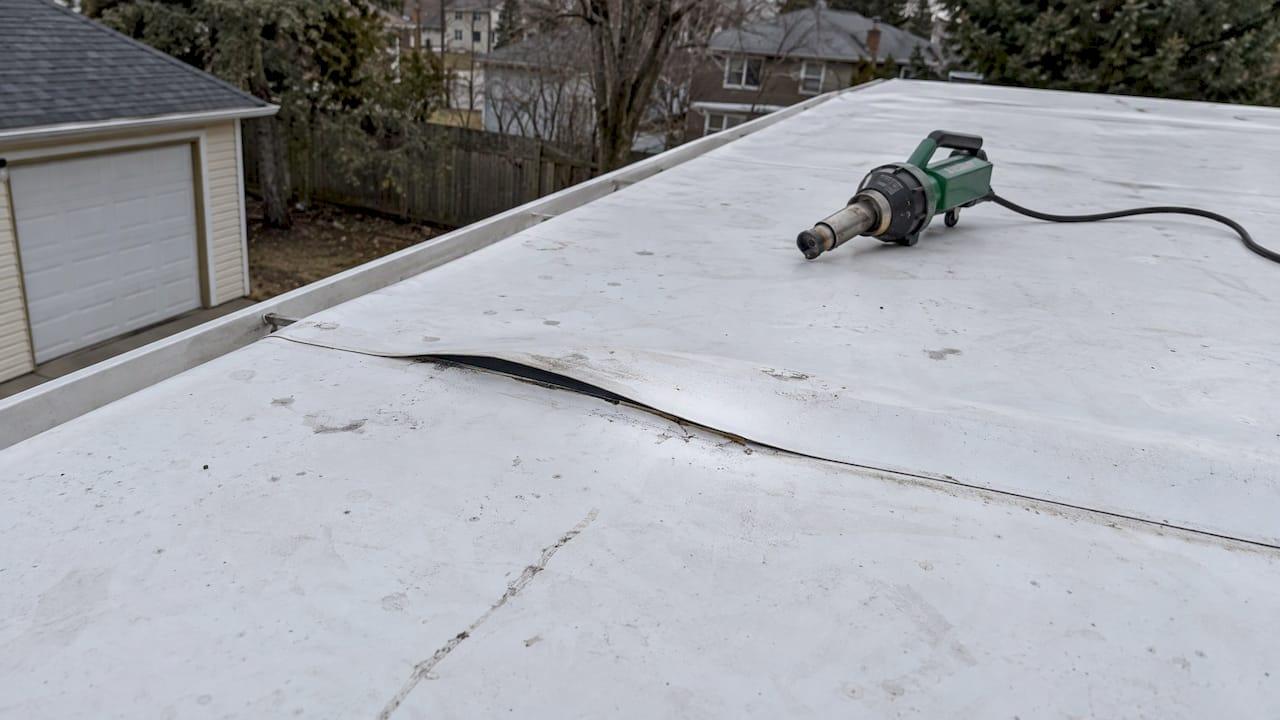
A TPO seam fails when the heat weld joining two membrane sheets never fully fused or has since opened. Most failures trace back to how the seam was welded, not to the membrane. A failed seam can be repaired by cleaning it and heat-welding it again, or by welding a new TPO strip over it. A glued fix is not a lasting repair. If the seam is open and water is coming in, call a roofer before the next rain.
TPO is a single-ply flat-roof membrane. Sheets are laid side by side and joined with hot air. Those joints are the seams. This page explains why they fail, what you can see from the ground or a window, and what a proper repair looks like. If you have a TPO roof in Southeast Wisconsin, we can inspect it.
TL;DR
- Most TPO seam failures start as cold welds: seams that were not fully fused when installed.
- Dirt, rushed setup, wrong heat and T-joint spots are the usual causes.
- Seam repair needs heat welding. Adhesive and sealant are not a weld.
- A short open section can often be re-welded. Wide or repeated failures point to a bigger fix.
- Water inside the home is a reason to act now, then document it.
Table of Contents
- What a TPO seam is and why it matters
- Why TPO seams fail
- Signs of a failed TPO seam
- How a leak is traced to a seam
- Can a failed TPO seam be repaired?
- Spot repair or bigger fix?
- How to prevent seam failures
- Insurance and seam failures
- Promo: TPO and flat roof work in Southeast Wisconsin
- Our perspective
- FAQ
- Sources
What a TPO seam is and why it matters
TPO stands for thermoplastic polyolefin. The membrane comes in rolls. Installers overlap the edges and melt them together with a hot-air welder. When the weld is good, the two sheets act as one.
The seam is the weakest point of the roof for a simple reason: everything else is one continuous sheet. The seam depends on workmanship. Heat, speed, pressure and a clean surface all have to be right.
On a home, TPO usually covers a flat or low-slope section: a porch, an addition, a garage, a dormer roof or a whole low-slope house. Water has little slope to leave by, so a bad seam is tested every time it rains or the snow melts.
Why TPO seams fail
Cold welds
A cold weld is a seam where the two layers touched but did not fuse. It can look fine on the day. A National Research Council of Canada study of TPO membranes notes that cold welds occur frequently in TPO. It also describes a narrow welding window: too little heat leaves a cold weld, and too much scorches or burns through the membrane.
The same study flags the spots where robotic welders start and stop, and the T-joints, where three layers meet, as especially critical. Re-welding after the membrane has been in the sun is described as problematic.
Dirt and residue in the lap
A membrane maker's technical article says contaminants such as dirt or adhesive overspray in the seaming area lead to cold welds that remain a significant cause of leaks and warranty claims. A seam welded over dust can look sealed and still peel.
Hard-to-read welds
One manufacturer's comparison of PVC and TPO points out that TPO does not show the visible bleed-out at the seam edge that PVC does. It also needs a wait time before the seam can be probed. That makes cold welds easy to produce, and a seam that is not watertight can eventually leak. The installer cannot judge the weld by eye alone. The weld has to be tested.

Other contributors
The same patterns show up in roofing practice: rushed setup, weak power from a generator, skipped probe checks, and stress at flashings and corners. Foot traffic, wind lifting an edge, and ponding water add load to a seam that was marginal from the start.
Our view: most seam failures are workmanship failures. That matches what the owner of AM Exteriors has seen over 25 years on roofs: installation quality decides whether a roof lasts.
Signs of a failed TPO seam
You will not always see the seam itself. Look for these:
- Stains on the ceiling below the flat section, especially after rain or a thaw.
- A lifted edge along a lap line, or a ripple in the membrane.
- A fishmouth: an open, curled edge that gapes.
- Water pooling near a seam, with damp insulation underneath.
- Bubbles or soft spots that feel spongy underfoot.
- A seam that opens when probed. A roofer slides a blunt probe along the lap edge. If the tip slides under, the weld is open.
Stay off a wet or icy roof. If you can only see the roof from a window or ladder, take photos and leave the probing to a roofer.
How a leak is traced to a seam
A stain inside rarely sits under the hole. Water travels along the deck and insulation before it shows up. Finding the source takes steps:
- Start at the seams, flashings and edges. These are the usual entry points on a flat roof.
- Probe the accessible seam edges. This shows whether the weld is continuous.
- Test one area at a time. Water testing a section at a time is the way to confirm where water gets in. Infrared scans only suggest where moisture may be.
- Check the insulation. If wet insulation sits under a seam, it has to be dealt with. Heat welding a patch over wet material only hides the problem.
If the leak showed up soon after a new roof was installed, read our five same-day steps for a new roof leak. The first hours matter for protecting the interior and for your paperwork.
Can a failed TPO seam be repaired?
Yes, when the membrane around it is sound. The repair has to restore a continuous, watertight surface. Covering the visible gap does not do that.
Why heat welding, not glue
TPO is joined by heat. One manufacturer's installation manual requires that all field seams be heat-welded. It sets a minimum 1.5-inch weld for a robotic welder and a minimum 2-inch weld, made in two passes, for a hand welder. TPO flashings must be hand-welded too. Mastic, roof cement and tape can slow a drip for a few days. They do not bond the sheets, and they get in the way of the repair that follows.
What a proper repair involves
- Find the whole open length. The visible gap is often shorter than the real one.
- Dry the area. Remove wet or damaged insulation.
- Clean the membrane. Dirt and old residue have to come off so the surface can weld.
- Re-weld the seam or weld a cover strip. A patch of new TPO is welded over the damaged area, extending past it on every side, with rounded corners.
- Probe the finished weld. Check the whole length once it has cooled.
- Photograph the work. You should have a record of where and what was done.
On an older roof the membrane may be too aged to take a clean weld. In that case a roofer will tell you before work starts.
Spot repair or bigger fix?
| Situation | Likely answer |
|---|---|
| One open seam, membrane in good shape, dry insulation | Clean and re-weld, or a welded cover strip |
| Open seam at a T-joint or flashing | Welded patch, with the corner detail rebuilt |
| Several seams opening across the roof | Inspect all seams. Plan wider repair |
| Wet insulation under the seam | Remove and replace the wet insulation, then weld |
| Thin or brittle membrane, repeated leaks | Compare repair cost to replacement |
| Roof is too thin for a home (see below) | Replacement with a heavier membrane |
The pattern matters more than the single leak. One failure from one weak spot is a repair. Failures spread along the roof suggest a welding problem across the whole job. A honest roofer will tell you which you have.
Our article on residential TPO thickness and seam testing explains why a 60 mil membrane and seam testing matter on a home. Our guide to TPO roof lifespan and tests homeowners can use covers how long a sound roof should last and what a good roofer checks.
How to prevent seam failures
Prevention happens at installation. Once the roof is covered, you cannot fix a cold weld you do not know about. Ask for these:
- Seam probing on the whole roof, not a sample of it.
- Clean laps before welding, and no welding in rain or on wet membrane.
- Careful T-joint work. The study above names these spots as critical.
- Photos of the work as it goes.
- A written scope that names the membrane thickness and the warranty.
- Drainage that works. Standing water adds load to every seam. See our guide on why drainage beats materials on flat roofs.
Our homeowner's checklist of roof installation mistakes and our list of roofing contract red flags help you read a quote before you sign.
Insurance and seam failures
Two cases look alike but are handled differently. Storm damage, such as hail, a tree limb or wind lifting an edge, may be covered by your homeowner's policy. A seam that failed because it was poorly welded is a workmanship issue, and it falls under the installer's warranty. Which applies depends on your policy and your contract. Read both, and call your insurance company or agent with questions about coverage. If a storm is involved, we help homeowners work through the claim and document the damage.

Promo: TPO and flat roof work in Southeast Wisconsin
We install TPO flat and low-slope roofing, repair roofs, and handle storm damage and leaks for homeowners in Dodge, Washington, Fond du Lac and Ozaukee Counties and the surrounding area. Installations are owner-supervised, and we document the work.

If a seam is open or a ceiling is stained, see our roofing services. For an active leak, use our emergency roof and leak repair page. Planning a full roof? Our Wisconsin roof replacement cost guide lists replacement ranges. Replacement for a roof runs $7,500 to $18,000 as published on our site.
Our perspective
Most of the leaks we are called to on flat roofs are not about the membrane. They are about the seam, and the seam is about the person who welded it.
A weld that is rushed, welded over dirt, or never probed will hold for a while and then let go. That is why we put an owner on the job and keep records of the work. A homeowner should be able to see what was done on their roof.
We also give honest repair or replacement advice. If one seam can be re-welded and the rest of the roof is sound, that is the right job. If the membrane is the problem, we say so and explain why.
When a storm is behind the damage, we help with the insurance claim so you are not working it out alone.
Heather
FAQ
Can a failed TPO seam be patched?
Yes. The area is cleaned and a patch or strip of new TPO is heat-welded over it. It has to extend past the damage on all sides and make a continuous weld. Sealant alone is a short-term stop.
Can TPO be glued down?
TPO seams are joined by heat, and manufacturer manuals require heat-welded seams. Adhesive can secure the membrane to the roof surface in some systems, but a seam repair needs a weld. Ask your roofer how the seam will be repaired.
How long does a TPO roof last?
It depends on membrane thickness, installation quality, climate and upkeep. Our TPO lifespan article explains the range and what affects it. Failed seams shorten the life of a roof that would otherwise last.
How do I know if my roof is TPO?
TPO is a white, tan or gray single-ply sheet with welded seams. It is common on flat and low-slope sections. A roofer can confirm the material and thickness from a short inspection or from your install paperwork.
Is a leaking TPO seam an emergency?
Treat it as urgent. Water in the insulation spreads and damages the deck and ceiling. Move belongings, catch drips, take photos and call a roofer. Our emergency roof repair team serves Dodge County and nearby areas.
Sources
- Thermoplastic Polyolefin Roofing Membranes, National Research Council Canada
- Roofing Sikaplan versus TPO
- SpecTips: Reduce TPO Cold Welds and Ensure Stronger Seams
- Innovi TPO installation manual