
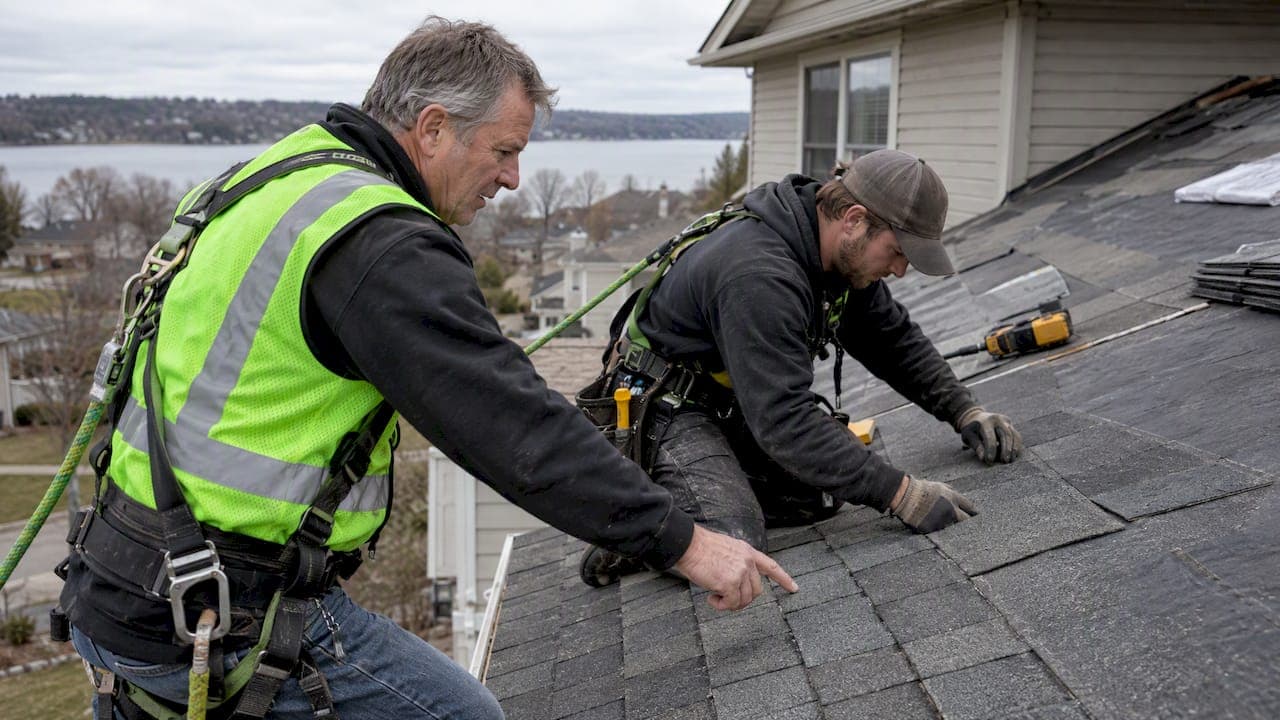
An owner-operated roofer gives you one person who is accountable for your roof. The owner sells the job, supervises the crew and answers the phone after the job is done. That means fewer lost details, clearer paperwork and someone who stays in your community. Below you will find what that looks like in practice, what to ask, and where an owner-operated company is not automatically better.
TL;DR
- The person who quotes your roof is the person who answers for it. Sales promises do not get lost between the office and the crew.
- Most roof failures come from poor installation, not bad shingles. Owner supervision targets that risk.
- An owner who lives and works nearby has a reason to protect their name. Storm chasers do not.
- Ask any roofer for proof: Wisconsin dwelling contractor certification, insurance, a written line-item quote and a written workmanship warranty.
- After a storm, do not sign before your insurer's adjuster has seen the damage.
Table of Contents
- What "owner-operated" means for a roofing company
- Benefit 1: One person is accountable
- Benefit 2: Better installation, which is where roofs fail
- Benefit 3: Workmanship is backed in writing
- Benefit 4: A local name that stays
- Benefit 5: Honest repair or replace advice
- Benefit 6: Help with insurance claims
- Benefit 7: Clear communication and records
- Our perspective: why the owner matters on the roof
- How to check any roofer, owner-operated or not
- Owner-operated vs. large sales-driven company
- What a roof, siding or window project costs with us
- Work with an owner-operated roofer in Southeast Wisconsin
- FAQ
- Sources
What "owner-operated" means for a roofing company
Owner-operated means the owner is part of the daily work. They are not an investor, a franchise holder or a name on a sign. They visit job sites, make decisions and take the calls when something goes wrong.
That is different from a large sales-driven company. There, the person who sells the roof is often not the person who installs it. Industry professionals point to this gap as the main weakness of those models. Promises made at the kitchen table about nailing, flashing or ventilation may never reach the field crew. An owner-operated firm keeps control of the whole process, so this "missing link" risk is lower.
We are an owner-operated company. AM Exteriors LLC is Wisconsin-based and has more than 25 years of owner-operated experience in roofing, siding and windows. We serve Dodge, Washington, Fond du Lac and Ozaukee counties and the surrounding area in Southeast Wisconsin.
Benefit 1: One person is accountable
When something is wrong with a roof, you want one name. Not a call center. Not a ticket number.
With an owner-operated roofer:
- The estimate comes from someone who will see the job through.
- Scope changes are decided by the person who can approve them.
- A complaint goes to the person whose reputation is at stake.
- Questions after the final walkthrough get an answer from someone who knows your house.
This is the simplest benefit and the most useful. It costs nothing extra to ask about it. Ask: "Who will be on my roof, and who supervises them?"
Benefit 2: Better installation, which is where roofs fail
Many homeowners spend most of their time comparing shingle brands. The installation matters more.
Experts say most roofing failures come from improper installation, such as incorrect nailing patterns or ventilation errors, not from material defects alone. One industry analysis of failure patterns, published by RoofPredict, also ties early granule loss to rework costs that add up fast.
That is why we put installation quality first. We use premium products, including Malarkey shingles and LP SmartSide, but a good product installed badly still fails.
Owner supervision helps here in plain ways:
- The owner checks the details that homeowners cannot see once the job is done: underlayment, flashing, nailing, ventilation.
- The same crew leaders work with the owner job after job.
- Mistakes cost the owner directly, so they are fixed.
Questions to ask about workmanship
- Who inspects the roof before the crew leaves?
- How are nailing patterns and ventilation checked?
- Will I get photos of the work at each stage?
- What does your written workmanship warranty cover, and for how long?
A good roofer answers these without hesitation.
Benefit 3: Workmanship is backed in writing
A manufacturer warranty and a workmanship warranty are not the same thing. Many homeowners assume one covers everything.
- Manufacturer warranty: covers the material. Terms and duration are set by the manufacturer.
- Workmanship warranty: covers the installation. It comes from the contractor.
- System warranties: some manufacturer programs cover both materials and installation quality, and are backed by the manufacturer rather than only the contractor's staying in business.
The details differ a lot: labor coverage, tear-off coverage, proration and transfer to a new owner. Our guide to roofing warranty types explains what to check on each. For a wider view of how warranties are structured and why the fine print matters, this guide on how builder warranties work is a useful read.
Owner-operators often differentiate themselves on the workmanship side, because the warranty is a direct promise on their own craft. Always read it before you sign. Ask what is excluded and what you must do to keep it valid.
Benefit 4: A local name that stays
After a hail or wind storm, out-of-area crews arrive and knock on doors. Some are reputable. Others take a deposit, do a rushed job and leave. Wisconsin took notice: Wisconsin Act 230 was signed on April 9, 2026, and it is aimed at high-pressure tactics from door-to-door storm contractors.
An owner who lives and works in the same community has a different incentive. Neighbors talk. Reviews stay. The owner will drive past your house for years.
This is not a guarantee. A local company can still be a poor one. It is a reason to look closer at local companies first, and then verify them.
Benefit 5: Honest repair or replace advice
Not every leak means a new roof. Not every hail event means a claim worth filing.
When the owner is also the estimator, the advice is tied to their name. We give honest repair vs. replacement recommendations. If a repair will do, we say so. If the roof is at the end of its life, we say that too, and we show you why.
A fair recommendation includes:
- Photos of the problem areas.
- The roof's age and the condition of the decking, flashing and ventilation.
- A repair option and a replacement option, each with a written price.
- A plain answer to "What happens if I wait?"
If you suspect hail damage, a free hail damage roof inspection is a low-risk first step. Our post on cosmetic vs. functional hail damage explains what counts for claims.
Benefit 6: Help with insurance claims
Storm claims are where a roofer's experience shows. A contractor who knows claims can document hail, wind and storm damage in the language adjusters use. That helps prevent denials and under-adjustments caused by thin documentation.
We help homeowners navigate that process. We also follow the basic rules the Wisconsin Office of the Commissioner of Insurance gives homeowners in its guide After a Storm Hits:
- Tell your insurance agent or company right away.
- List the damaged items for your adjuster.
- Take clear photos and keep swatches of damaged materials before anything is thrown away.
- Do not feel forced to sign a contract before the adjuster has assessed the property.
- Check that any contractor carries general liability and workers' compensation insurance.
Adjusters need documentation, not speed. Be wary of anyone who rushes you to sign.
More on this in our guides: filing a storm damage insurance claim in Wisconsin, what to photograph after hail and what to do after wind damage.
Benefit 7: Clear communication and records
A roof project is stressful when you do not know what is happening. Owner-operated companies can keep it simple, because fewer people stand between you and the decision-maker.
What good communication looks like:
- A start date and a crew name.
- A daily update or a call if the weather changes the schedule.
- Photos of the work as it is done.
- A final walkthrough.
- Documents you can keep: the contract, the warranty and the work record.
We document our work in detail. That record helps you if you sell the house, file a warranty claim or deal with an insurer later.
Our perspective: why the owner matters on the roof
We have seen the same pattern for 25 years. A roof rarely fails because the shingle was wrong. It fails because a step was skipped, rushed or never explained to the crew.
That is why we stay close to the work. The owner supervises installations. The owner talks to the homeowner before, during and after. The owner stands behind the written warranty.
We also think homeowners should ask hard questions of every roofer, including us. Ask for the certification. Ask for the insurance papers. Ask for a line-item quote. A company that is proud of its work will not mind.
Our clients tell us what they value most: they know who to call, they know what was done, and they were not pushed. That is the standard we aim to keep.
— Heather
How to check any roofer, owner-operated or not
The "owner-operated" label is not proof of quality. Use this checklist.
1. Wisconsin credentials
Wisconsin has no separate state roofing license. But contractors working on one- and two-family homes must hold a Dwelling Contractor certification and employ a Dwelling Contractor Qualifier, under Wis. Stat. § 101.654 as described by the Department of Safety and Professional Services. They must also show proof of financial responsibility: a $250,000 general liability policy or a $25,000 surety bond. Ask for the certification number and check it with the state.
2. Insurance
Ask for a certificate showing general liability and workers' compensation. Ask your insurer or the contractor's agent to confirm it is current.
3. A written, line-item quote
A line-item proposal lists tear-off, underlayment, ice and water shield, flashing, ventilation, shingles, disposal and permit costs. It is your best defense against bait-and-switch pricing. A typical quote for a standard roof should show what is included, as cost guides for a 2,000-square-foot home also illustrate.
4. Manufacturer credentials
If a roofer claims a manufacturer certification, verify it with the manufacturer. Those programs can unlock manufacturer-backed warranties that still stand if a contractor closes.
5. Permits
Some Wisconsin jurisdictions require them and some do not for same-shingle replacements. See our post on Wisconsin roof permits. Ask the roofer who handles it.
6. References and local work
Ask for addresses of recent jobs nearby. Drive by. Our guide on how to choose a roofing contractor in Wisconsin goes deeper.
Owner-operated vs. large sales-driven company
| Question | Owner-operated | Large sales-driven company |
|---|---|---|
| Who sells the job? | Often the owner | Commissioned sales rep |
| Who supervises the install? | Often the owner | Project manager or crew lead |
| Who handles complaints? | Often the owner | Customer service |
| Flexibility on scope | Usually high | Often set by policy |
| Capacity after big storms | Can be limited | Often larger |
| Warranty source | Contractor plus manufacturer | Varies |
The table shows tendencies, not rules. Larger firms can do excellent work. Small firms can fall short. The point is to know where the risk sits and ask about it. One honest trade-off: a small owner-operated company has limited crews. After a major storm, scheduling can take time. Ask for a realistic start date.
What a roof, siding or window project costs with us
Prices vary by size, pitch, materials and condition. These are the ranges published for our work.
| Project | Published range |
|---|---|
| Roof replacement | $7,500 to $18,000 |
| Vinyl siding | $12,000 to $20,000 |
| LP SmartSide | $18,000 to $32,000 |
| James Hardie | $25,000 to $45,000 |
| Insert / pocket window | $700 to $1,100 per window |
| Full-frame window | $1,000 to $1,600 per window |
| Bay / bow window | $3,500 to $7,000 per window |
Roof repair, storm damage roofing, standing seam metal, synthetic slate, cedar shake and TPO flat roofing are quoted after we see the property. Details are on our roofing services page, and the roof replacement cost guide for Wisconsin breaks down what drives the price.
On windows, the U.S. Department of Energy's guide says ENERGY STAR certified replacements can cut energy bills by about 7% to 15%, depending on climate and your existing windows. See our window replacement costs and siding replacement costs.

Work with an owner-operated roofer in Southeast Wisconsin
We handle roof replacement, siding, windows, gutters, storm damage repair and insurance claim help for homeowners in Dodge, Washington, Fond du Lac and Ozaukee counties. Start with a free hail damage roof inspection if you think a storm hit your roof. If you already know what you need, see what we offer or visit am-exteriors.com. You will deal with the owner's team from the first call to the final walkthrough.
FAQ
Is an owner-operated roofer cheaper?
Not always. Price depends on materials, roof size, pitch and scope. Owner-operated firms often carry less sales overhead, but that is not a promise of a lower quote. Compare written, line-item quotes for the same scope.
Does Wisconsin require roofers to be licensed?
There is no separate state roofing license. For one- and two-family homes, the contractor must hold a Dwelling Contractor certification and employ a Dwelling Contractor Qualifier, per the state's DSPS page. Ask to see the credentials before you sign.
Should I call a roofer or my insurer first after a storm?
Call your insurance agent or company right away to start the claim. You can have a roofer inspect and document the damage, but do not sign a contract before the adjuster has assessed the property. Take photos and keep swatches of damaged material first.
What is the difference between a workmanship warranty and a manufacturer warranty?
The manufacturer warranty covers the product. The workmanship warranty covers how the roofer installed it. Some manufacturer system warranties cover both. Read what is excluded, and whether labor and tear-off are covered.
How do I know a roofer will still be around in ten years?
You cannot be sure. Look for years in business, a local office, verified credentials and references you can visit. A manufacturer-backed warranty adds protection if the contractor closes.
Sources
- Wisconsin DSPS: Dwelling Contractor certification
- Wisconsin OCI: After a Storm Hits
- RoofPredict: What Causes Accelerated Granule Loss Failure Patterns
- Jax Roofing: About
- New Wisconsin Law Protects You From Storm Chaser Contractors
- CostPrism: Roof replacement cost, 2,000 sq ft house
- U.S. Department of Energy: Guide to Energy Efficient Windows