
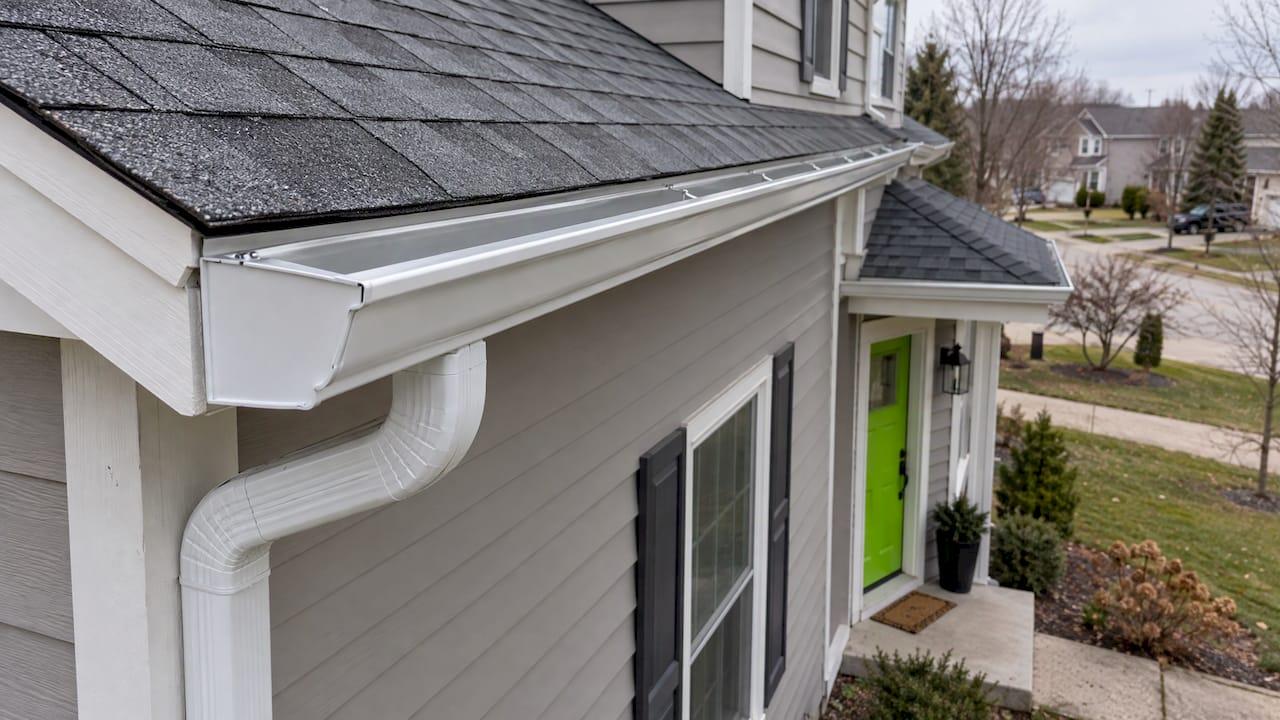
Most Wisconsin homeowners should plan on a few thousand dollars to replace the gutters on a whole house. National figures put the typical range at about $2,000 to $6,000, and the final number depends on how many linear feet you have, the material, the number of stories and what is hiding behind the old gutters, usually the fascia board. This guide shows how the price is built so you can read a quote line by line. We install gutters with our roofing and siding work in Southeast Wisconsin, and gutters are most often replaced together with a roof or siding job.
TL;DR
- Nationally, a full replacement runs about $2,000 to $6,000, with installed prices from $4 to $40 per linear foot depending on material. Large or multi-level homes can reach $10,000.
- Seamless aluminum is the usual choice. It costs more per foot than sectional gutters, but it has no seams to leak.
- Removal of old gutters, extra downspouts, guards and fascia repair are the line items that move a quote the most.
- Wisconsin winters matter: ice adds weight, so hangers and slope affect how long the system lasts.
- Replace when several sections fail, the fascia is rotting or repairs keep recurring. Repair when one section is the problem.
Table of Contents
- What gutter replacement costs: the short version
- Price per linear foot by material
- What a whole-house replacement adds up to
- The add-ons that change the price
- Why Wisconsin winters change the build
- Repair or replace?
- Replace gutters with the roof or siding?
- Storm damage and insurance
- Can you install gutters yourself?
- How to read a gutter quote
- Gutters with AM Exteriors
- Our view on gutter replacement
- FAQ
- Sources
What gutter replacement costs: the short version
Two numbers build every quote: price per linear foot and total linear feet. A single-story ranch might have 120 to 150 feet of gutter. A two-story home with several rooflines can have well over 200 feet. Multiply the footage by the per-foot price, then add the extras covered below.
NerdWallet reports a national average replacement cost of about $2,000 to $6,000, with installation pricing across materials from $4 to $40 per linear foot. Custom, large or multi-level projects can reach $10,000.
These are national figures, not Wisconsin prices. Labor, material costs and the complexity of your roofline set the real number, so treat the ranges as a way to check a quote, not as the quote itself. Prices also shift from year to year with metal costs and labor rates.
Price per linear foot by material
Material is the biggest choice you control. Here is how the common options compare on a typical installed basis.
| Material | Typical installed price | Notes for Wisconsin homes |
|---|---|---|
| Sectional aluminum | About $4 to $8 per foot | Lowest cost, but every joint is a place to leak |
| Seamless aluminum | About $6 to $12 per foot | Most common choice, formed to length with no seams along the run |
| Galvanized steel | Often priced between aluminum and copper | Strong under snow load, can rust if the coating wears |
| Copper | Highest of the common options | Premium look, usually a custom job |
The sectional and seamless aluminum ranges come from HomeGuide's aluminum pricing as reported by The Roofing Brief, which puts seamless at about $2 to $5 more per linear foot than sectional.
Why seamless costs more and often saves money
Sectional gutters are joined in short lengths, and each joint is sealed. According to HomeGuide's seamless gutter guide, sectional gutters typically begin to leak after 3 to 5 years as the sealant ages, and UV exposure and freeze-thaw cycling speed that up. Wisconsin has a lot of freeze-thaw cycling, so fewer joints is a real advantage here.
Seamless gutters are formed from a coil to the length of each run, which leaves joints only at corners and downspout outlets. The extra cost per foot is usually recovered in fewer repairs.
What a whole-house replacement adds up to
Here is a worked example with round numbers. These are illustrations built from the per-foot ranges above, not a quote.
A one-story home with 150 feet of gutter. At $6 to $12 per foot for seamless aluminum, the gutter itself comes to $900 to $1,800. Add removal of the old system, a few downspouts and any trim work, and the total lands in the low thousands.
A two-story home with 220 feet of gutter. At the same per-foot range, the gutter is $1,320 to $2,640. Second-story work takes more time and more safety equipment. One estimating source puts the labor premium for multi-story homes at 15 to 35%.

A large or complex home. Multiple gables, dormers and a walkout lower level raise both footage and labor. This is where totals move toward the $10,000 end of NerdWallet's range.
The point of the exercise: ask for your linear footage in writing. If two quotes disagree, the footage and the downspout count are the first things to compare.
The add-ons that change the price
A bare per-foot price rarely covers everything. Remodeling Expense's 2026 calculator lists these common add-ons, and the figures are a useful checklist for reading an estimate:
- Old gutter removal and disposal: $1 to $3 per linear foot.
- Extra downspouts: $75 to $250 each.
- Gutter guards: $4 to $15 per linear foot.
- Fascia repair: $6 to $20 per linear foot.
- Drainage extensions or splash blocks: $25 to $250 or more each.
For a 150-foot home, removal alone is $150 to $450. Guards on every run could add $600 to $2,250. Neither is wasted money if you need it, but each should appear as its own line so you can decide.
Fascia: the cost most people do not expect
Gutters hang on the fascia, the board along the roof edge. If water has been leaking behind old gutters, that board can be soft. New gutters on rotten wood will not hold. Repair is a separate cost, and it is better to learn about it before the day the old gutters come down. If your fascia, soffit and gutters all need work, soffit, fascia and gutter repair is something we handle together.

Downspouts and where the water goes
A gutter only works if water leaves the house. The number and placement of downspouts matter as much as the gutter itself. Our guide to downspout placement covers run length and how far to discharge away from the foundation.
Why Wisconsin winters change the build
Gutters in the northern half of the country carry ice for long stretches. GutterWorks notes that ice buildup in and on gutters calls for a stronger hanger or more hangers to hold the added weight for an extended time. That is a spec you can see on a quote: hanger type and spacing.
The Roofing Brief says gutter failures are rarely about the metal. They come from slope, hanger spacing and downspout sizing. It cites Englert's guidance of at least a quarter inch of slope per 10 feet and hangers no more than 18 to 24 inches apart. Those two numbers are easy to check on a finished job. Our page on gutter slope explains how it is set.
Ice is also connected to the roof. Gutters that overflow or freeze solid are often part of an ice dam problem. For how winter affects the roof edge, see roof in winter in Wisconsin.
Repair or replace?
Not every gutter problem needs a new system. A practical way to decide:
Repair makes sense when:
- One section leaks at a joint or a corner.
- A single run sags because hangers pulled loose.
- A downspout has come off or is crushed.
- The rest of the system is sound and the fascia is solid.
Replace when:
- Several sections leak, sag or have rusted through.
- Fascia behind the gutters is rotted in more than a spot or two.
- Repairs keep coming back within a season or two.
- The gutters are sectional and old, with sealant failing at many joints.
- Storm damage, such as a fallen branch or hail dents, affects most of the system.
Age alone is not a rule. A well-installed aluminum system can last a long time, and a poorly pitched one can fail early. If you are unsure, an on-site look at the slope, hangers and fascia gives a straight answer. We give honest repair or replacement recommendations, and our gutter repair page covers the smaller jobs.
Replace gutters with the roof or siding?
Gutters, fascia and soffit are usually priced separately from a roof. One Wisconsin roof calculator notes that gutters, soffit and fascia are usually separate from a standard roof replacement. Even so, doing them in one project has a clear logic. The roof edge, drip edge and fascia are exposed during a roof or siding job, so bad wood is easier to find and fix, and new gutters go onto a clean edge. Doing the gutters first and then re-roofing risks damage to new gutters.
If a roof or siding job is already planned, add the gutters to the same scope. See the costs for roof replacement and siding replacement in Wisconsin to plan the whole exterior budget.
Storm damage and insurance
Hail, high winds and falling branches can dent, bend or pull gutters off the house. If the damage came from a storm, your homeowner's policy may cover it. Take dated photos before any cleanup, and do not throw away damaged sections until the claim is settled. Gutters are often part of a larger storm claim that includes the roof and siding, so it helps to have one contractor documenting everything. We help homeowners work through insurance claims, from documenting the damage to the repair itself. Your deductible and your policy terms decide what is paid, so read them or call your insurance agent for coverage questions.
Can you install gutters yourself?
Technically yes. In practice, it is a poor trade for most homeowners. NerdWallet cautions that DIY gutter installation can cause ladder or roof injuries, usually takes more than one person and sometimes needs special equipment. Wrong measurements, pitch or attachment can also damage the house. Seamless gutters are formed on site from a coil by a machine, so they are not a homeowner product at all. For a two-story home, hiring a professional is the safer plan.
How to read a gutter quote
Use this checklist on any estimate you receive:
- Linear footage. It should be stated, with the count of corners and downspouts.
- Material and gauge. Seamless or sectional, aluminum or steel, and the color.
- Hangers. Type and spacing. Winter ice load is why this line matters in Wisconsin.
- Slope. A quarter inch per 10 feet is the benchmark above.
- Removal and disposal. Included or extra.
- Fascia. What happens if rotted wood is found, and what it costs per foot.
- Downspouts and extensions. Number, size and where they discharge.
- Warranty and workmanship. In writing, covering both product and labor.
For more on seamless systems and what to look for, see our seamless gutters guide and the full new gutters cost guide.
Gutters with AM Exteriors
AM Exteriors is an owner-operated exterior contractor with more than 25 years of experience, serving homeowners in Southeast Wisconsin, including Dodge, Washington, Fond du Lac and Ozaukee counties. We install gutters alongside roofing, siding and windows, so the water, the roof edge and the wall are planned as one system. Our installations are owner-supervised, because most exterior failures come from poor workmanship rather than materials.
If you want a quote that lists footage, downspouts and fascia separately, start with our roofing and exterior services.

For a gutter, soffit or fascia repair in Dodge County, go to our repair page. For leaks and storm damage that cannot wait, there is emergency roof and leak repair.
Our view on gutter replacement
Gutters look like a small job, and that is why they get done badly. Most gutter trouble we see on a house traces back to workmanship: a run pitched wrong, hangers too far apart, a downspout that dumps water at the foundation. The metal is rarely the problem.
Our position is simple. Price the whole edge of the house, not just the gutter. That means checking the fascia, the slope, the hanger spacing and where every downspout discharges before anyone writes a number. In Wisconsin, ice load is part of that spec.
We prefer to supervise the installation ourselves and document the work, so you can see what was done. When a repair is enough, we say so. When the whole system has reached the end, we say that too.
Heather
FAQ
How much does it cost to replace gutters on a house in Wisconsin?
National figures put a typical whole-house replacement at about $2,000 to $6,000, with large or multi-level homes reaching $10,000. Installed prices run from roughly $4 to $40 per linear foot depending on material. Seamless aluminum is generally $6 to $12 per foot. Your footage, stories and fascia condition set the final price.
Is seamless worth the extra cost?
For most homes, yes. Seamless aluminum costs about $2 to $5 more per foot than sectional, but it has joints only at corners and outlets. Sectional gutters can start leaking at their seams in 3 to 5 years, and Wisconsin freeze-thaw cycles speed that up.
Should I replace 20-year-old gutters?
Replace them if several sections leak or sag, the fascia is rotting or repairs keep coming back. If the system is sound and pitched correctly, a repair may be enough. An on-site check of slope, hangers and fascia settles it.
Does homeowner's insurance cover gutter replacement?
Often, when the cause is a covered storm event such as hail or wind. Normal wear and age are not covered. Photograph the damage before cleanup and check your deductible. We assist homeowners with the claim process.
Can I install gutters myself?
It is risky. Ladder falls are a real danger, the work needs more than one person, and wrong pitch or attachment can damage your home. Seamless gutters are also formed on site with a machine, so most homeowners hire a professional.
Sources
- NerdWallet: Cost to Install or Replace Gutters
- The Roofing Brief: Seamless vs. Sectional Gutters
- The Roofing Brief: Gutter Installation in 2026
- Remodeling Expense: Cost of Gutters
- GutterWorks: Gutter Installation Check Sheet
- EstimationPro: Gutter Installation Cost Calculator