
Seamless gutters are worth the extra upfront cost for most long-term homeowners because they dramatically cut leak points and cleaning demands. Expect to pay roughly $8 to $14 per linear foot installed, and only a licensed pro with a roll-forming machine can put them up. The sections below cover the actual math on leaks, cost breakdowns by material, and exactly what to check before you sign a contractor's quote.
TL;DR:
- Seamless gutters eliminate 70 to 80% of leak points compared to sectional systems, reducing water damage risks and maintenance needs over time.
- The typical cost for aluminum seamless gutters ranges from $8 to $14 per linear foot, with total installation expenses influenced by size, height, and extra services.
- Proper installation involves specified gauge, sealed corners, riveted joints, and correct hanger spacing, which significantly extends gutter lifespan.
- Damage and repairs often relate more to workmanship quality than to the material chosen, making contractor vetting crucial.
- Seamless gutter systems are ideal for long-term homeowners in areas with heavy rain, snow, or multiple stories, where minimal repairs and enhanced curb appeal are priorities.
Table of Contents
- Seamless Gutters Pros: What Fewer Joints Actually Mean for Your Home
- Seamless Gutter Cost: What to Expect Per Foot and for the Whole Job
- Seamless vs Sectional Gutters: A Decision Checklist
- Materials and Lifespan: What Your Written Quote Should Specify
- Installer Vetting: Questions That Separate Good Quotes From Bad Ones
- Maintenance, Common Problems, and Honest Downsides
- Why Installation Quality Matters More Than the Material Label
- When Seamless Gutters Are Genuinely the Best Investment
- Get a Seamless Gutter Quote From a Local Wisconsin Crew
- Sources
- FAQ
Seamless Gutters Pros: What Fewer Joints Actually Mean for Your Home
The core advantage of seamless gutters comes down to arithmetic. A sectional gutter run is built from multiple short pieces joined every few feet, and every joint is a potential leak. A seamless system is roll-formed on-site into one continuous piece that runs the length of your roofline, with no seams except at corners and downspout outlets.
That difference isn't cosmetic. Seamless systems eliminate roughly 70 to 80% of the leak points that show up in a comparable sectional installation. Fewer joints mean fewer places for caulk to dry out, fewer spots where water finds a gap during a freeze-thaw cycle, and fewer emergency calls after a heavy storm.
Fewer leak points cut long-term risk in several ways:
- Less water reaches your fascia boards and roof sheathing, where hidden rot is expensive to catch early, which is why proper sealing pavers and water management around your home matter.
- Foundation and basement moisture problems drop because water actually travels through the downspout instead of dripping along a seam.
- You spend less time each fall checking for the telltale rust streaks or drip marks that mark a failing joint.
- Paint and trim near the gutter line last longer without repeated water exposure.
Fewer Leak Points, Less Risk: Cutting seam count by 70 to 80% versus sectional systems means the majority of the failure points a typical gutter develops over ten years simply don't exist on a seamless run.
Maintenance is the other half of the pitch. Because seams trap leaves, pine needles, and shingle grit, sectional gutters need more frequent attention. Homeowners with seamless gutters typically clean twice a year, compared with more frequent cleanouts on a sectional system where debris snags at every joint. That's real time back in your fall and spring, and fewer ladder trips on a roof you'd rather not climb.
Curb appeal rounds out the case. Seamless gutters come in a wide range of factory-baked colors that match trim and fascia without a separate paint job, and the clean, unbroken line reads as a finished, higher-end detail from the street. Buyers notice straight, gap-free gutter runs even if they can't articulate why.
Seamless Gutter Cost: What to Expect Per Foot and for the Whole Job
Budgeting starts with the per-foot number, and it varies by material more than almost anything else.
- Aluminum: roughly $8 to $14 per linear foot installed, the most common choice because it resists corrosion, stays light, and keeps costs reasonable.
- Steel: typically priced above aluminum, with the exact premium depending on gauge and coating, chosen mainly where hail or heavy snow load is a real concern.
- Copper: the highest-cost option by a wide margin, usually reserved for historic homes or owners who want the material to weather to a green patina over decades.
For comparison, sectional aluminum gutters installed by a pro run about $5 to $9 per linear foot, so seamless carries a real premium at the point of sale. On an average single-story home with 150 to 200 feet of gutter run, that gap can mean a difference of several hundred to over a thousand dollars on the total job.
Several line items push a quote higher than the base per-foot rate:
- Removal and disposal of your old gutters and downspouts.
- A story-height premium if the crew needs extra ladder work or lift equipment for a two-story or three-story elevation.
- Oversized gutter profiles (6 inch versus the standard 5 inch) for roofs with large water volume.
- A machine setup or trip surcharge if your job is small and located far from the contractor's shop.
Here's the part most cost guides skip: seamless gutters cost 30 to 50% more upfront, but over a 10-year span the total cost of ownership often closes that gap, because seamless systems need far fewer repairs and cleanings. If you plan to own your home for five years or more, or you live somewhere with heavy rain or serious freeze-thaw cycles, the premium tends to pay for itself in avoided repair calls.
Seamless vs Sectional Gutters: A Decision Checklist
Seamless wins on leak resistance and long-term maintenance. Sectional still has a place, especially for small jobs, DIY installs, and homeowners who specifically want copper without the seamless copper price tag, since copper is almost always fabricated in sections rather than roll-formed on-site.
The lifecycle trade-off matters as much as the upfront price. Damage a section of sectional gutter and you replace that one piece. Damage a run of seamless gutter and you're often replacing the entire continuous piece back to the nearest corner, which can mean a bigger repair bill for a single dent or a ladder mishap.
Use this to decide:
- Choose seamless if you're staying in the home 5+ years, live somewhere with heavy rain or snow, or you're tired of cleaning debris out of seam pockets twice a season.
- Choose sectional if you're doing the install yourself, have a small or oddly shaped section to patch, or specifically want copper on a budget.
- Choose seamless if curb appeal and resale presentation matter for an upcoming sale.
- Choose sectional if you expect frequent tree limb or ladder damage in one specific spot and want cheap, isolated repairs.
Materials and Lifespan: What Your Written Quote Should Specify
Material choice drives how long your gutters last, and the differences are bigger than most quotes make clear. Aluminum typically lasts 20 to 30 years. Steel's lifespan swings widely based on coating quality and how well it's maintained. Copper, properly installed, often exceeds 50 years, which is why it shows up on older homes people intend to keep in the family.
Gauge matters more than most homeowners realize. A thicker .032 aluminum gutter resists denting from hail, ladders, and ice far better than a thinner .027 gauge, even though both get marketed as "seamless aluminum." The cost difference is modest; the durability difference is not.
Your written estimate should specify:
- Exact material and gauge (not just "aluminum")
- Factory finish and color, plus any corrosion warranty tied to that finish
- Downspout size and count
- Whether hangers are included and what type
Pro Tip: Ask the contractor to write the gauge number directly on the estimate. If they hesitate or say "our standard aluminum," that's a sign they're quoting the cheaper .027 stock.
Installer Vetting: Questions That Separate Good Quotes From Bad Ones
The "seamless" label doesn't guarantee a good install. Whether the contractor runs its own roll-forming machine or subcontracts the fabrication tells you a lot about quality control and turnaround. A crew with its own machine fabricates on-site to your exact measurements and controls the whole process.
Ask every bidder these questions before comparing prices:
- What material and gauge are you quoting, in writing?
- What's your hanger type, and how far apart are they spaced? Hidden hangers every 18 to 24 inches hold up far better than exposed spikes.
- How are corners and outlets sealed, riveted and sealed, or just caulked?
- What's your workmanship warranty, separate from the material manufacturer's warranty?
- Are you licensed and insured for this work?
What Separates Good Installs From Bad Ones: Corner miters and outlet seals are the most common failure points in seamless systems, and riveted, sealed miters consistently outlast simple caulk joints.
Watch for vague line items like "aluminum gutters, various colors" with no gauge listed, or a labor line with no warranty attached. Line up three quotes side by side on material, gauge, and hanger spec before you look at the total price.
Maintenance, Common Problems, and Honest Downsides
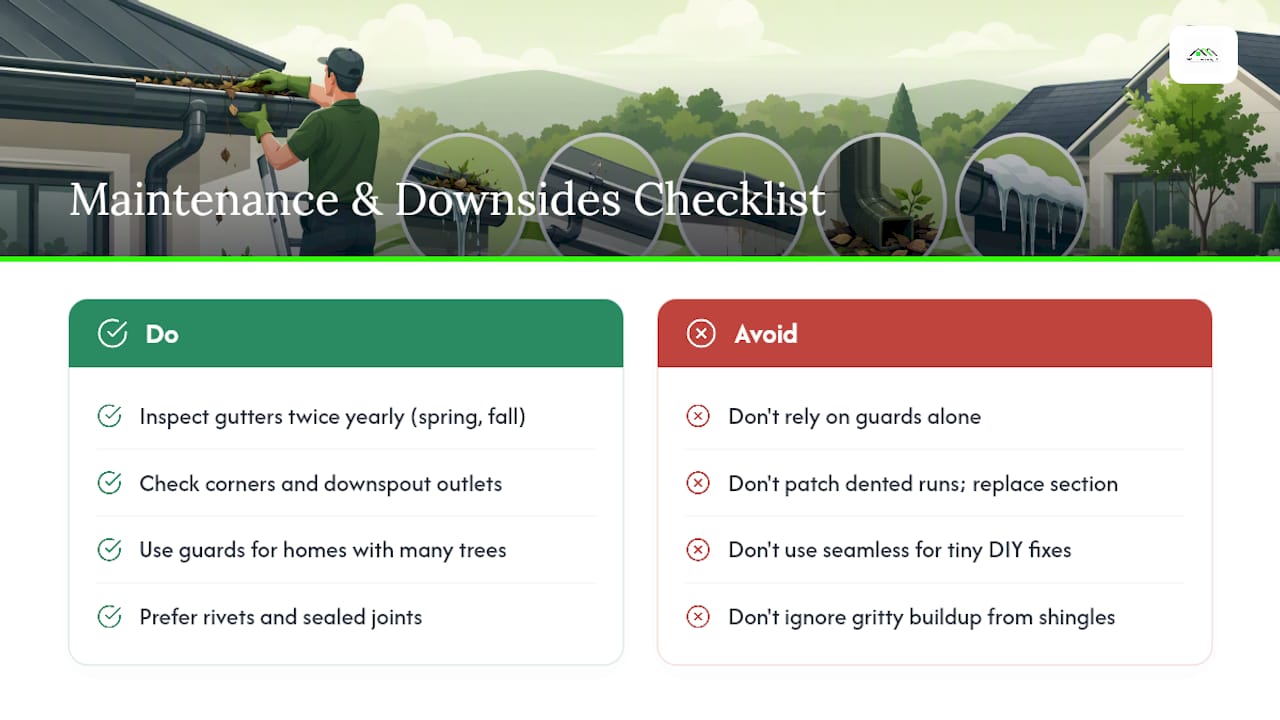
Seamless doesn't mean maintenance-free. Inspect gutters twice a year, spring and fall, focusing on corners and downspout outlets, since debris still piles up at every transition point even without mid-run seams.
Real failure modes still happen. Denting from ladders, ice, or falling branches is the most common issue, and a dent in a continuous run sometimes means replacing the whole section rather than a two-foot patch. Miter and outlet seals can eventually fail if they were caulked instead of riveted and sealed.
Gutter guards can extend the interval between cleanings, but they add cost and don't eliminate inspection needs entirely, they just reduce debris volume. For homes with minimal tree cover or low-slope roofs shedding fine grit, guards may be unnecessary. For homes under mature trees, they're often worth the add-on. If your gutters and downspouts also show gritty buildup from aging shingles, that's a separate material issue worth understanding.
Seamless is a poor fit for tiny patch jobs or homeowners who want to DIY a repair themselves, since fabrication requires the machine and a trained crew.
Why Installation Quality Matters More Than the Material Label
Experienced exterior contractors have observed that most gutter failures trace back to workmanship, not the metal itself.
Correct hanger spacing, riveted and sealed miters, and a properly specified pitch toward the downspout do more for a gutter's lifespan than upgrading from aluminum to steel ever will.
A gutter hung with hidden hangers every 18 to 24 inches and pitched correctly sheds water the way it's supposed to for decades. One hung too flat, or with hangers spaced too far apart, sags and pools water within a few seasons regardless of material grade. Am-exteriors handles soffit, fascia, and gutter repair and installation as part of full exterior projects, which matters because gutters only perform as well as the roofline and fascia they're attached to.
When Seamless Gutters Are Genuinely the Best Investment
If you're staying put and want to stop thinking about your gutters, seamless is the better bet. It's the strongest fit for homes with mature trees, heavy regional rainfall or snow, or multiple stories where ladder work is a hassle you'd rather minimize. If you're weighing a quote right now, the next section covers exactly how to get one.
— Heather
Get a Seamless Gutter Quote From a Local Wisconsin Crew
Seamless gutters are sometimes installed as part of full exterior projects covering several counties, with crews that can also address fascia, soffit, and roofline issues. That matters, because a gutter is only as good as what it's bolted to.

Every quote should list exact material, gauge, and hanger spacing in writing, so you're comparing specifics rather than guessing at what "aluminum gutters" actually means. Good contractors also document the work step by step and help homeowners navigate insurance claims when storm damage is part of the picture, so a hail-damaged fascia or roof section doesn't turn into a drawn-out fight with an adjuster. If your gutters, fascia, or soffit need attention, request an estimate through the gutter and exterior repair page and get a written breakdown before you commit to anything.
Sources
- Seamless vs. Sectional Gutters: Cost, Install | TRB
- Seamless gutters explained (This Old House)
- What Are Seamless Gutters? Cost, Pros & Cons (American Gutter Service)
FAQ
What are the pros and cons of seamless gutters?
The main pros are far fewer leak points, less frequent cleaning, and better curb appeal from a continuous, gap-free line. The main cons are a higher upfront cost and the fact that damage to one section often means replacing the full continuous run instead of a small patch.
How much should 100 feet of seamless gutters cost?
For aluminum, expect a typical installed cost based on the typical $8 to $14 per foot range, before add-ons like old gutter removal or story-height premiums.
What are the common problems with seamless gutters?
The most frequent issues are dents from ladders, ice, or debris, and failures at corner miters or downspout outlets where seams still exist. Riveted and sealed miters hold up far better than simple caulked joints.
What is the average lifespan of seamless gutters?
Aluminum seamless gutters typically last 20 to 30 years, while copper systems can exceed 50 years with proper installation and upkeep. Steel's lifespan varies more depending on coating quality and gauge.