
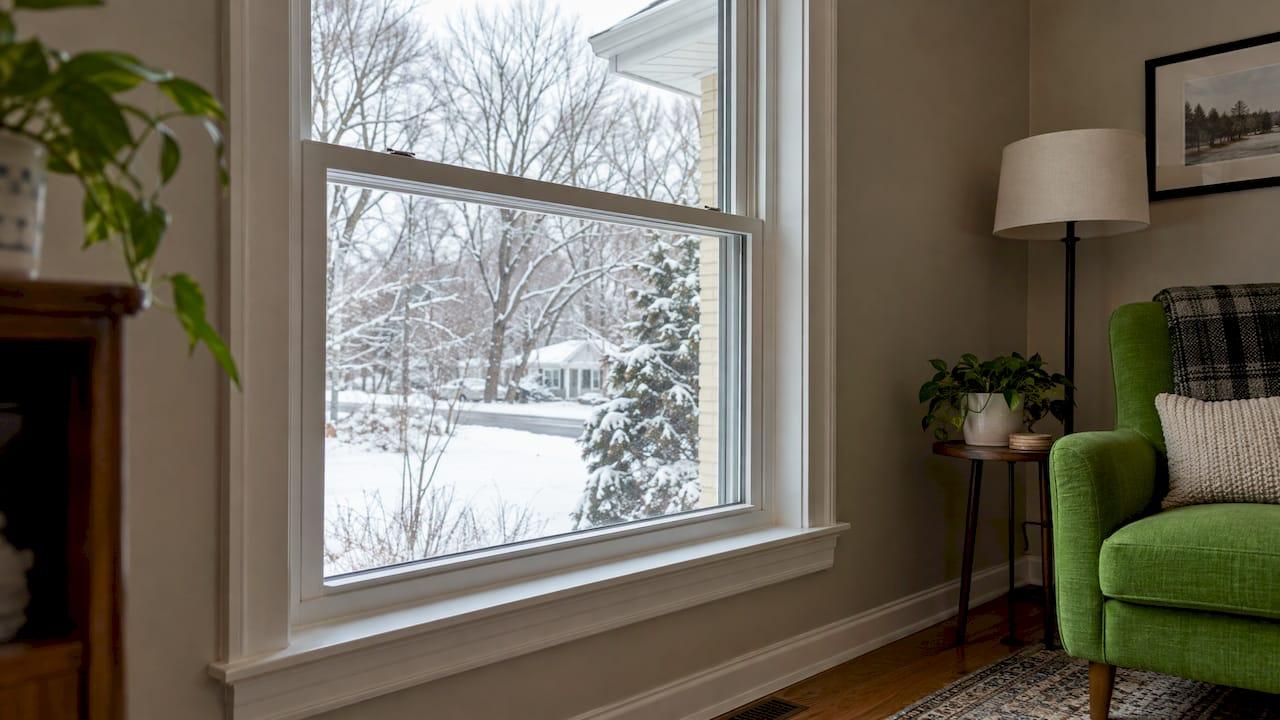
Yes, you can replace windows in a Wisconsin winter. The glass and frames do not care about the cold. The sealing work does. Foam, sealant, flashing and air sealing must go on dry, clean surfaces, and each opening must stay open for as little time as possible. Done by a crew that controls those steps, a January install performs like a June install. We are AM Exteriors, an owner-operated Wisconsin contractor, and our window replacement work covers insert, full-frame and bay or bow units.
This guide covers what changes in cold weather, which ratings to buy, how to prepare, what it costs and what to document if a storm broke your glass.
TL;DR
- Windows can be installed in winter. The risk is in the sealing materials and the install method, not the window.
- Wisconsin is Climate Zone 6. The code ceiling for replacement windows is a U-factor of 0.30. Look for the NFRC label.
- Our published window prices are $700 to $1,100 (insert), $1,000 to $1,600 (full-frame) and $3,500 to $7,000 (bay or bow), each per window.
- Prepare by clearing access, moving furniture and keeping pets and kids away from open walls.
- Storm-broken window? Photograph first, make only temporary repairs, and call your insurer before permanent work.
Table of Contents
- Can you replace windows in a Wisconsin winter?
- What installers do to keep heat and moisture out
- Which windows suit Wisconsin winters
- Insert, full-frame or bay: choosing the install type
- How to prepare your home for winter window installation
- How much does winter window installation cost in Wisconsin?
- Storm-damaged windows: what to document for insurance
- Our perspective on winter window work
- Talk to us about your windows
- FAQ
- Sources
Can you replace windows in a Wisconsin winter?
Yes. The work is routine for a trained crew. Three things change in cold weather.
- Sealants and foam have working limits. Products that bond to cold, wet or frosty surfaces fail later. Manufacturer guidance for new-construction windows says not to install unless temperatures will stay above freezing for the next 24 hours, and not to seal wet, frozen or frosty surfaces. That guidance comes from Ply Gem's cold weather installation tips. The point carries over to replacement work: the surface must be ready before the seal goes on.
- Exposure time matters. A open rough opening lets heat out and cold air in. Crews work one opening at a time and close each one before starting the next.
- Moisture control is the same as in any season, but mistakes show sooner. Water that gets behind a poorly flashed window in January freezes and thaws all winter.
So the question is not "is it too cold." The question is "does the crew have the right products and method for the day's conditions."
What installers do to keep heat and moisture out
A good winter install follows the same sequence as a good summer one. Cold weather gives less room for shortcuts.
Insulate and air-seal the rough opening
The gap between the window frame and the wall framing is where most heat loss happens after installation. The U.S. Department of Energy's Building America program, through its window replacement checklist, calls for the rough opening to be insulated and air-sealed with non-expanding spray foam or blown-in insulation, plus sealants. Non-expanding foam matters because expanding foam can bow a window frame and make the sash bind.

Flash the opening so water drains out
The same checklist requires head, jamb and sill flashing that ties into the weather-resistant barrier in shingle fashion. The upper layer laps over the lower layer, so any water that gets in is directed outward. In winter this is the step that prevents ice damage inside the wall.
Add an airtight layer inside
Some builders add more than one air barrier. A Fine Homebuilding installation account from 2021 describes a pitched sill that sends water toward a ventilated rainscreen, flashing of the rough opening, and interior air-sealing tape as an extra airtight layer. Details like these separate a window that simply fits from one that holds up over many Wisconsin winters.
Keep surfaces clean and dry
Ply Gem's November 2025 guidance also says windows and doors should be clean and dry before installation, so sealants and insulation can perform as designed. In practice, that means wiping off frost and condensation, and waiting out a wet day if needed.
Why workmanship decides the result
Our view is simple: most failures come from poor installation, not from the product. A premium window with a bad seal leaks air. A mid-range window with a sound seal does its job. That is why our installations are owner-supervised and why we document the work.
Which windows suit Wisconsin winters
Start with the numbers on the label, not the marketing.
| Item | What to look for | Source |
|---|---|---|
| Climate zone | Wisconsin replacement windows fall under Climate Zone 6 in the state code guide | Wisconsin IECC guide |
| U-factor | 0.30 or lower (lower means less heat loss) | Wisconsin IECC guide, DOE window guide |
| SHGC | Any value meets the Northern-zone prescriptive target | DOE window guide |
| Label | NFRC label showing U-factor and SHGC, plus air-infiltration labeling | Wisconsin IECC guide |
| Safety | Egress and safety glass per local code | Building America checklist |
A few notes on that table.
U-factor comes first. The Wisconsin compliance guide, based on the 2018 IECC, states that its fenestration table applies to replacement windows and gives Climate Zone 6 a maximum U-factor of 0.30. The DOE guide uses the same 0.30 as its Northern-zone target. Pick a window at or below it.
The label is the proof. The guide says U-factors and solar heat-gain coefficients must be determined by an accredited independent laboratory and shown on an NFRC label. Read the label on the exact unit, not the brochure.
Certification. The Building America checklist says to choose an ENERGY STAR-certified or better window matched to the home's climate zone.
Glass and frames. Double-pane low-E is common. Triple-pane glass and insulated frames cut heat loss further. A well-known cold-climate example is the Zone 6a Passive House in the Woods case study, which used triple-pane low-E glazing and insulated frames. Most homes do not need that level, but it shows where the top of the range sits.
For a longer read on ratings, see our guides to energy efficient windows in Wisconsin and windows for cold climates. If a window sits near a door, a tub or a stair, read where tempered glass is required.
Insert, full-frame or bay: choosing the install type
The install type changes the winter work.
- Insert (pocket) replacement. The new window goes inside the existing frame. The trim and exterior stay in place. It is the quickest option and exposes the opening the least. Our published price is $700 to $1,100 per window.
- Full-frame replacement. We remove the old window down to the rough opening. This lets us inspect for rot, insulate the cavity and re-flash the opening. It is the right call when the frame is damaged or when you want the best air seal. Our published price is $1,000 to $1,600 per window.
- Bay or bow windows. These are larger, projecting units. Our published price is $3,500 to $7,000 per window.
If you are not sure which one fits, we give honest recommendations. A sound frame can take an insert. A soft or stained frame needs full-frame work.
How to prepare your home for winter window installation
Preparation takes an hour or two and shortens the install day. Use this list.
- Measure the clear space. Move furniture, shelves and wall art at least three feet back from each window.
- Take down blinds, curtains and rods. Bring them to a different room.
- Clear the outside. Move snow from the walkway and from beneath each window. Clear grills, planters and holiday lights that block access.
- Protect floors and belongings. Cover items near the work area with sheets. Dust from trim removal travels.
- Plan for the temperature drop. One opening is open at a time, but it is still open. Keep a space heater out of the work zone, and set the thermostat as you normally do.
- Secure pets and children. Keep them in a room away from the work.
- Check the forecast with your crew. Wind and wet snow can move a start time. A short delay is better than sealing a wet frame.
- Confirm the window specs. Compare the order form to the NFRC labels when the windows arrive, before any opening is cut.
Time on site varies by window type, floor level and what the crew finds in the wall. Rot or damaged framing adds time. Ask for a schedule per room when you sign.
How much does winter window installation cost in Wisconsin?
Cold weather does not change what the window is worth. Cost depends on window type, size, glass package, frame material and how much carpentry the openings need.
For context, the Home Improvement Research Institute's 2025 Project Decision Study summary reports average spending of about $14,000 and median spending of $10,000 on window and door replacements, and says a single window generally costs $450 to $1,500 to replace.
Our published ranges are per window:
| Window type | Price per window |
|---|---|
| Insert / pocket | $700 to $1,100 |
| Full-frame | $1,000 to $1,600 |
| Bay / bow | $3,500 to $7,000 |
Multiply by your count. Ten insert windows at those rates land between $7,000 and $11,000. Ten full-frame windows land between $10,000 and $16,000. Add any bay or bow unit on top. Our window replacement cost guide breaks the numbers down further.
A useful way to compare bids: ask each one to list U-factor, SHGC, install type, flashing method and how the cavity is insulated. Prices only mean something when these match.
Also, fall and winter can be less crowded than spring, which can help with scheduling. Ask for the current lead time on your windows.

Storm-damaged windows: what to document for insurance
A broken window in January cannot wait. Take these steps in order.
- Stay safe. Keep away from broken glass. Board or cover the opening to keep out snow and wind.
- Photograph before cleanup. Six Corners' Midwest storm claim guidance says to take wide and close-up photos of windows and related damage before cleanup, and to note the storm date and time.
- Keep receipts for temporary repairs. The same guidance says to keep them, and to avoid permanent repairs until the adjuster has inspected.
- Write notes and record video. Insurance.com's claim guidance lists photos before and after, detailed notes, video where possible, serial numbers and receipts.
- Call your insurer promptly. Confirm your deductible and coverage limits, and get written repair estimates.
The insurance steps are written for storm claims in general, so check your own policy for its terms. Claim navigation is part of what we do for homeowners. We work with you on the documentation, so your claim reflects the damage that was done.
Our perspective on winter window work
Homeowners often wait for spring because they assume cold weather ruins an install. We see it differently.
The failures we get called about trace back to workmanship. A rushed seal, a missed flashing lap, foam that went on a damp frame. Those mistakes happen in July as often as in January.
That is why our projects are owner-supervised. We have more than 25 years of experience in Wisconsin, and we build around its weather: hail, high winds and heavy snow. We keep the homeowner informed at each stage and document the work.
If your windows are drafty, fogged or hard to open, do not let the calendar make the decision. Let the condition of the windows make it.
Heather
Talk to us about your windows
We replace windows for homeowners across Southeast Wisconsin, including Dodge, Washington, Fond du Lac and Ozaukee Counties. Insert, full-frame and bay or bow options are on our window replacement page, with prices as published. If a storm caused the damage, we also help you through the insurance claim.

Start with a look at your openings. We give an honest recommendation on insert or full-frame, and we put the scope in writing. See all our roofing, siding and window services. Planning roof work too? Read our winter roof replacement checklist.
FAQ
Is it too cold to install windows in Wisconsin?
There is no single cutoff. The limit is the sealing products and the surface condition. Surfaces must be clean, dry and free of frost before sealing, and manufacturer guidance for new-construction windows advises waiting unless temperatures will stay above freezing for 24 hours. A crew that picks the right products and works one opening at a time can install through winter.
Will my house get cold during installation?
Some heat will escape while an opening is open, but crews work one opening at a time and close each one before starting the next. Move furniture away from the windows and keep your thermostat at its usual setting. The room is usually back to normal when the window is sealed.
What U-factor should I choose for Wisconsin?
Choose a U-factor of 0.30 or lower. That is the Climate Zone 6 limit for replacement windows in the Wisconsin compliance guide, and the same figure the DOE gives for the Northern zone. Confirm it on the NFRC label of the exact window.
Do insert windows or full-frame windows work better in winter?
Both work. Insert windows are faster and keep the existing trim. Full-frame windows let the crew inspect, insulate and flash the whole opening, so they suit frames with rot or water stains. We recommend based on the condition of your openings.
Does insurance cover storm-broken windows?
It depends on your policy, your cause of loss and your deductible. Photograph the damage before cleanup, keep receipts for temporary repairs and contact your insurer promptly. We help homeowners work through the claim process.
Sources
- Window Replacement, Building America Solution Center
- Guide to Energy-Efficient Windows, U.S. Department of Energy
- IECC Compliance Guide for Homes in Wisconsin
- Passive House in the Woods Case Study
- Airtight and Waterproof Window Installation, Fine Homebuilding
- Cold Weather Window and Door Installation Tips, Ply Gem
- Window Market Watch, Home Improvement Research Institute
- Hail & Summer Storm Claims, Midwest
- How to file a claim after a hurricane, Insurance.com