
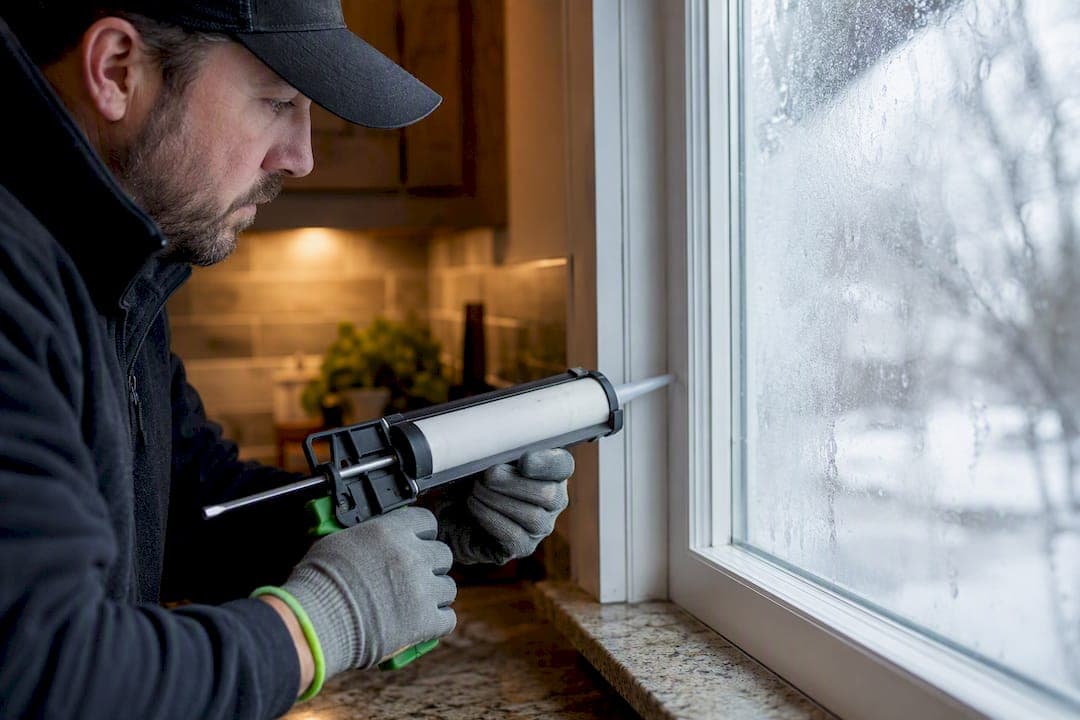
For cold climates, prioritize windows with a U-factor of 0.22 to 0.25 or lower, double- or triple-pane glazing with low-E coatings, and argon or krypton gas fills. Choose casement or awning styles in vinyl or fiberglass frames, and confirm ENERGY STAR and NFRC labels before you buy. None of that matters if installation isn't airtight.
TL;DR:
- A U-factor of 0.22 to 0.25 or lower is essential, with triple-pane glazing and low-E coatings providing the best insulation for cold climates.
- Proper installation with airtight flashing, insulated jambs, and continuous air barriers is often more important than window brand or model.
- Casement and awning windows seal better than double-hung or sliders, especially when crank-closed with compression seals.
- Storm windows, especially exterior low-E models, can deliver up to 20% energy savings and are a cost-effective retrofit option.
- Materials like fiberglass or multi-chamber vinyl outperform wood and aluminum in freeze-thaw conditions due to better expansion control and insulation properties.
Table of Contents
- What Window Specs Matter Most for Cold Climates?
- Double-Pane vs. Triple-Pane: Which Glazing Wins in Winter?
- Which Frame Material and Window Style Seal Best?
- How Does Orientation Change Your Glass Choice?
- Why Installation Quality Beats Brand Selection
- Are Storm Windows Worth It Instead of Full Replacement?
- What Should You Budget for Windows and Storm Upgrades?
- Why Installation Track Record Matters More Than Marketing
- How Do You Prevent Condensation on Cold-Climate Windows?
- How Do You Maintain Windows Through Freeze-Thaw Cycles?
- Which Window Styles Actually Hold Up in Extreme Cold?
- How Does Cold Weather Wear Down Window Materials Over Time?
- What Homeowners Get Wrong About Cold-Climate Windows
- Get Cold-Climate Windows Installed the Right Way
- Where to Verify Window Specs and Certifications
- Sources
What Window Specs Matter Most for Cold Climates?
Two numbers drive everything: U-factor and Solar Heat Gain Coefficient (SHGC). U-factor measures how much heat escapes through the window. Lower is better in winter. SHGC measures how much solar heat passes through the glass, and that number should shift depending on which direction the window faces.
ENERGY STAR sets different performance targets by climate zone, and for Northern zones it recommends a U-factor around 0.22 or lower. Pella's own buying guidance lands close to that, suggesting cold-climate buyers target a U-factor near 0.25 or lower and check climate compatibility before purchasing.
Quick spec checklist for cold-climate windows:
- U-factor: low enough to provide strong insulation (about 0.22 to 0.25 or lower)
- Glazing: double or triple pane with at least one low-E coating
- Gas fill: argon (standard) or krypton (premium, tighter cavities)
- Labels: ENERGY STAR certified, NFRC-rated
Low-E coatings are microscopically thin metallic layers applied to the glass surface. Placement matters more than most homeowners realize. In double-pane units, the coating usually sits on the interior-facing surface of the outer pane to reflect heat back into the home. Triple-pane units can carry two coated surfaces, which pushes performance even higher but adds cost.
Quick fact: ENERGY STAR's Northern zone guidance targets a U-factor near 0.22, which is stricter than the baseline typical in warmer regions.
Double-Pane vs. Triple-Pane: Which Glazing Wins in Winter?
Triple-pane glass earns its keep in specific situations, not every situation. If you're dealing with large picture windows, north-facing rooms, or a genuinely brutal winter climate, the extra pane cuts heat loss noticeably and reduces the cold-glass feeling near the window. For a standard-sized bedroom window in a moderately cold region, double-pane with a good low-E coating often performs close enough that the price jump isn't worth it.
Spacer type matters almost as much as pane count. Older aluminum spacers conduct cold straight to the glass edge, which is why frost lines up along the perimeter of older windows. Warm-edge spacers, made from stainless steel or composite materials, interrupt that heat path and cut condensation risk at the edge while extending the life of the sealed glazing unit.
Gas fill guidance:
- Argon: the standard choice, roughly 10 percent denser than air, good value for most cavity widths
- Krypton: denser and more effective in narrower gaps, typically reserved for triple-pane or space-limited retrofits
Pro Tip: If your installer offers both argon and krypton at similar pricing, take krypton on any triple-pane unit. The gap between the panes is usually too narrow for argon to perform at its best.
Which Frame Material and Window Style Seal Best?
Frame material determines how much a window flexes, cracks, or lets air slip through after a few winters of freeze-thaw cycling. Vinyl and fiberglass frames dominate cold-climate installations for good reason: multi-chamber vinyl traps insulating air pockets inside the frame itself, and fiberglass expands and contracts at nearly the same rate as glass, which keeps seals tighter over time. Wood offers strong natural insulation but demands more upkeep to prevent moisture damage. Aluminum without a thermal break is a poor cold-climate choice, though aluminum with a thermal break barrier performs reasonably well when budget or design requires it.
Operating style affects seal quality just as much as material. Casement and awning windows crank shut against the frame, compressing a continuous weatherstrip seal, which makes them tighter than single- or double-hung windows that rely on sash-to-frame friction.
Frame and style rankings for cold climates:
- Best sealing operable styles: casement, awning
- Strong thermal frame materials: multi-chamber vinyl, fiberglass
- Acceptable with trade-offs: wood (upkeep), thermally broken aluminum (cost)
- Weakest cold-climate performers: single-pane sliders, non-thermal-break aluminum
How Does Orientation Change Your Glass Choice?
South-facing windows in a cold climate are a free heating asset if you spec them correctly. A higher SHGC on that elevation lets in more winter sun, which genuinely warms a room on a clear January afternoon. ENERGY STAR's own guidance points to varying SHGC by orientation rather than using one blanket spec across the whole house.
West-facing windows deserve the opposite treatment. Low afternoon sun angles can cause overheating even in winter, so a lower SHGC or added shading keeps rooms comfortable year-round.
Orientation guidance at a glance:
- South: higher SHGC to capture winter solar heat
- West: lower SHGC or exterior shading to limit glare and overheating
- North and east: standard SHGC, since solar gain is minimal either way
- Overhangs and awnings: pair well with south glass to block high summer sun while letting in low winter sun
Uniform specs across a house are fine for a tight budget. A per-elevation strategy squeezes out real comfort gains for a modest cost difference.
Why Installation Quality Beats Brand Selection
The best window on the market fails if it's installed poorly. MIT research on window energy loss points squarely at installation and air-sealing quality as the difference between a window performing to spec and one leaking heat around every edge. Glazing and frame choice only matter once the assembly is sealed correctly into the wall.
What separates a solid installation from a problem one:
- Continuous flashing that directs water away from the rough opening, not into it
- Insulated jambs and low-expansion foam, not just caulk, filling the gap between frame and framing
- A continuous air barrier tying the window into the house wrap, with no gaps at corners
- Proper shimming so the sash operates freely without binding or sagging over time
- Sealants rated for the temperature swings your climate actually produces
Pro Tip: At the estimate stage, ask any contractor how they handle jamb insulation and flashing sequencing. A vague answer is a bigger red flag than any brand name on the window itself.
Are Storm Windows Worth It Instead of Full Replacement?
Full replacement isn't always the right first move, especially on a tight budget or in a home with historic windows worth preserving. ENERGY STAR data shows full replacement cuts heating and cooling energy use by an average of up to 13%, while ENERGY STAR-certified low-E storm windows deliver about 20% savings with roughly a 3-year payback on the incremental cost.
Retrofit options ranked by typical impact:
- Exterior low-E storm windows: strongest retrofit performance, visible from outside
- Interior storm panels: nearly invisible, easier DIY install, slightly less airtight
- Low-E window film: budget option, modest gains, no structural change
- Weatherstripping and cellular shades: cheap, quick, meaningful on drafty older units but no substitute for a real storm window
What Should You Budget for Windows and Storm Upgrades?
By the numbers: Full window replacement saves an average of up to 13% on heating and cooling costs, while ENERGY STAR storm windows deliver closer to 20% savings with about a 3-year payback.
Replacement windows carry a wide cost range depending on frame material, glazing package, and how many units you're replacing at once. Double-pane units sit at the lower end of the range, triple-pane runs higher, and storm windows cost a fraction of full replacement per opening.
Simple payback logic:
- Storm windows: lower upfront cost, faster payback, ideal when replacement isn't in the budget yet
- Double-pane replacement: mid-range cost, solid payback over a decade-plus lifespan
- Triple-pane replacement: highest upfront cost, best suited to extreme cold or large glazed areas where the comfort gain justifies the price
Homeowners comparing real project numbers can check a Wisconsin-specific replacement cost guide to see how these ranges play out on actual houses.
Why Installation Track Record Matters More Than Marketing
Am-exteriors has spent over 25 years installing replacement windows, roofing, and siding across Southeast Wisconsin under the same owner-operated team. That matters because most window failures trace back to workmanship, not the glass or frame. Every project gets documented, and for storm-damage jobs, the team handles insurance navigation directly so homeowners aren't left translating adjuster paperwork alone.
How Do You Prevent Condensation on Cold-Climate Windows?
Condensation on the inside of a window means warm, moist indoor air is hitting a cold glass surface. It's a humidity and temperature problem more than a window-defect problem, though the window's insulating performance plays a role in how cold that interior surface gets.
Frost between the panes, on the other hand, signals a failed seal. Once the argon or krypton gas fill leaks out and moist air gets into the cavity, that unit needs replacing. No amount of interior humidity control fixes a broken seal.
Practical condensation fixes:
- Run a bathroom or kitchen exhaust fan longer after showers or cooking
- Keep indoor humidity in the 30 to 40 percent range during winter months
- Use warm-edge spacers on any new units, since they run warmer at the glass perimeter than aluminum spacers
- Check storm window vent settings, since a sealed-too-tight storm window can trap moisture between the storm and primary window
If condensation appears consistently on a specific window and nowhere else in the house, that's usually a sign of a local air leak or a spot where insulation is thin around that particular opening. It's worth having a contractor check that specific rough opening rather than assuming it's a house-wide humidity issue.
Older single-pane windows condensate more readily simply because the interior glass surface runs colder. Upgrading that specific window, even without replacing every window in the house, often resolves a chronic condensation spot.
How Do You Maintain Windows Through Freeze-Thaw Cycles?
Cold-climate windows take more abuse than windows in milder regions. Freeze-thaw cycling stresses seals, hardware, and weatherstripping every single winter, so a light annual maintenance routine extends the life of even a well-installed window by years.
Fall maintenance checklist:
- Inspect exterior caulk lines and re-caulk any cracked or separated joints before the first freeze
- Clean weep holes on vinyl frames so meltwater drains instead of pooling and freezing inside the frame
- Lubricate casement and awning hardware with a silicone-based lubricant, not oil, which attracts grit
- Check weatherstripping for compression loss and replace it if it no longer springs back after being pressed
Spring maintenance checklist:
- Wash frames and glass to remove winter road salt and grime, which can degrade vinyl finish over time
- Check for any new frost or condensation patterns that appeared over winter and investigate immediately
- Test that operable sashes still open and close smoothly after months of temperature swings
Ice dams deserve a specific mention. Ice buildup on the roof edge can force meltwater under siding and around window headers, so keeping gutters clear and addressing attic insulation reduces indirect water damage to window openings. A siding repair check after a heavy winter can catch problems before they reach the window frame itself.
Which Window Styles Actually Hold Up in Extreme Cold?
Not every window style is built for a Wisconsin January. Casement and awning windows consistently outperform other operable styles in raw sealing ability because the sash compresses against the frame when cranked shut, creating continuous contact along the weatherstrip. Double-hung and slider windows rely on sash-to-frame friction instead, which naturally leaves more room for air infiltration as the mechanism ages.
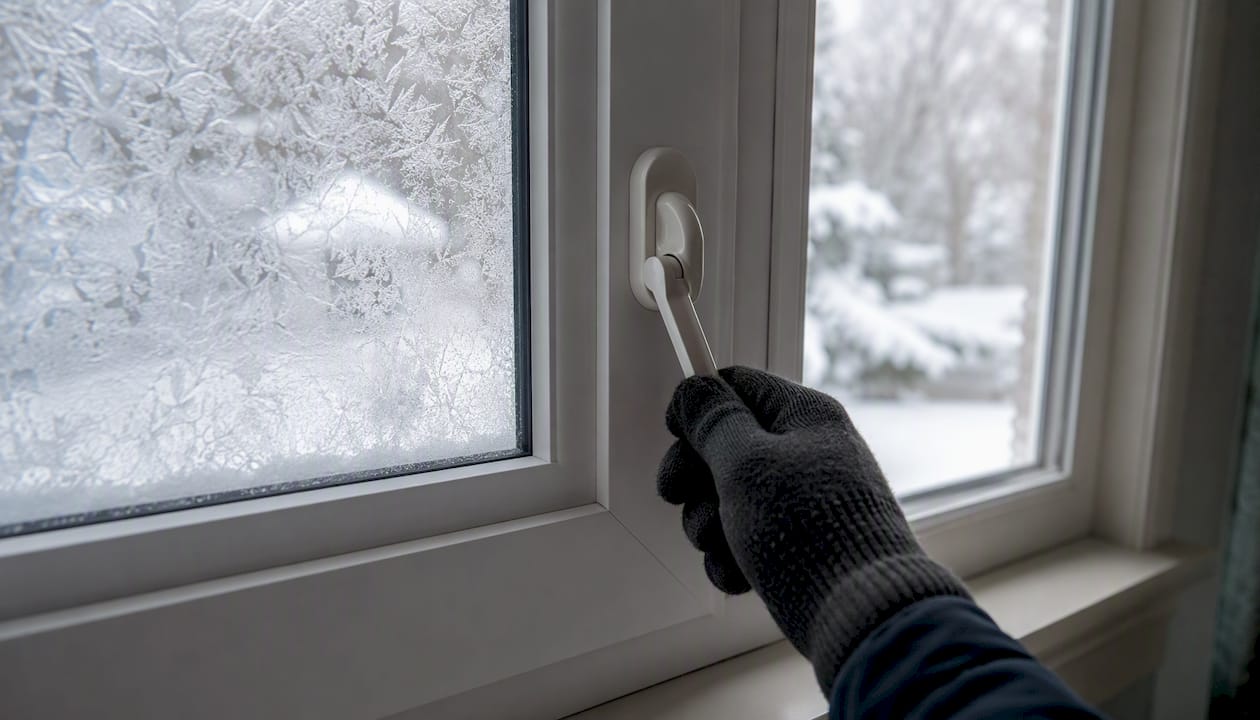
Picture windows and fixed units, since they never open, offer the tightest seal of all, but they only work where ventilation isn't a priority for that specific room. Many cold-climate homes mix fixed picture windows in living spaces with casement or awning units in rooms that need ventilation, getting the thermal benefit of a sealed unit where it matters most.
Style comparison for extreme cold:
- Fixed/picture windows: tightest seal, no operability
- Casement and awning: best sealing among operable styles, compression-based seal
- Double-hung: moderate performance, easier to maintain and clean
- Sliders: weakest sealing typically, though quality varies significantly by manufacturer
Bay and bow windows deserve a caution in extreme cold. Their multiple panes and increased surface area create more opportunities for heat loss unless each unit within the assembly meets the same U-factor standard as the rest of the house. A bay window built with budget-grade glass in an otherwise high-performance home becomes the weak point in the whole envelope.
How Does Cold Weather Wear Down Window Materials Over Time?
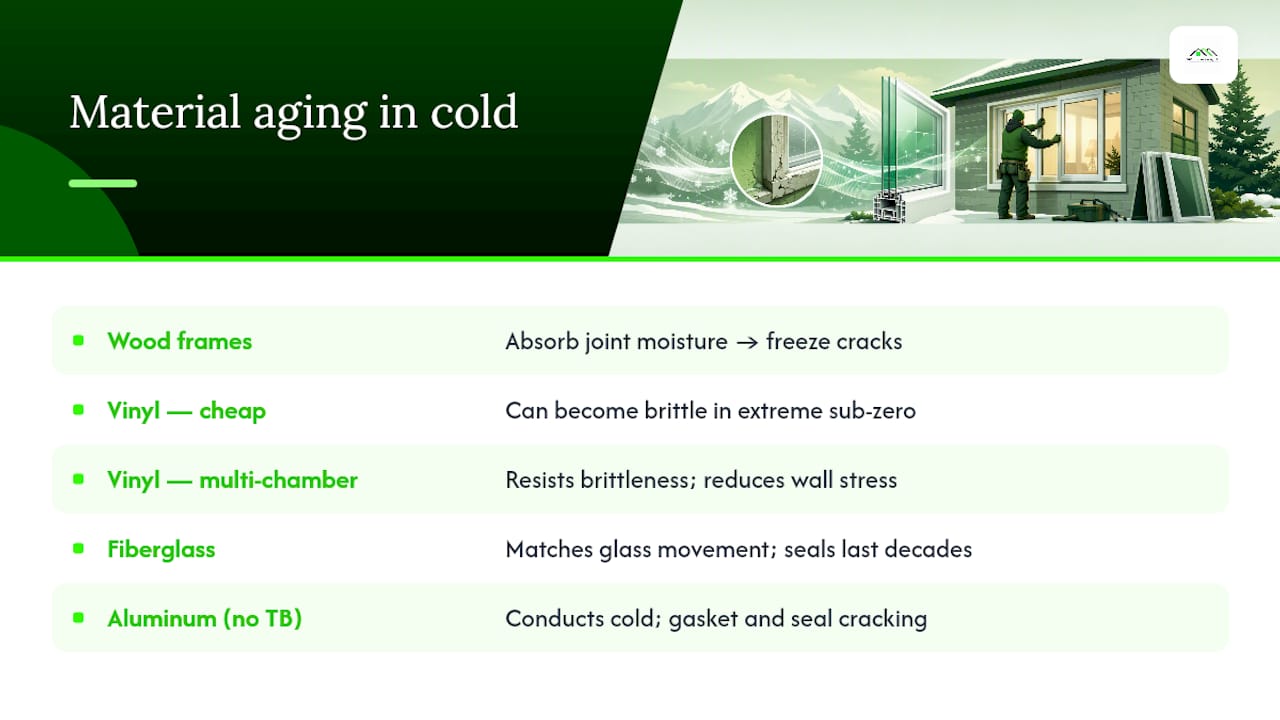
Materials age differently under repeated freeze-thaw stress, and picking the wrong one for a cold climate shows up as cracking, warping, or seal failure years before it should. Wood frames, while excellent insulators, absorb moisture at the joints and that moisture expands when it freezes, which is why untreated or poorly maintained wood windows in cold regions eventually develop cracks at the corners.
Vinyl handles cold far better than most homeowners expect, but cheaper vinyl formulations can become brittle in extreme sub-zero temperatures. Higher-quality multi-chamber vinyl resists that brittleness because the additional internal structure reduces stress on any single wall of material. Fiberglass sidesteps the issue almost entirely. It expands and contracts at close to the same rate as glass, so the seal between glass and frame stays intact through decades of temperature swings.
Aluminum frames without a thermal break are the clearest cautionary tale. Metal conducts cold directly into the home, and that constant thermal cycling accelerates gasket wear and can crack sealant lines within a handful of winters. A thermal break, which is a non-conductive strip separating the interior and exterior metal, solves most of that problem but adds cost.
Ice and frost don't damage quality frame materials directly. The real damage comes from repeated expansion and contraction at joints and seals, which is exactly why spacer quality and installation sealing matter as much as the frame material choice itself.
What Homeowners Get Wrong About Cold-Climate Windows
Most homeowners fixate on brand names and skip past the two numbers that actually predict performance: U-factor and installation quality. I've seen premium windows underperform budget units simply because the installer skipped continuous flashing or rushed the air barrier tie-in.
Three rules I'd tell anyone specifying windows for a cold climate: demand the U-factor and SHGC numbers in writing, never accept "energy efficient" as a substitute for an actual NFRC label, and ask your installer to walk through their flashing sequence before signing anything.
Before you sign a contract, ask for proof of NFRC and ENERGY STAR certification on the exact product being installed, not just the product line.
— Heather
Get Cold-Climate Windows Installed the Right Way
Comparing U-factor ratings and glazing packages only gets a homeowner halfway there. The other half is workmanship, and that's where a lot of window projects quietly go wrong. Am-exteriors approaches window replacement as an installation-first job: continuous flashing, proper air-sealing, and insulated jambs on every unit, backed by the same owner-operated team that's handled roofing and siding across Southeast Wisconsin for over 25 years.

That track record covers more than glass and frames. Every project gets documented from start to finish, so homeowners have a clear record of what was installed and how. For storm-damage jobs, the team also handles insurance claim navigation directly, which saves homeowners from chasing adjusters on their own. If your current windows are drafty, frosting between the panes, or just past their useful life, request a quote through the replacement windows page and get specific U-factor and SHGC recommendations for your home's exposure and climate zone.
Where to Verify Window Specs and Certifications
Check the ENERGY STAR product finder for climate-zone guidance, the Efficientwindows for NFRC-certified comparisons, and door-sealing tips from One Day Doors & Closets for whole-entryway winterizing.
Sources
- How to Choose Energy-Efficient Windows: A Complete Guide | Pella
- Best windows by climate | This Old House