
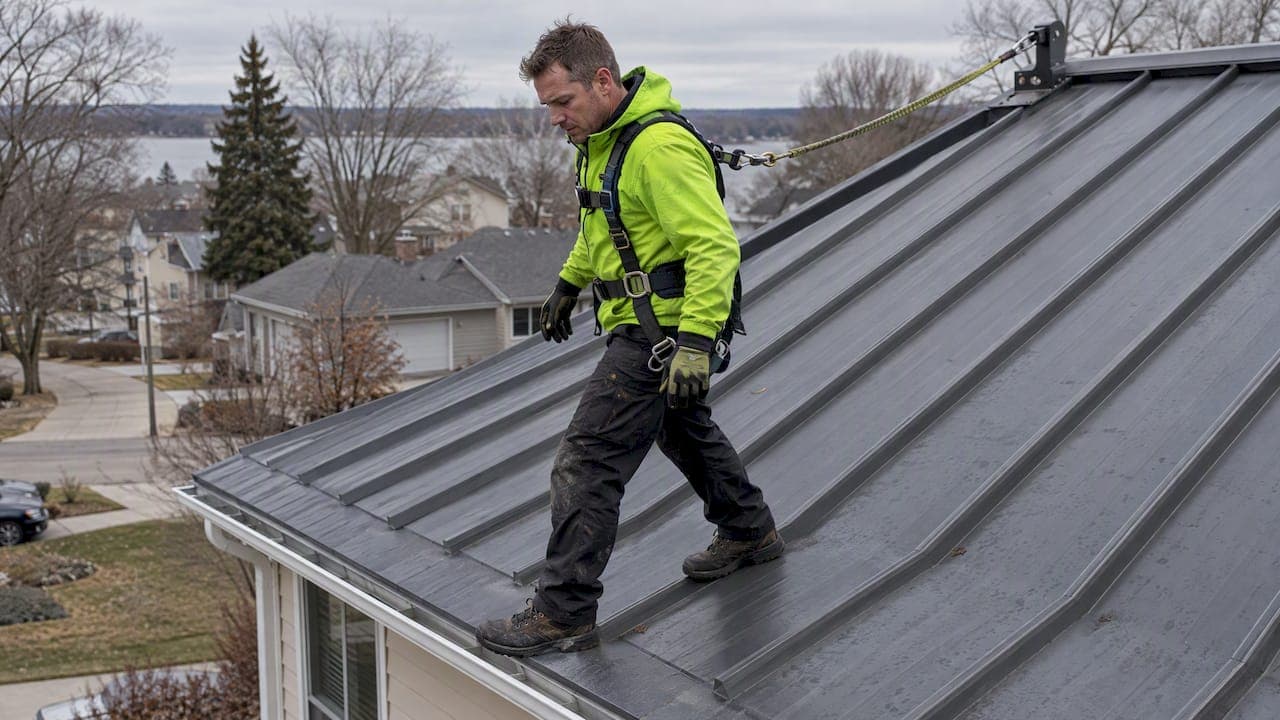
You can walk on a metal roof only when the pitch, surface condition, and access checks out, and you stay under the OSHA 6-foot fall-protection threshold with no exposed edge. Above that height, or on steep or wet surfaces, skip it. Below, we cover the checklist, the gear, and when to call us instead.
TL;DR:
- OSHA requires fall protection for residential construction workers at 6 feet: use guardrails, nets, rated arrest systems, or restraint that prevents reaching the edge.
- Use a 4:1 ladder angle, extend the rails 3 feet above the roofline, and keep three points of contact while climbing.
- Walk parallel to the eave with small steps over fastener lines, clips, or purlins, and wear soft rubber soles to protect the roof finish.
- Avoid access after rain, during gusts, in frost, or in freezing conditions; steep pitches, damaged panels, and repair work call for a trained crew.
- Check skylights, loose fasteners, weak panels, and debris before stepping up; keep only one person on each panel span to limit concentrated loading.
Table of Contents
- 1. Essential safety checklist before you step on the roof
- 2. Fall protection basics and the OSHA thresholds homeowners should know
- 3. How to walk and move on a sloped metal roof
- 4. Footwear, traction aids and equipment that protect you and the roof
- 5. Safe roof access and ladder setup
- 6. Skylights, ridges, fasteners and panel damage: hazards to avoid
- 7. How professionals approach safe metal roof work
- 8. Recommended weight limits and how many people belong on the roof
- 9. How temperature affects metal roof walking safety
- Author perspective: safety-first guidance from a roofing pro
- Free inspections, rated anchors and standing-seam repairs from AM Exteriors
- FAQ
- Sources
1. Essential safety checklist before you step on the roof
Run through this list every time, not just the first time.
- Confirm the task actually requires going up. Many inspections can be done with binoculars or a drone from the ground.
- Check the weather. Skip the roof if it rained recently, frost is present, or wind is gusting.
- Check fall-protection needs. If any edge puts you 6 feet or more above grade, you need a rated anchor or a harness system.
- Inspect for skylights, weak panels, loose fasteners, and debris before you commit your weight to any one spot.
- Stage tools and materials near your access point so you spend less time walking around once you're up there.
Each step takes a minute. Skipping one does not.
2. Fall protection basics and the OSHA thresholds homeowners should know
6 feet is the number that matters. OSHA's 29 CFR 1926.501(b)(13) requires conventional fall protection in residential construction once a worker is exposed to a fall of 6 feet or more. That rule was built for job sites, but the physics do not change for a homeowner on a ladder.
Conventional fall protection means one of these:
- A guardrail system around the work area.
- A safety net below the work area.
- A personal fall arrest system (PFAS): harness, lanyard, and rated anchor.
A PFAS catches you after a fall starts. A fall restraint system works differently: it physically keeps you from reaching the edge in the first place. OSHA accepts restraint in place of arrest when it is rigged to prevent the fall, which is often the simpler option on a steep metal roof.
If conventional protection is not feasible for a job, a written site-specific plan from a qualified person is required. That requirement is usually the signal to call a contractor rather than improvise your own plan.
3. How to walk and move on a sloped metal roof
Standing seam and corrugated panels both get more stable once you know where to put your feet.
- Move sideways or parallel to the eave instead of straight up or down the slope.
- Keep your weight low and take small, deliberate steps instead of long strides.
- Place your feet on structural attachment lines, not mid-span panels, since unsupported spots flex under your weight.
- Secure any tool in a pouch or lanyard before you move, and avoid sudden turns that shift your balance.
Standing seam panels give you a raised rib to orient against; corrugated panels require more attention to where the underlying purlins actually sit.
Pro Tip: Walk with your shoulders square to the slope and your eyes on your next two steps, not your feet.
4. Footwear, traction aids and equipment that protect you and the roof
What you put on your feet affects both your grip and the panel finish underneath it.
- Choose soft rubber, slip-resistant soles over anything with a hard lug pattern.
- Avoid metal cleats or spiked boots. They dent or puncture painted panels.
- Use removable, roof-safe traction pads or rubber walk mats if you access the same spot repeatedly.
- Set up toe boards or temporary brackets when staging materials on the slope, rather than leaning them against a panel seam.
Pro Tip: Keep a dedicated pair of clean, dry-soled shoes just for roof access. Dirt and grit on a sole act like sandpaper on painted metal.
5. Safe roof access and ladder setup
Most falls happen getting on or off the roof, not while walking on it, so the ladder matters as much as your footing up top.
- Extend the ladder at least 3 feet above the roofline, or secure the top to a rigid support if that is not possible.
- Set the base using a 4:1 ratio: for every 4 feet of height to the support point, move the base 1 foot out from the wall.
- Maintain three-point contact while climbing, and hoist tools up in a bag or bucket instead of carrying them in your hands.
- Inspect the ladder's rails, rungs, and feet, and confirm its load rating before you trust it with your weight plus tools.
A ladder set at the wrong angle is one of the most preventable causes of fall injuries, which is why the 4:1 base ratio exists as a fixed rule rather than a guideline.
6. Skylights, ridges, fasteners and panel damage: hazards to avoid
A metal roof hides more hazards than it shows at a glance.
- Mark or cover skylights before you start, since translucent or painted-over panels are easy to mistake for roof surface.
- Step on fastener lines, clips, or directly over purlins, and avoid mid-span panel areas that flex underfoot.
- Install a dedicated walkway with a non-slip surface if the roof needs regular access for maintenance.
- Walking on fastener lines instead of open panel also limits the cosmetic dents and finish scuffs that show up on bare metal over time.
Ridges and protrusions remain common trip hazards even on roofs that look clear from the ground, so treat every ridge line as a spot to step carefully, not lean on.
7. How professionals approach safe metal roof work
Contractors handle metal roof access differently than a one-time homeowner climb, and the gap shows up mostly in preparation, not bravery.
- We install rated anchors before work starts and keep inspection records rather than relying on a makeshift tie-off.
- Crews stage materials and tools at the access point and use aerial lifts for steep or high roofs to cut down on time spent walking the surface.
- Steep pitches, any exposure over 6 feet, and actual repair work (replacing panels, resealing seams) are jobs we recommend leaving to a licensed crew rather than a DIY attempt.
- Our standing-seam installation experience comes from more than 25 years of owner-operated roofing work, which shapes how we sequence anchor placement and panel walkways on every job.
8. Recommended weight limits and how many people belong on the roof
Metal roofing panels are engineered for distributed loads like wind and snow, not concentrated point loads from a standing adult, which is why foot placement matters more than a single weight number. Most residential panels can support a single adult walking carefully on fastener lines or structural supports, but multiple people in the same area increase the load on panels and underlying framing that may not be designed for simultaneous foot traffic.
Keep it to one person on the roof surface at a time whenever possible. If a second person needs to be up there, say to hand off tools or materials, have them stay near the ridge or a walkway rather than standing beside the first person on open panel. Spread out, not stacked, and never let more than one person occupy the same panel span.
This is also where staging pays off. If your checklist in Section 1 already moved your tools and materials to the access point, you reduce the number of trips, and the number of people, needed on the roof at once. Fewer trips means less cumulative load and less time exposed to a fall hazard.

9. How temperature affects metal roof walking safety
Metal expands and contracts with temperature more than asphalt shingles do, and that movement changes how a roof behaves underfoot depending on the season. On a hot afternoon, panels can feel slightly looser at the seams as the metal expands, and the surface itself gets hot enough to affect your grip through thin-soled shoes. In cold weather, metal contracts and seams tighten, but the surface also becomes more brittle and far more likely to carry a thin layer of frost that is invisible from the ground.
Early morning and late evening are the riskiest times to walk a metal roof in any season, since temperature swings are sharpest then and condensation or frost has the most time to settle. Midday in moderate weather, once any morning dew has burned off, is generally the safer window for access.

Avoid roof access altogether in freezing conditions or right after a temperature drop, since a dry-looking panel can still carry a layer of ice too thin to see. If you are unsure whether a cold morning has cleared, wait another hour rather than testing it with your first step.
Author perspective: safety-first guidance from a roofing pro
We lean conservative on every threshold in this guide, and that is deliberate. Most roof failures we see come down to workmanship, not materials, which is exactly why repairs deserve a trained crew rather than a weekend fix. A quick visual check with this checklist is reasonable for most homeowners. Anything involving a steep pitch, a damaged panel, or real exposure above 6 feet is a job for someone who does it daily.
— Heather
Free inspections, rated anchors and standing-seam repairs from AM Exteriors
If your checklist raised more questions than it answered, we handle the parts of this job that carry real risk. Our crews inspect roofs, install rated anchors and walkways, and complete standing-seam repairs without asking you to climb anything.
Our roofing services cover everything from a single panel repair to a full standing-seam replacement, backed by more than 25 years of owner-operated experience in Southeast Wisconsin. When hail or wind damage is the reason you're eyeing your roof in the first place, our free hail damage inspection gets a trained eye on the problem before you ever need a ladder. Reach out and we'll schedule a look.
FAQ
Can I walk on my metal roof?
Yes, if the pitch is manageable, the surface is dry and clean, and you stay under the 6-foot fall exposure threshold without proper fall protection. Above that height, or on steep or wet roofs, treat it as a job for a professional crew.
What type of shoes are best for walking on a metal roof?
Soft rubber, slip-resistant soles work best because they grip the panel finish without puncturing or denting it. Avoid any boot with metal cleats or hard lugs, since those damage the coating and reduce your actual traction.
Will walking on a metal roof damage it?
Walking on mid-span panels can cause cosmetic dents and flex the metal, while stepping on fastener lines, clips, or purlins spreads your weight over supported points and limits damage. Frequent access points benefit from a dedicated walkway or roof-safe traction pad to protect the finish long term.
How do you walk on a metal roof without slipping?
Move sideways or parallel to the eave rather than straight up or down the slope, keep your weight low, and take small, deliberate steps. Avoid the roof entirely when it's wet, icy, or covered in debris, since slip risk rises sharply under those conditions.
When should I hire a professional instead of doing it myself?
Hire a crew for any job involving a steep pitch, exposure above 6 feet without fall protection, or actual repair work like replacing panels or resealing seams. A vetted metal roofing contractor brings rated anchors, proper staging, and training that a one-time homeowner climb cannot match.