
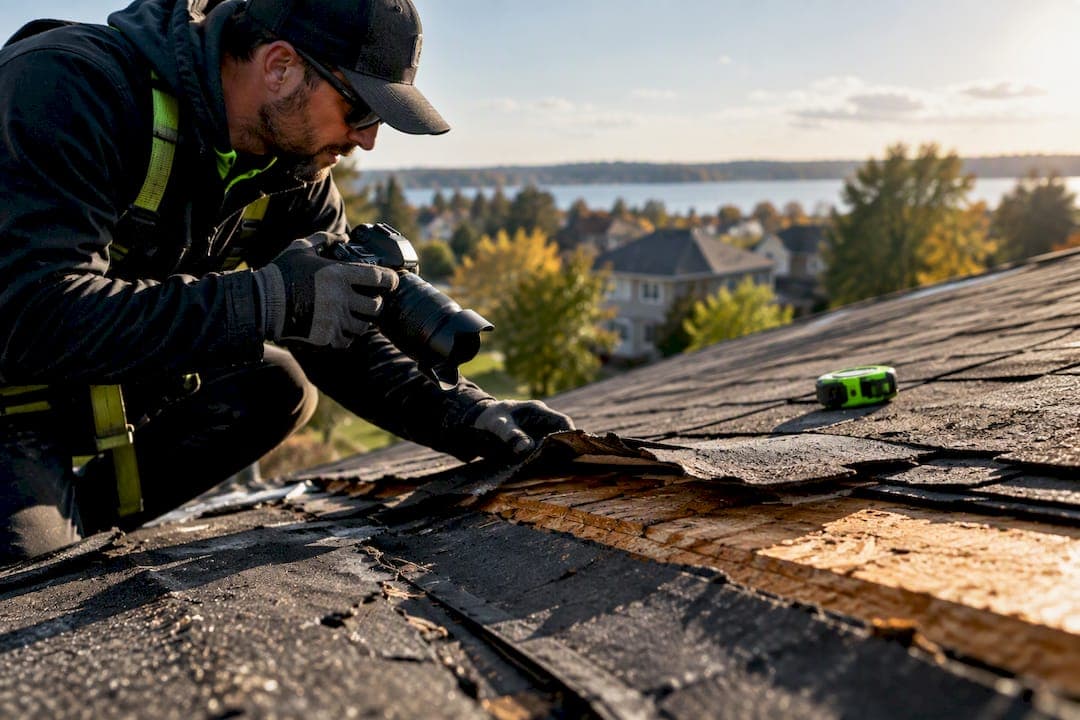
Yes, roof age changes how insurers underwrite and pay for your roof, and the shift usually starts earlier than most homeowners expect. Carriers commonly begin closer scrutiny around 15 years, switch settlement from replacement cost to depreciated payouts somewhere between 15 and 20 years, and consider non-renewal past 20 depending on the material. The one thing to do right now: pull your declarations page, confirm your settlement type, and line up proof of your roof's age and condition before your next renewal.
TL;DR:
- Roofs over 15 years old often face increased insurer scrutiny, shifted payout methods, or non-renewal, especially for asphalt shingles.
- Insurers verify roof age through inspections, permit records, contractor invoices, prior claims, and aerial imagery, not homeowner estimates.
- A depreciation-based payout (ACV) can significantly reduce claim amounts on older roofs, while replacement cost value (RCV) coverage remains more advantageous.
- Documenting roof details before renewal, including inspections, invoices, photos, and permits, helps maintain coverage and expedite claims.
- Metal, tile, or slate roofs typically avoid early scrutiny due to longer rated lifespans, unlike asphalt shingles, which are often flagged after 15 to 20 years.
Table of Contents
- What Insurers Look at: Age, Material, and Condition
- How RCV, ACV, and Roof Schedules Change Your Payout
- How Do Insurers Verify Roof Age and Condition?
- What to Do When Your Roof Is Near or Past the Threshold
- Your Renewal and Claims Documentation Checklist
- What Documentation Actually Convinces an Adjuster
- Why the Standard Advice on Roof Age Falls Short
- Get an Inspection Before Your Insurer Forces the Issue
- Sources
- FAQ
What Insurers Look at: Age, Material, and Condition
Roof age matters to an insurer for one reason: it predicts failure. An older roof is statistically more likely to leak under wind-driven rain, crack under hail, or lose shingles in a straight-line wind event, which drives up claim frequency and severity. That risk curve isn't gradual. It moves in identifiable steps.
- Around 10 years: some carriers start noting roof age in underwriting files, even without immediate action.
- Around 15 years: scrutiny increases, and many insurers request inspections or start flagging the policy for review, per Progressive's analysis of roof type and insurance.
- 15 to 20 years: this is the common window where insurers shift asphalt shingle roofs from replacement cost value to actual cash value or a payment schedule.
- 20 years and beyond: non-renewal becomes a real possibility for asphalt roofs specifically.
Material changes everything about this timeline. Metal, tile, and slate roofs routinely get rated for 40 to 50 years or more, so a 20-year-old standing seam roof doesn't trigger the same alarms as a 20-year-old three-tab shingle roof. Some states also regulate how insurers can treat older roofs. Florida, for instance, has statutory provisions limiting when insurers can deny coverage based solely on roof age if a qualified inspection shows adequate remaining life, an approach that illustrates how state rules can override a carrier's default cutoff. Check your own state's insurance department for the rules that actually apply to you.
How RCV, ACV, and Roof Schedules Change Your Payout
The dollar difference between settlement types is where roof age actually bites. Replacement Cost Value (RCV) pays what it costs to install a new roof of like kind and quality, with no deduction for age. Actual Cash Value (ACV) pays that same replacement cost minus depreciation, according to the Office of Public Insurance Counsel's breakdown of ACV and RCV. On a roof, depreciation adds up fast.
The math that catches homeowners off guard: a wind-damaged roof with a substantial replacement cost, on an older asphalt shingle roof, might get heavily depreciated under an ACV policy, resulting in a much smaller check than the full replacement cost, leaving the homeowner to cover the rest out of pocket or finance a partial repair instead.
Some carriers avoid the depreciation debate entirely by attaching a roof payment schedule or limited loss settlement endorsement. Instead of calculating depreciation at claim time, the endorsement sets a fixed payout percentage tied to roof age at the time of loss, often published right in the policy. Either way, the practical effect is the same: the older the roof, the smaller the check, unless the policy specifically guarantees RCV regardless of age. Reading your endorsement page matters as much as reading your coverage limits.

How Do Insurers Verify Roof Age and Condition?
Insurers rarely take a homeowner's word for it. Roof age is one of the most commonly misreported details on an application, and carriers have built several ways to check it.
- Physical inspections, either insurer-ordered or third-party, look at shingle wear, granule loss, flashing condition, and decking soundness.
- Aerial and satellite imagery, increasingly processed through predictive models, lets carriers estimate roof condition and age without ever sending someone to the property, a trend Moody's roof-age data analysis says is reshaping underwriting because self-reported ages are so often wrong.
- Permit records from the local building department show when a roofing permit was pulled, which often serves as the closest thing to an official install date.
- Prior claims history flags roofs that have already had partial repairs or previous payouts, which can affect how a new claim gets handled.
- Contractor invoices submitted at underwriting or claim time confirm materials, dates, and scope of work.
The biggest mistakes homeowners make: guessing at installation year, forgetting that a permit was never filed for a past repair, or assuming a shingle overlay counts as a full replacement when insurers typically don't count it that way. Credible proof means a dated invoice, a permit number, a certified inspection report, or a set of sequentially dated photos, not a memory of "sometime after we bought the house."
What to Do When Your Roof Is Near or Past the Threshold
A roof creeping toward 15 or 20 years old doesn't automatically mean lost coverage, but it does mean fewer easy options. Here's how homeowners typically work through it.
- Get a certified inspection first. A documented inspection showing sound decking and several years of remaining life can be enough to keep your current carrier and current settlement type.
- Target repairs instead of full replacement when the damage is limited and the inspection supports it, since replacing only what's failing can extend eligibility without the cost of a full new roof.
- Replace before renewal, not after a claim, when the roof is genuinely at the end of its life. A full, permitted, documented replacement resets the roof's age to zero and often restores RCV eligibility going forward, according to BriteCore's explainer on ACV and RCV.
- Consider a specialty or high-risk carrier if standard insurers decline, understanding that these policies usually cost more, often settle on ACV, and may carry more limited coverage forms, per Policygenius's guide to insuring an older roof.
Pro Tip: In some states, a homeowner-paid inspection showing more than five years of useful life left can stop a scheduled non-renewal before it happens. It's a few hundred dollars spent to protect coverage worth far more.
Repairs make sense when the roof still has real years left and the damage is isolated. Full replacement makes sense when you're stacking multiple repairs, losing RCV eligibility anyway, or facing a carrier that's already signaling non-renewal.

Your Renewal and Claims Documentation Checklist
Whether you're heading into a renewal or filing a claim, the paperwork you gather now determines how smoothly it goes later.
- Pull your declarations page and every endorsement attached to it, and confirm whether your roof is settled on RCV, ACV, or a fixed payment schedule.
- Gather contractor invoices, permit records, and any prior repair receipts, along with product and warranty information for the current roof.
- Take dated, sequential photos of the roof's current condition, not just after storm damage.
- Schedule any inspection 30 to 90 days before renewal, giving yourself time to act on the results.
- Know your RCV holdback window. Many replacement-cost policies release the depreciation holdback only after you submit a final invoice, commonly within 24 months of the loss.
- Ask your agent directly: Is this roof on ACV or RCV? Is there a roof-specific endorsement or payment schedule attached? Will you require a homeowner-paid inspection to avoid non-renewal?
What Documentation Actually Convinces an Adjuster
Contractors who work insurance claims regularly know which documents get a roof replacement approved on the first pass and which ones get kicked back for more information. Ask your roofing contractor for an itemized invoice showing installation dates, shingle or underlayment brand and model, manufacturer serial numbers where available, a copy of the pulled permit, and timestamped before-and-after photos. A contractor-prepared claim packet built from these pieces tends to move faster through adjuster review than a homeowner's own patchwork of receipts.
The most common pitfalls contractors end up fixing after the fact: no permit on file, an invoice too vague to confirm scope of work, or a shingle overlay that got mistaken for a true replacement. Documenting a full tear-off, with dated proof at every stage, is what separates a roof that reads as "new" to an insurer from one that still reads as its original age.
Why the Standard Advice on Roof Age Falls Short
Most guidance on roof age and insurance stops at the threshold numbers: watch for 15 years, worry at 20. That's useful but incomplete, because it treats every roof and every carrier the same. It isn't. A 22-year-old standing seam metal roof is a non-issue for most insurers. A 14-year-old asphalt roof in a hail-prone region can already be drawing scrutiny. The number matters less than what you can prove about condition and material.
The bigger gap in conventional advice is timing. Homeowners tend to think about roof age when a claim gets denied or a renewal notice arrives with a surprise. By then, options have narrowed to accepting ACV, paying for a rushed inspection, or shopping a specialty carrier at a higher premium. Acting 60 to 90 days ahead of renewal, before there's a crisis, is what actually preserves choice.
If there's one thing worth prioritizing over everything else in this guide, it's this: get your documentation in order before you need it, not after. A permit, an invoice, and a few dated photos cost almost nothing to gather now. They're worth real money the day a claim depends on them.
— Heather
Get an Inspection Before Your Insurer Forces the Issue
A local contractor can help homeowners get the documentation insurers want, rather than guessing a roof's age and hoping a claim goes through clean.
Owner-supervised installs mean the person who signs off on your roof is also the one standing behind the paperwork an adjuster will review. Am-exteriors provides certified inspections, insurance claims assistance, and full replacements using warranty-backed products like Malarkey shingles, all documented with the dated invoices, permit records, and photo evidence that carriers and adjusters look for first. That documentation is what speeds up a claim decision and cuts down on disputes over settlement type.
If your roof is approaching 15 years or you're staring down a renewal notice, request a free hail damage roof inspection or check current roof replacement options before your carrier makes the decision for you.
Sources
- ACV vs RCV basics — Office of Public Insurance Counsel (Texas)
- How roof types affect homeowners insurance — Progressive
- How to get homeowners insurance with a bad roof — Policygenius
FAQ
Will Insurance Cover a Roof Over 20 Years Old?
Coverage is still possible, but it typically comes with conditions. Many standard carriers require an inspection, switch settlement to ACV or a payment schedule, or decline renewal on asphalt shingle roofs past 20 years, though metal or tile roofs often avoid this entirely because they're rated for decades longer, according to Progressive.
Is a 13-Year-Old Roof Considered Old?
Not by most insurers. An asphalt shingle roof usually sits below the scrutiny threshold that typically begins closer to 15 years, so it should still qualify for standard coverage and replacement cost settlement in most cases. Condition and prior claims history matter as much as the number itself.
How Does Insurance Know Roof Age?
Carriers verify age through physical inspections, permit records, prior claims history, contractor invoices, and increasingly through aerial or satellite imagery processed with predictive models, since homeowner-reported ages are frequently inaccurate, as Moody's roof-age analysis points out. A dated contractor invoice or permit is the strongest proof you can offer.
Can You Insure a 12-Year-Old Roof?
Yes, a roof typically qualifies for standard homeowners insurance without special conditions, assuming no major visible damage or prior unresolved claims. Most carriers reserve added scrutiny, inspections, or settlement changes for roofs closer to the 15 year mark and beyond.