
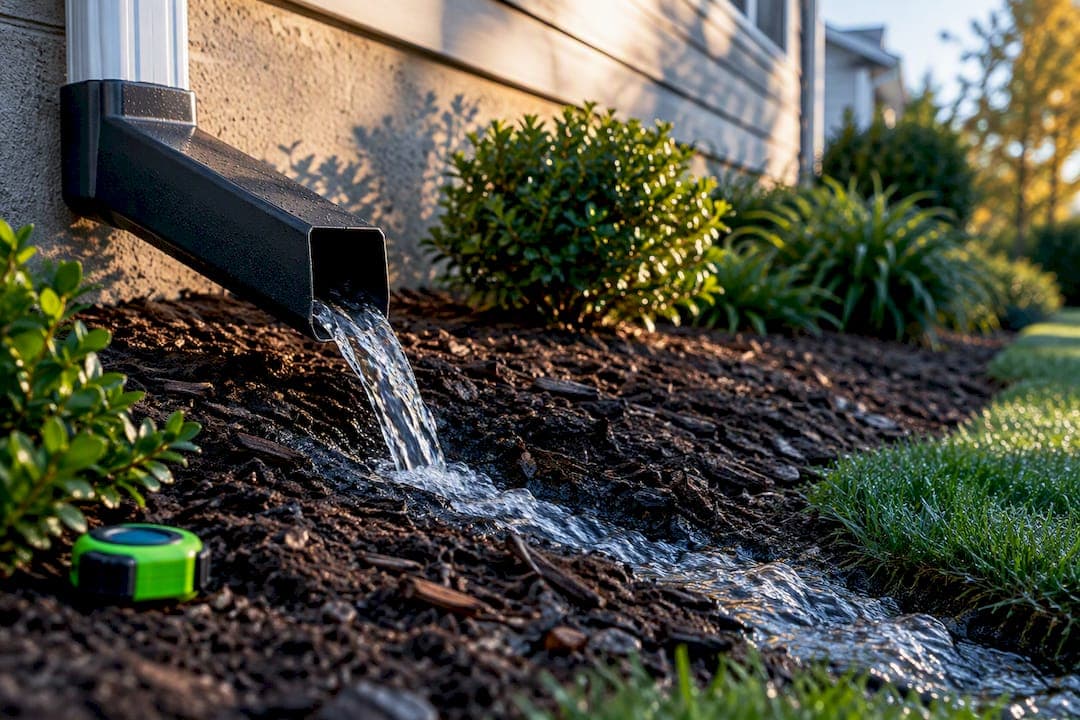
Your downspout extension should send water at least 5 feet from your foundation for a standard surface run. Homes with basements or heavy clay soil need 8 to 10 feet. If the downspout ties into an underground catchment system, the Building America / DOE guidance calls for 10 feet or more. Slope and soil type change these numbers. Persistent seepage or a buried line points you toward a professional.
TL;DR:
- Water should be discharged at least 5 feet from the foundation for typical lots, but 8 to 10 feet is recommended for homes with basements or clay soil.
- Homes with underground catchment systems require downspout extensions of 10 feet or more to ensure proper drainage.
- Conduct a hose test and soil squeeze check before installation to determine if your yard has proper slope and soil drainage capacity.
- Flat or clay-heavy soil conditions necessitate longer extenders and careful slope management; sandy or loamy soil usually allows shorter distances.
- Proper slope during installation means a downward pitch of roughly 1/4 inch per foot for above-ground extenders and 5/8 inch per foot for buried lines.
Table of Contents
- Quick rules and a homeowner checklist
- How soil, slope, and foundation type change the required distance
- Types of downspout extensions and how far each one reaches
- Getting the slope and route right during installation
- Buried lines versus above-ground extenders over time
- DIY versus hiring a pro, and what it costs
- What AM Exteriors sees in the field
- Why the standard advice undersells site conditions
- Get a properly measured drainage plan from a professional exterior home improvement contractor
- Sources
- FAQ
Quick rules and a homeowner checklist
Start with the numbers, then check your yard against them.
- Under 4 feet: high risk. Water pools near the footing and can seep into a crawlspace or basement.
- 5 feet: the general minimum for surface discharge on most lots, per Building America Solution Center guidance.
- 8 to 10 feet: recommended for homes with basements or heavy clay soil that drains slowly.
- 10 feet or more: required when the downspout connects to an underground catchment system, dry well, or French drain.
Run a hose test before you buy anything. Pour water at the downspout base and watch where it settles after two or three minutes. If it puddles near the foundation, your current setup is too short or too flat.
Check slope with a 4-foot level or a string line pulled taut from the foundation outward. The ground should drop away from the house, not toward it. A quick soil test helps too: squeeze a handful of damp soil. If it holds a tight ball and feels slick, you have clay and need extra length. If it crumbles, you're likely in sand or loam and closer to the 5-foot minimum.

Easy fixes for most yards include repositioning a splash block, adding a rigid 4 to 6 foot extender, or routing the discharge to a dry well if the yard is flat.
Pro Tip: Run the hose test after a dry week, not right after rain. Saturated soil hides drainage problems that show up clearly once the ground has had time to dry.
How soil, slope, and foundation type change the required distance
A basement foundation sits below grade and faces hydrostatic pressure from water in the surrounding soil. Water dumped within 3 to 4 feet of that wall raises the risk of seepage, which is why Building America / DOE recommends pushing basement discharge out to 8 to 10 feet rather than the standard 5.
Soil type drives drainage speed:
- Sandy or loamy soil absorbs water quickly, so a shorter extender generally suffices.
- Heavy clay drains slowly and holds water near the surface, requiring a longer extension than the minimum.
- Compacted or graded fill near new construction often behaves like clay even when the native soil doesn't, so test it directly rather than assuming.
Slope interacts with all of this. A yard that drops even slightly away from the house moves water faster and can work with the shorter end of these ranges. A flat lot needs the longer distance because there's no natural pull carrying water away. Measure slope with a level or a string and stakes: a barely visible incline is often enough, but zero incline means you need either more length or a French drain.
Building America Solution Center recommends pitching lateral piping at roughly 5/8 inch per foot away from the foundation, which keeps water moving even on nearly flat sites.

Types of downspout extensions and how far each one reaches
Each option trades reach, cost, and permanence differently.
- Rigid aluminum extenders typically run 4 to 6 feet per section and connect easily to standard downspouts. They're durable and visible, which makes them a solid choice for a short, permanent run along a side yard.
- Flexible corrugated sleeves stretch and bend around obstacles, so they suit renters or anyone needing a quick, temporary fix. They trap leaves and debris more easily than rigid pipe, so expect to clean them out more often.
- Splash blocks and rock beds cost little and work fine when the yard already slopes well and the goal is just to break up the water's fall, not send it far. They rarely provide enough reach on their own for basements or clay soil.
- Buried lateral pipe, usually Schedule 40 PVC, carries water underground to a discharge point 10 feet or more from the house. This Old House notes this option requires trenching and a pitched line, but it's the right call when a visible extender would cross a walkway, driveway, or mowed lawn area.
Match the type to the site: short, sloped, sandy yards do fine with rigid extenders or splash blocks, while flat lots and basement foundations usually need buried pipe to hit the recommended distance without leaving a tripping hazard across the lawn.
Getting the slope and route right during installation
Length only works if the water actually flows downhill the whole way. Follow this sequence:
- Check the slope target. Above-ground extenders need roughly 1/4 inch of drop per foot, according to Bob Vila's installation guidance. Buried lines need closer to 5/8 inch per foot.
- Set elbow height. Position the first elbow 6 to 12 inches above ground level so gravity carries water into the extender without backflow toward the downspout.
- Lay out the route with stakes and string. Mark the path from the downspout to the termination point before digging or attaching anything, and confirm it clears mower paths, garden beds, and walkways.
- Pick a termination point on permeable ground, not over a patio, driveway, or sidewalk, where water would just run right back toward the house.
- Test with a hose before calling the job finished.
The most common mistakes are ending the run over pavement, skipping the slope check and assuming gravity will handle it, and installing an extender so short that runoff simply pools and creeps back toward the foundation anyway.
Pro Tip: If the ground near your termination point still looks damp a day after rain, the water isn't draining fast enough there. Move the endpoint or add a small gravel bed to help it disperse.
For homes dealing with broader roof drainage issues beyond a single downspout, a flat roof drainage assessment can help identify where water collects before it ever reaches the gutter.
Buried lines versus above-ground extenders over time
Buried drain lines stay out of sight and out of the way of mowers, which matters if the discharge point needs to cross a lawn. The tradeoff is trenching cost upfront and a real freeze risk in cold climates, since water sitting in a shallow pipe can ice over and back up. Contractors mitigate this with an air-gap technique at the transition point and by installing cleanouts at low spots so the line can be flushed if it clogs.
Above-ground extenders cost less and take minutes to clean or replace, but they sit in the open. That means they can get mowed over, kicked loose, or tripped on if placed across a walking path.
A simple maintenance routine keeps either system working:
- Check extenders and buried outlets each spring and fall for clogs or crushed sections.
- Install a leaf guard at the gutter if falling debris is a recurring problem.
- Clear cleanouts on buried lines before the ground freezes.
- Disconnect and drain flexible sleeves before winter if your region sees hard freezes.
Homes in colder regions often benefit from reviewing ice and water shield guidance alongside their drainage plan, since both address how the roof system handles freeze and thaw cycles together.
DIY versus hiring a pro, and what it costs
Attaching a rigid extender, placing a splash block, or running a short flexible sleeve are all reasonable DIY jobs with basic hand tools and maybe an hour of time.
Burying a lateral line, regrading a yard, or diagnosing recurring basement seepage are different jobs. These involve digging to the right depth, maintaining consistent pitch over a long run, and sometimes tying into an existing drainage system, work better suited to a contractor who does it regularly.
On cost, This Old House puts DIY materials for two downspout lateral runs at roughly $250 to $500, with full trenching and installed buried systems running higher once labor or equipment rental enters the picture.
Before hiring anyone, ask:
- What slope will the buried line maintain, and where will cleanouts go?
- Will the work disturb existing landscaping or septic lines?
- Is there a written scope of work and a warranty on the installation?
If you're also dealing with gutter sizing or spacing questions, a seamless gutter vetting checklist covers what to ask before signing a contract.
What AM Exteriors sees in the field
Most downspout drainage failures trace back to workmanship, not materials. A properly rated extender or a well-sized buried line still fails if the slope wasn't checked or the termination point wasn't verified before backfilling. Owner-supervised installation catches those details before they become a callback.
In cold-climate regions, buried drains near the surface are worth a seasonal check for ice blockage, particularly at the transition point between the downspout and the underground run. A quick visual inspection each fall, before the ground freezes, catches most problems early.
When you bring a contractor in for an estimate, ask for documented measurements of slope and termination distance, not just a verbal assurance. For related repair work, the Dodge County gutter and downspout repair page outlines what a professional inspection typically covers.
Why the standard advice undersells site conditions
Most guides hand you a single number and move on. That number is a reasonable floor, not a finished answer. The real variable is what's underneath your yard, not what's printed on the extender box. A 5-foot rigid extender on sandy soil with a gentle slope does the job completely. The same 5 feet on flat clay next to a basement wall barely slows the problem down.
The advice that gets skipped most often is the soil test. It takes thirty seconds and tells you more than any length chart. Homeowners who skip it tend to buy the shortest, cheapest extender, watch water pool anyway, then blame the product instead of the setup.
If you take one thing from this guide, prioritize the hose test and the soil squeeze test before buying anything. They tell you which bracket you're actually in. Length matters, but only once you know what you're draining into.
— Heather
Get a properly measured drainage plan from a professional exterior home improvement contractor
If your downspout keeps sending water back toward the house no matter how many extenders you add, the issue is often bigger than the downspout itself: grading, gutter capacity, or a roofline that's overwhelming the system it feeds. A professional contractor inspects the whole picture, not just the last few feet of pipe, and documents what's actually happening before recommending a fix.

Homeowners in Southeast Wisconsin dealing with recurring water problems near the foundation, storm damage, or gutters that no longer keep up with roof runoff can start with a roofing and gutter services overview to see what a full inspection covers. Proper installation means checking slope and termination points before the job is called finished, not after water shows up where it shouldn't.
Ready to get your drainage checked properly? Request an inspection and get a documented plan instead of a guess.
Sources
- Stormwater, Gutters & Downspouts | Building Science Education
- Gutters and downspouts | Building America Solution Center
- This Is the Right Length for Your Gutter Downspouts - Bob Vila
- How To Extend a Downspout - This Old House
FAQ
Can you put a 3x4 downspout on a 5 inch gutter?
Downspout size is generally matched to the gutter's water capacity rather than a fixed rule tied to gutter width alone, and a 3x4 downspout is a common pairing for many residential gutter systems. Confirm sizing with the gutter manufacturer's specifications or a contractor, since capacity depends on roof area and rainfall intensity, not gutter size alone.
Do downspout extenders really work?
Yes, when they're the right length and properly sloped. Building America Solution Center guidance shows that extending discharge at least 5 feet from the foundation, or 10 feet for underground catchment connections, meaningfully reduces the risk of soil saturation and seepage near the home.
How far should a downspout extension be from a house?
At least 5 feet for a standard surface discharge, according to Building America / DOE guidance. Homes with basements or heavy clay soil should extend to 8 to 10 feet, and connections to underground catchment systems need 10 feet or more.
What is the rule of thumb for downspouts?
The general rule is 5 feet minimum from the foundation for surface runs, per Building America / DOE, with longer distances for basements, clay soil, or buried catchment connections. Extenders also need a slight downward slope, roughly 1/4 inch per foot above ground, to keep water moving instead of pooling.