
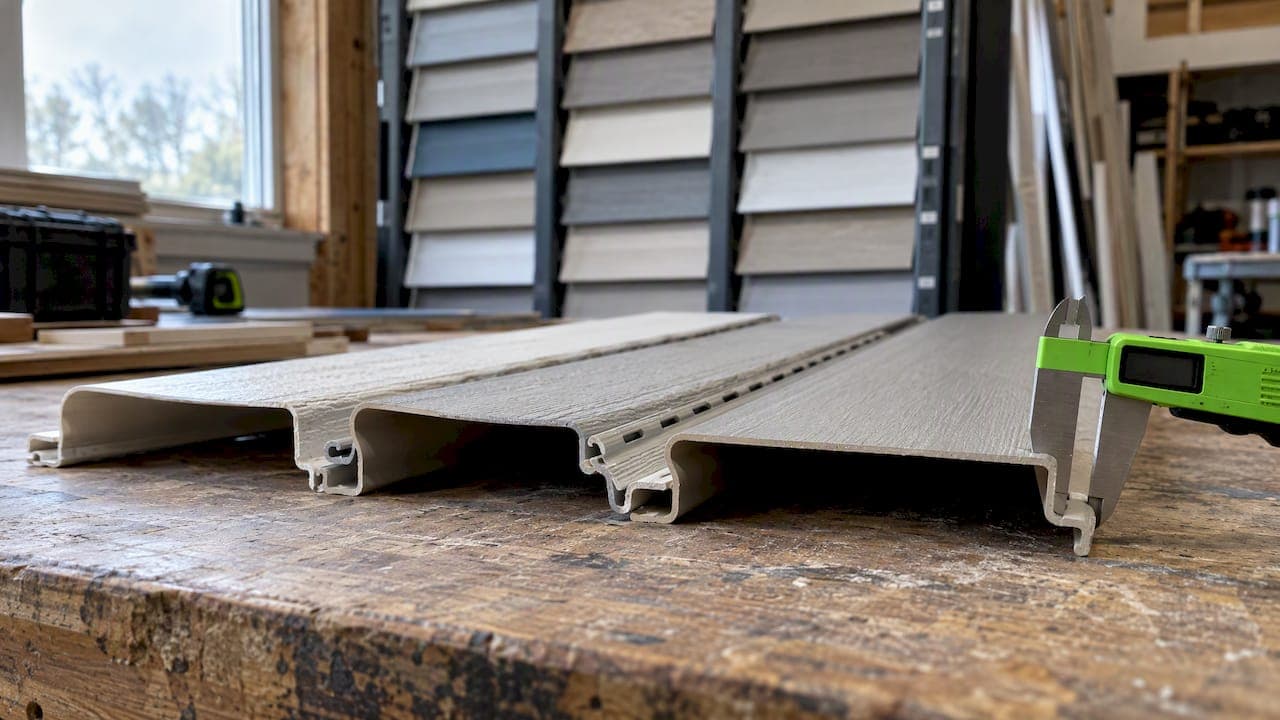
Vinyl siding is sold in thickness grades that run from about .035 inch to about .055 inch. Economy panels sit at the thin end. Premium panels sit at the thick end. Thicker panels are stiffer and usually cost more. But thickness is only one factor. Installation quality, wind rating and certification matter just as much.
This guide shows the grades, what each one is good for, and how to read a quote. It also covers the terms that confuse buyers, like D4 and D5.
TL;DR
- Residential vinyl siding must meet ASTM D3679. Common grades run from about .040 to .050 inch, and many premium lines sit at .046 inch.
- "D4" and "D5" describe the panel profile. They do not describe thickness or quality.
- Thicker panels are stiffer and resist waviness better. They do not fix bad installation.
- Look for the VSI-certified label and a published wind design pressure rating, not only a thickness number.
- Insulated vinyl is a different product, not just a thicker panel.
Table of Contents
- How vinyl siding thickness is measured
- The minimum standard: ASTM D3679
- Vinyl siding thickness grades compared
- Is .046 vinyl siding good?
- What thickness changes, and what it does not
- D4 and D5: what the letters mean
- Wind rating matters more than thickness
- Installation decides how long vinyl lasts
- Perspective: how we choose vinyl thickness
- Insulated vinyl siding is a different product
- How thickness affects cost
- How to choose a vinyl thickness: a checklist
- When vinyl is the wrong choice
- Get a siding quote with the specs in writing
- FAQ
- Sources
How vinyl siding thickness is measured
Thickness is measured in decimal inches. A panel listed as .044 is 44 thousandths of an inch thick. That is roughly the thickness of a few sheets of paper stacked together.
Two details change how you read the number:
- Nominal thickness. Manufacturers list a nominal value. Real panels vary slightly across the profile.
- Where it is measured. Panels have ridges, shadow lines and a nailing hem. The hem is usually thicker than the face. Compare nominal numbers, not measurements from a scrap piece.
Some sources and spec sheets list thickness in millimeters. A .040 inch panel is about 1.0 mm. A .046 inch panel is about 1.17 mm. Convert before you compare quotes from different sources.
The minimum standard: ASTM D3679
Vinyl siding must meet or exceed ASTM D3679, the standard specification for rigid PVC siding, according to the Vinyl Siding Institute installation manual. Products in the VSI certification program are verified by independent third parties against that standard.
For residential panels, the commonly cited floor is 0.035 inch. That is the legal-style minimum for a certified product. It is not what most contractors want on a house.
Treat 0.035 as the bottom of the range, not a target. Panels at that thickness meet the standard. They also flex more in wind and show more waviness on long, sunny walls.
Vinyl siding thickness grades compared
There is no single legal grading system. Each manufacturer names its own lines. Names like "builder," "standard" and "premium" are marketing labels. The numbers below are typical ranges you will see across the industry.
| Grade | Typical thickness | Typical use | What to expect |
|---|---|---|---|
| Economy | .035 to .040 inch | Rentals, sheds, quick fixes | Flexes more, shows waves sooner, thinner profile |
| Builder or standard | .040 to .044 inch | Budget replacement, tract homes | Acceptable on sheltered walls, more noise in wind |
| Mid-grade | .044 to .046 inch | Most whole-house replacements | Good balance of cost and rigidity |
| Premium | .046 to .050 inch | Exposed walls, long runs, higher-end homes | Stiffer, flatter on the wall, often better wind ratings |
| Top of range | About .050 to .055 inch | Custom or high-wind projects | Heaviest wall feel, highest cost |
A premium product line commonly sits at .046 inch, with other offerings starting at .040 or reaching .050. That matches what you will see on most spec sheets.
Two cautions on the table. First, a thicker panel from a weak line can still perform worse than a thinner panel from a strong line. Second, ranges overlap. A .046 panel from one maker may have a better profile and formulation than a .048 panel from another.

Is .046 vinyl siding good?
Yes. A .046 panel is a solid, widely used thickness for whole-house replacement. It is stiff enough to stay flat on most walls and sits in the range most premium lines use.
For most homes in Southeast Wisconsin, .046 is a sensible target if the panel also carries a VSI certification and a clear wind rating. Going thinner saves money up front. Going thicker adds cost, and you only see the benefit on very exposed or very long walls.
What thickness changes, and what it does not
Thicker vinyl does these things:
- Feels more rigid. Thicker panels resist sagging and rippling on the wall.
- Looks flatter. Light shows waves in thin panels, especially on south and west walls.
- Handles handling better. Panels are less likely to crack or kink during installation.
Thicker vinyl does not do these things:
- It does not add insulation. Solid vinyl has almost no R-value. Insulation needs foam.
- It does not fix poor fastening. A thick panel nailed too tight still buckles.
- It does not guarantee impact resistance. Hail damage depends on many factors. See our post on which siding actually holds up to hail.
- It does not replace a wind rating. More on that below.
Premium thickness is also often paired with other upgrades: better color retention, deeper wood-grain embossing and longer warranties. Part of what you pay for is those features, not only the extra mils.
D4 and D5: what the letters mean
Shoppers often ask about the difference between D4 and D5 vinyl siding. It is not a thickness grade.
The "D" stands for double. A D4 panel shows two rows of siding, each with a 4 inch exposure. A D5 panel shows two rows at 5 inches. The VSI installation manual describes these profile types. Both are offered in several thicknesses.
So a D4 panel can be thin or thick. A D5 panel can be thin or thick. Choose the profile for how the house looks. Choose the thickness for how the panel performs. Treat them as two separate decisions.
Wind rating matters more than thickness
A thickness number is easy to market. A wind rating is harder to fake. Certified manufacturers label products with a design pressure rating, tested under ASTM standards. The same VSI manual describes this certification system. Homeowners in windy regions should look for the VSI-certified label on the carton and compare that rating across products.
Wisconsin gets strong straight-line winds and storm fronts across open land. If your home faces a field, a lake or a wide street, ask for the design pressure rating in writing. A thicker panel with a weak rating is a poor buy. A .044 panel with a strong rating, installed correctly, can outperform it.
Related: the wall behind the panel matters too. Our guide to house wrap under siding covers the contractor rules that keep moisture out.
Installation decides how long vinyl lasts
Most vinyl problems trace to installation, not grade. The VSI manual says panels must move freely. That means:
- Nail in the center of the slot. The slots let the panel expand and contract.
- Do not drive nails tight. Leave a small gap between the nail head and the hem so the panel can slide.
- Leave expansion gaps. The manual calls for about 1/4 inch generally, and 3/8 inch when temperatures are below 40°F.
- Never face-nail panels. Face nails lock the panel in place.
When panels cannot move, they ripple and buckle as temperatures change. Wisconsin swings from well below zero to above 90°F. That is a wide range for plastic to move. A thick premium panel installed tight will still buckle. A mid-grade panel installed correctly will usually stay flat.
That is why installer quality belongs on your checklist ahead of the thickness line.
Perspective: how we choose vinyl thickness
We install vinyl, LP SmartSide and James Hardie on homes across Southeast Wisconsin. We have been owner-operated for over 25 years. Our view is simple: most siding failures come from poor workmanship, not from the material.
So we do not start a siding conversation with a thickness number. We start with the wall. How exposed is it? How long are the runs? What is behind the old siding? What does the climate do to it across a year?
Then we recommend a panel. For most whole-house vinyl projects, we point homeowners to a premium line with a certified wind rating and an extended warranty, because the extra cost is small against the total project and the panel stays flatter. We also tell homeowners when a different material suits them better. If a house takes heavy hail or wind, vinyl may not be the best fit, and we say so.
We document the work, explain each step and supervise the installation. That is how thickness grades turn into a wall that lasts.
— Heather
Insulated vinyl siding is a different product
Buyers sometimes confuse "thicker" with "insulated." They are not the same.
Insulated vinyl siding is vinyl with rigid foam permanently attached to the back, usually expanded polystyrene. The Building America Solution Center describes it as vinyl siding with integrated rigid foam. It can reduce thermal bridging, and it is recognized under the IECC as a form of continuous insulation.
Documented R-values for these products are typically between R-2.0 and R-3.0, per the same resource. That is a modest gain, but it is real, and it does not depend on panel thickness.
Also note the difference between laminated foam and a loose "drop-in" backer. They are not the same product. Ask which one your quote includes. We offer insulated vinyl as part of our siding line. See our siding services for the options.

How thickness affects cost
Thickness raises price, but not as much as people expect. Material is only one part of a siding job. Labor, removal of old siding, wall prep, trim, flashing and house wrap all add cost. Moving from a mid-grade to a premium vinyl panel usually changes the total by a small share of the project.
Our published ranges for Southeast Wisconsin siding projects are:
| Siding type | Published range |
|---|---|
| Vinyl Siding | 12000-20000 USD |
| LP SmartSide | 18000-32000 USD |
| James Hardie | 25000-45000 USD |
The detail behind those ranges is on our siding replacement cost page. Final price depends on the size of the house, number of stories, trim, and the condition of the wall under the old siding.
If you want to compare vinyl against other materials, our post on LP SmartSide vs. premium vinyl vs. James Hardie lays out the tradeoffs. For resale value, see siding replacement ROI.
How to choose a vinyl thickness: a checklist
Use this list when you compare quotes.
- Confirm certification. Ask for the VSI-certified label on the product.
- Get the exact product line and nominal thickness in writing. "Premium vinyl" is not a spec.
- Ask for the wind design pressure rating. Compare it between products.
- Set a floor. For a full replacement, aim for about .044 inch or more, and consider .046 inch for exposed walls.
- Ask about insulation. If you want it, ask for laminated foam, and ask for the R-value.
- Ask how panels are fastened. The answer should mention center-of-slot nailing and expansion gaps.
- Check the warranty. Read what it covers, and what installation conditions it requires.
- Ask for documentation. Photos and a written scope protect you later.
The first six items cost nothing to ask. They also show you quickly which contractors know their work.
When vinyl is the wrong choice
Vinyl suits many Wisconsin homes. It is not right for every wall.
- Heavy hail exposure. Hail can crack or dent vinyl, especially in cold weather when it is more brittle.
- Walls near high heat. Grills, reflected sun from low-E windows and nearby heat sources can warp vinyl.
- Homes where you want a painted, wood-like finish. Engineered wood or fiber cement fits better.
If you are weighing options, start with our overview of LP SmartSide, James Hardie and vinyl siding in Wisconsin. If your siding is damaged but not ready for replacement, our siding repair service covers vinyl, LP SmartSide and hail damage in Dodge County.
Get a siding quote with the specs in writing
We install vinyl, LP SmartSide and James Hardie across Dodge, Washington, Fond du Lac and Ozaukee counties. Every quote names the product line, the thickness, the rating and the warranty. Our installations are owner-supervised, and we document the work from start to finish.
View pricing ranges on the siding replacement cost page, or visit am-exteriors.com to request an estimate.
FAQ
What is the best thickness for vinyl siding?
For most whole-house replacements, .044 to .046 inch is a good target. Use .046 inch or more on exposed walls or long runs. Always pair thickness with a VSI certification and a wind rating.
What are the different grades of vinyl siding?
There is no single official grading scale. Manufacturers name their own lines, such as economy, builder, mid-grade and premium. These generally track thickness, from about .035 inch at the low end to about .050 inch or more at the top.
What is the difference between D4 and D5 vinyl siding?
D4 and D5 are profiles, not quality grades. "D" means double, so D4 shows two rows of 4 inch exposure, and D5 shows two rows of 5 inch exposure. Both come in several thicknesses.
Is thicker vinyl siding always better?
No. Thicker panels are stiffer and stay flatter. But a thick panel installed tightly, without room to expand, will still ripple and buckle. Installation quality and wind rating matter as much as the number.
Does thicker vinyl siding insulate better?
No. Insulation comes from foam attached to the back of the panel. Insulated vinyl commonly carries R-values between R-2.0 and R-3.0, no matter how thick the vinyl is.
Sources
- Vinyl Siding Institute installation manual
- ProMatcher: Grades and Thickness of Vinyl Siding
- ProVia Ultra siding product document
- Building America Solution Center: Vinyl siding with integrated rigid foam