
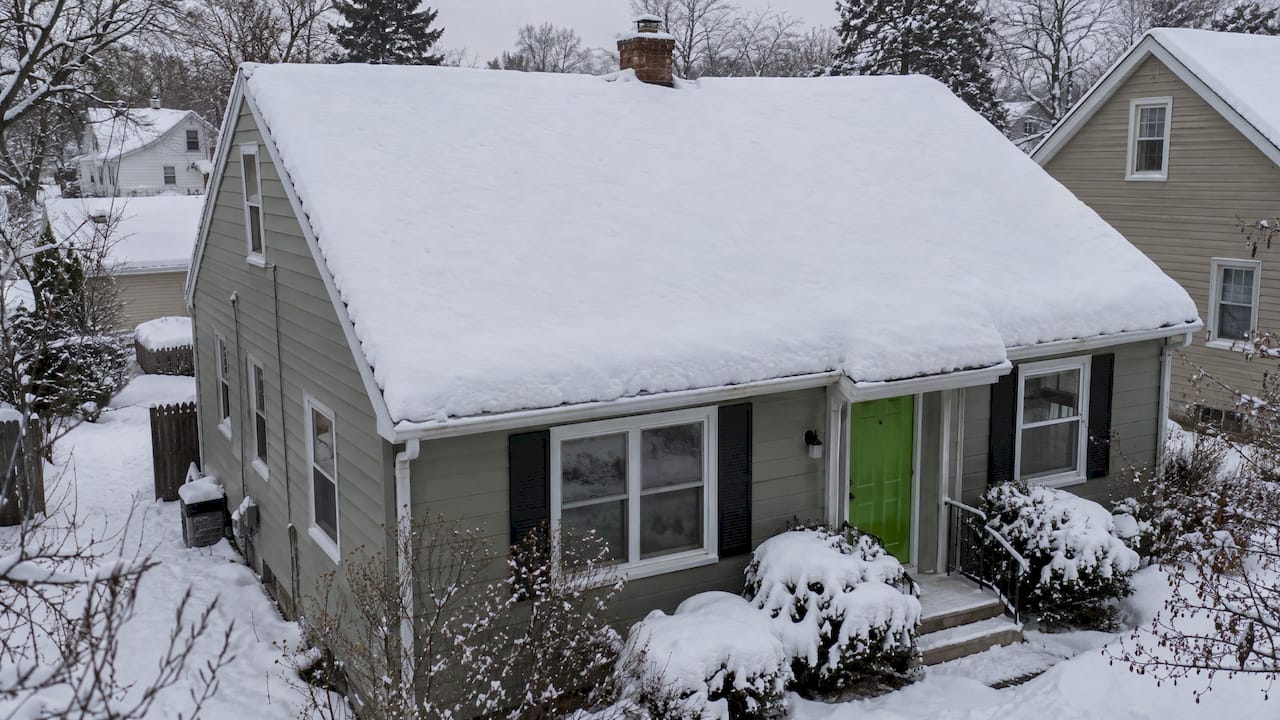
Wisconsin's building code requires new homes to be designed for a minimum roof snow load of 30 or 40 pounds per square foot (psf), depending on where the house sits. That number is a design minimum for new construction. It does not tell you how much snow your roof can carry today. Age, repairs, ventilation, roof shape and drifting all change that. This guide explains the rule, shows how to estimate the weight of snow on your roof, and lists the warning signs that mean you should act.
TL;DR
- Wisconsin's Uniform Dwelling Code sets a minimum roof snow load of 30 or 40 psf, depending on the zone. Northern Wisconsin gets the higher figure.
- One inch of snow weighs roughly 1 to 1.5 pounds per square foot. Wet, packed snow and ice weigh the most.
- Drifts, valleys and lower roofs next to taller walls collect more snow than the rest of the roof.
- Sagging, creaking, sticking doors and new cracks are warning signs. Leave the building and call a qualified engineer.
- A roof inspection before winter tells you the condition of the roof. The code number does not.
Table of Contents
- What Wisconsin requires
- Ground snow load and roof snow load are not the same
- How heavy is snow on a roof?
- Why attic heat and ice make loads worse
- Warning signs of a overloaded roof
- Roof condition decides how a roof handles snow
- Storm damage and insurance
- Our view on snow and roofs
- Have your roof inspected before the next snowfall
- FAQ
- Sources
What Wisconsin requires
Wisconsin sets roof snow loads for one- and two-family homes in the Uniform Dwelling Code (UDC). The UDC is the state's building code for houses. The rule sits in Wisconsin Administrative Code SPS 321.02. It says roofs must support the minimum snow loads shown on the zone map. The load is counted straight down over the roof area as seen from above, not along the slope.
The state's commentary on the code says the minimum is 30 or 40 psf, applied uniformly. "Uniformly" means the same load over the whole roof.
What "psf" means: pounds per square foot. A 30 psf roof is designed to carry 30 pounds on every square foot of its footprint.
Which zone are you in?
The map splits the state roughly north and south. A WXPR report from March 2019 gives Oneida County in the north as a 40 psf example and Dane County in the south as a 30 psf example. Check the official zone map in the code for your county. If you live in Dodge, Washington, Fond du Lac or Ozaukee County, look up your zone there rather than assuming.

What the number does not tell you
The code figure is a minimum for the design of a new house. It does not account for:
- how old your roof framing and decking are
- past leaks that soaked the wood
- changes made during later remodels
- how much snow is on the roof right now
Treat it as the starting point of the discussion, not a guarantee.
Ground snow load and roof snow load are not the same
Ground snow load is the weight of snow that builds up on open ground. The Building America resource guide, drawing on the IRC, ASCE 7-16 and IBHS, notes that ground snow load does not necessarily equal the weight on a roof.
Roof load depends on:
- local ground snow load
- the shape of the building
- the type of snow
- total snowfall over the season
- ice
- snow sliding down from a higher roof
- temperature and insulation under the roof
The same guide explains that wind and roof shape can pile snow unevenly. Some roof areas can carry loads well above the ground snow load.
Where snow collects
The state commentary says drifting and sliding snow should be considered as good design practice. That matters most on complex roofs, especially low areas below higher roofs.
Check these spots on your own house:
- Valleys where two roof planes meet
- Lower roofs beside a second-story wall
- Dormers and chimneys that block wind and create drifts
- Leeward sides of the roof, away from the prevailing wind
- Garage and porch roofs attached to a taller house
Steep roofs and slick surfaces
The UDC allows a reduced snow load for roofs sloped 7 in 12 or steeper. It does not set reduced loads for glass or other slippery roof surfaces. Steep pitch helps snow slide off, but a slide can dump snow onto a lower roof.
How heavy is snow on a roof?
Snow weight depends on how much water it holds. The National Research Council of Canada gives a rough rule: about 1 to 1.5 pounds per square foot for each inch of snow, for snow with a specific gravity of about 0.2 to 0.3. Light powder weighs less. Wet snow weighs more. This is an estimate, not a Wisconsin code limit.
| Snow depth on roof | Rough weight at 1 lb/ft² per inch | Rough weight at 1.5 lb/ft² per inch |
|---|---|---|
| 6 inches | 6 psf | 9 psf |
| 12 inches | 12 psf | 18 psf |
| 20 inches | 20 psf | 30 psf |
| 30 inches | 30 psf | 45 psf |
Can a roof hold 20 inches of snow?
Usually a sound roof can. Twenty inches of dense snow comes to about 20 to 30 psf by this rule. That is near the 30 psf design minimum for southern Wisconsin, and under the 40 psf figure for the north. Two cautions:
- The estimate is rough. Rain on snow or a thaw and refreeze can raise the weight fast.
- The estimate is an average. A drift in a valley can hold far more than the open roof.
A roof in good shape, with sound framing and dry decking, has the best chance. A roof with old leaks, rot or sagging has less.
How much snow is too heavy?
There is no single depth that applies to every house. Use these as signals, not as limits:
- Deep snow after rain or a warm spell
- Large drifts on one section of the roof
- Ice built up on top of snow
- Any of the warning signs listed below
How to estimate your own roof
- Measure the snow depth in a few spots you can see from the ground, such as a garage roof or a low porch.
- Judge whether the snow is light and dry, or wet and packed.
- Multiply depth in inches by 1 for light snow and 1.5 for wet snow.
- Compare the result with 30 or 40 psf for your zone.
- Remember the real number is higher in drifts.
Do not climb on a snowy roof to measure. Work from the ground.
Why attic heat and ice make loads worse
Heat that leaks into the attic melts snow from below. Meltwater runs to the cold eave and refreezes as an ice dam. That ice is heavy, and it pushes water under shingles. The building guide lists below-roof temperature and insulation as a factor in roof load. Air sealing and insulation in the attic keep the roof deck cold. Ice dam prevention examples show how insulation work is used to reduce this problem.
Ventilation matters too. A poorly ventilated attic runs warm in winter and hot in summer, and that wears out roofing early. Our guide on attic ventilation and roof lifespan in Wisconsin covers it. For repairs and ice dams through the season, see roof care in a Wisconsin winter.

Warning signs of a overloaded roof
The federal guidance lists these signs of possible structural overload:
- sagging or bowed truss chords or ceiling panels
- creaking or cracking sounds
- doors or windows that stop opening and closing normally
- new cracks in drywall, plaster or framing
If you see them, FEMA advises occupants to evacuate and contact a qualified design professional, such as an experienced professional engineer, for a detailed inspection. If collapse is a concern, stop snow removal and leave the building. Call 911 if someone is in danger.
A roof contractor handles roofing. A structural question belongs to an engineer. Once the engineer clears the house, we can inspect the roof covering and repair what the winter damaged.
Roof condition decides how a roof handles snow
Snow load is mostly a framing question, but the roof covering and decking show how a house has aged. These are common trouble spots after a heavy winter:
- Shingles that lifted or cracked under ice
- Flashing that let meltwater in at chimneys and valleys
- Wet or stained decking, seen from the attic
- Gutters pulled loose by ice
- Stains on ceilings under the roof edge
Most of these show up in a good inspection. If the roof is near the end of its life, a straight repair-versus-replace answer saves money. Read how to know when your Wisconsin roof is done.
What a replacement costs
Our published range for a roof replacement is $7,500 to $18,000. Size, pitch, roof shape and material move the price. The full breakdown is in our roof replacement cost guide for Wisconsin.
Storm damage and insurance
Heavy snow, ice dams and wind can all damage a roof. Hail and wind damage are different events, but the steps are alike: document, inspect, file. Photograph damage before you move anything. Keep dated notes. Use the hail storm roof inspection checklist as a guide to what to record.
We help homeowners with insurance claims and keep detailed documentation of the work. See our storm damage roof repair guide for Wisconsin homeowners.
Our view on snow and roofs
Most roof failures we are asked about come from workmanship, not from the snow. A roof that is installed correctly, with sound decking, flashing and ventilation, is built to handle a Wisconsin winter.
That is why our crews work under owner supervision. We have 25 years of owner-operated experience with hail, high winds and heavy snow. Details such as valleys, flashing and eaves are where a roof either holds or fails.
We also give honest repair versus replacement advice. If a repair is enough, we say so. If the roof is done, we explain why and show the documentation.
We install premium products, including Malarkey shingles, with extended warranties. We also respond quickly to storm damage and leaks.
Heather
Have your roof inspected before the next snowfall
If your roof is older, has leaked before, or has valleys and lower roofs that collect drifts, an inspection gives you facts. We inspect and repair roofs across Dodge, Washington, Fond du Lac and Ozaukee Counties, and we replace roofs when repair is not enough. Our roofing services page lists repair, storm damage work, standing seam metal and more.

If hail may have hit your roof, ask about our free hail damage roof inspection. Not sure who to hire? Read our guide to choosing a roofing contractor in Wisconsin.
FAQ
What snow load do I need in Wisconsin?
The Uniform Dwelling Code sets a minimum roof snow load of 30 or 40 psf, depending on the zone map. Northern counties are in the higher zone. Check the map in SPS 321 for your county.
What is a typical snow load for a roof?
In Wisconsin, a typical design load is 30 to 40 psf. Real snow loads vary with depth and density. A rough guide is 1 to 1.5 pounds per square foot per inch of snow.
Can a roof hold 20 inches of snow?
A sound roof usually can. Twenty inches of dense snow is about 20 to 30 psf by the rough rule. Drifts, ice and wet snow raise the load in places. Watch for warning signs.
How much snow is too heavy for a roof?
No single depth fits every home. Sagging, creaking, sticking doors and new cracks mean the load may be too much. Leave the building and call a qualified engineer.
Sources
- Chapter SPS 321, Wisconsin Administrative Code
- Chapter SPS 321 Subchapter I commentary, Wisconsin DSPS
- How Is This Snow Impacting My Home? WXPR
- Managing Snow Loads on Roofs and Decks, Building America
- CBD-37 Snow Loads on Roofs, NRC