
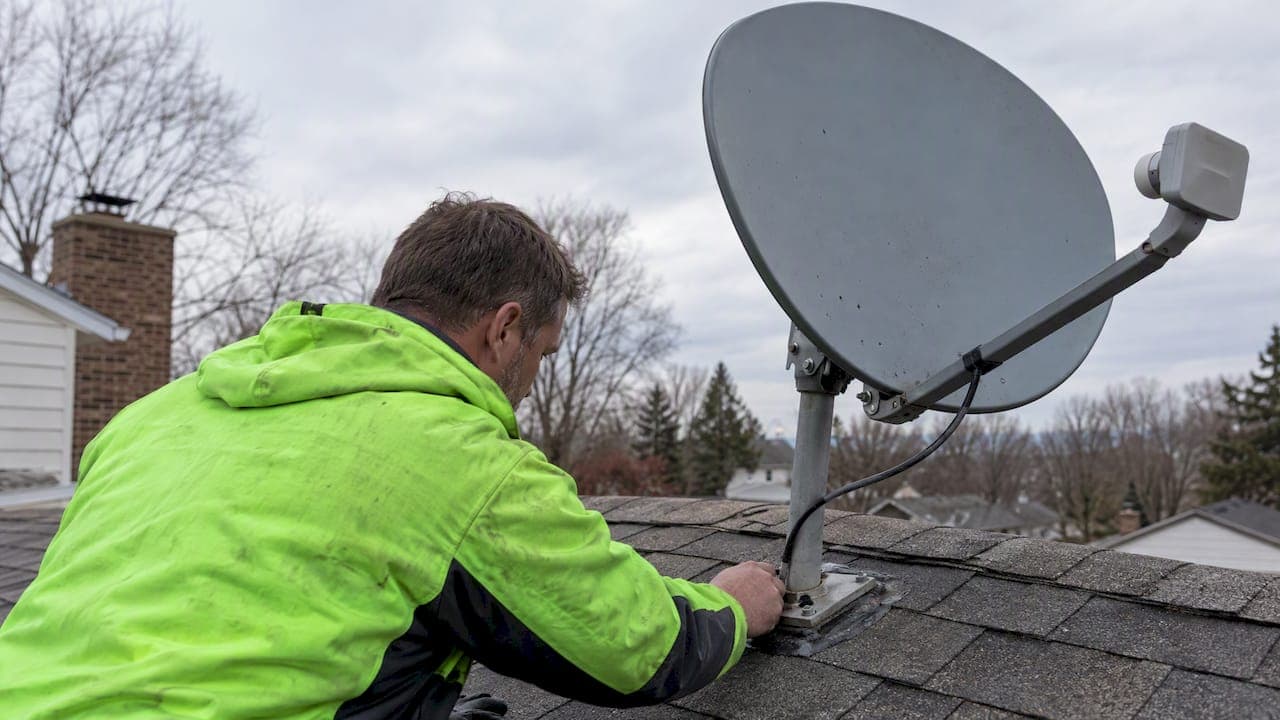
A satellite dish on your roof is held by bolts that go through the shingles. Each bolt is a hole. If the holes are not sealed and flashed well, water gets in. If you remove the dish, those holes are still there, and you must repair them. This guide covers how dishes are mounted, how to spot a leak, how to remove a dish, and how to fix the roof afterward.
TL;DR
- A roof-mounted dish is bolted through the shingles. Every bolt hole is a possible leak point.
- Leaks often show up far from the dish. Water can travel along rafters before it drips (Profound Roofing).
- Removing a dish does not fix the roof. Caulk over bolt holes is not a lasting repair. Damaged shingles need to be replaced.
- You are usually responsible for roof damage left by removal, even when the provider installed the dish (Only Roofing).
- Active leak? Call a roofer. Do not climb up in rain, ice or snow.
Table of Contents
- How a satellite dish is attached to a roof
- Signs your dish mount is leaking
- Removing a satellite dish from the roof
- Repairing the roof after the dish is gone
- Repair or replace the roof
- Hail, wind and the dish
- What to do if it is leaking right now
- Should you put a dish on the roof at all?
- Our view on dish mounts
- Get the roof side handled
- FAQ
- Sources
How a satellite dish is attached to a roof
A satellite dish has three parts: the dish, the footplate with its mounting bracket, and the cables that run into the house (WireFreeSky). The footplate is fastened to the roof with lag bolts. Those bolts pass through the shingles and into the roof deck or rafters below.

The cable then runs to an entry point in the wall or roofline. That is a second opening to seal.
Most installers are telecom technicians. They focus on signal, not on roof performance. That is not a criticism. It is a different job. The result is a mount that may hold the dish well and still be a weak point in your roof.
Why dishes end up on the roof
A dish needs an unobstructed view of the sky. In North America that means a clear line toward the southern sky. Buildings and trees block the signal (DIRECTV support). The roof is often the only spot with a clear view, and height helps (Solid Signal).
In Wisconsin, that southern view can be blocked by mature trees, a two-story neighbor or your own roofline. That is how many dishes end up high on the roof.
Can your HOA or town stop you?
Usually not for a dish on your own roof. The FCC's OTARD rule limits restrictions by homeowners' associations and local governments on dishes installed where you have exclusive use or control, such as a roof, balcony or patio (FCC). Rules for rentals and shared roofs differ. Check the FCC page for your case.
Signs your dish mount is leaking
Water does not always drip under the dish. It can enter at the mount, follow a rafter and show up several feet away. Homeowners often blame the wrong spot (Profound Roofing).
Check for these signs:
- Brown or yellow stains on the ceiling or upper wall near the dish side of the house.
- Stains in the attic on the roof deck or rafters around the mount.
- Damp or dark insulation in the attic.
- Lifted, cracked or missing shingles near the mount.
- Rust streaks or loose bolts at the footplate.
- Cracked, dried or missing sealant around the bolt heads.
- Musty smell in the room below.
- Peeling paint or bubbling drywall on a wall where the cable enters.
Take photos. Note the date and the weather. Photos help a roofer diagnose the leak. They also help if an insurance claim becomes part of the picture.
Check the attic first
On a dry day, go into the attic with a flashlight. Look at the roof deck under the dish. Look for dark rings, wet wood or daylight at a bolt hole. Do not step between the joists. Stay on the framing.

If you find moisture, mark the spot. Tell your roofer exactly where it is.
Moisture does not stay in the roof
Water that gets into a wall opening or roof deck can spread and cause hidden damage. Wall moisture has its own diagnosis and treatment path. This overview of how moisture entering walls is diagnosed and treated shows why a proper seal and a proper repair matter more than a surface patch. Deal with the entry point first, then dry out and repair what got wet.
Removing a satellite dish from the roof
You have three choices: the provider, a professional, or you. Each has trade-offs.
| Option | Good for | Watch out for |
|---|---|---|
| Your TV provider | Active service, equipment returns | They may remove the dish but not repair the roof |
| Roofer | Old dishes, damaged shingles, leaks | Ask for shingle repair, not only sealant |
| DIY | Low, easy-access, single-story roofs | Falls, new holes, poor sealing |
Who is responsible for the damage?
Many homeowners do not know this: the roof damage from removal is often theirs to fix, even if the provider installed the dish. Roofers advise using quality sealant and repairing or replacing damaged shingles instead of only patching holes (Only Roofing). Read your service agreement. Ask the provider in writing what they will and will not repair.
Is DIY removal a good idea?
Only if the roof is low, dry and easy to reach. Roof-mounted dishes raise the risk of removal. On a sloped roof, a safety harness is part of the basic gear (SatTVforMe). If the roof is steep, tall, wet, icy or covered in snow, hire a professional. A fall costs far more than a service call.
Wisconsin adds a real constraint. From late fall to spring, frost, ice and snow make a roof slippery. Wait for a dry, warm day or call a pro.
Steps for a safe removal
These steps apply to a low, accessible roof. If any step feels unsafe, stop and call a roofer.
- Cancel or move your service first. Ask about equipment return.
- Check the forecast. Pick a dry, calm day.
- Set a ladder on firm, level ground. Have a second person hold it.
- Wear a harness tied to a proper anchor, and shoes with good grip.
- Unplug or disconnect the cable at the dish.
- Unbolt the dish from the mount.
- Deal with the footplate. See below.
- Photograph the holes and the shingles around them.
- Cover the area with a tarp if you cannot repair it the same day.
- Arrange a proper repair.
Do not pry up the footplate
Prying the base off can tear shingles and create new holes in the roof deck. A safer approach is to cut the bracket just above the footplate. That leaves the base in place and avoids more damage (WireFreeSky). The leftover base must then be sealed and covered properly. A roofer can remove it and repair the shingles correctly.

The cable entry
Do not forget the wall or roofline opening. Cable holes need to be sealed. Check them again after the first heavy rain.
Repairing the roof after the dish is gone
The dish is off. The roof still has holes. This is the part people skip, and it is where leaks start.
Why caulk alone does not last
Sealant dries, shrinks and cracks under sun, freezing and thawing. A glob of caulk over a bolt hole is a short-term cover. It is not flashing. Roofers recommend proper sealant and repair or replacement of the damaged shingles (Only Roofing).
What a proper repair includes
- Remove the old bolts and the footplate.
- Inspect the shingles around the mount for cracks, tears and lifted tabs.
- Check the roof deck under the holes for rot or moisture.
- Replace damaged shingles. Do not smear over them.
- Seal and cover each opening with the right materials for your roof system.
- Check the attic for stains and wet insulation.
- Document the work with photos.
The same steps apply on any roof type. Metal, cedar and synthetic roofs need methods that match the material. Ask your roofer what they use and why.
When the roof is old
If your roof is near the end of its life, a patch may not be worth it. Several holes plus brittle shingles can point to a larger fix. A fair contractor tells you which one you need. We cover repair versus replacement below.
Repair or replace the roof
Two or three bolt holes in sound shingles are a repair. Widespread damage is a different question. Use this as a guide.
| Situation | Likely answer |
|---|---|
| Roof is newer, a few holes, shingles intact | Repair |
| Deck is wet or soft around the mount | Repair the deck, then the shingles |
| Shingles are curling, cracking or granule-bare overall | Talk about replacement |
| Leak plus other storm damage | Inspect the whole roof |
| Several old mounts on different slopes | Repair each, or replace if the roof is worn |
Our published price range for a full roof replacement is $7,500-$18,000. Repair work has no published price because it depends on what we find. A short inspection tells you which side of the line you are on.
Hail, wind and the dish
Storms stress a dish mount. High winds can loosen a mount or tear shingles around it. Hail can crack shingles near it. If a storm hit and your dish moved, inspect the whole roof, not only the mount. Our guides on photographing hail damage for claims and hail size and roof damage show what to look for. If the damage looks storm-related, see our storm damage roof repair page.
What to do if it is leaking right now
- Stay off the roof.
- Move belongings away from the drip. Place a bucket under it.
- Take photos of the stain and the drip.
- If water pools in a ceiling bulge, a small hole can relieve pressure into a bucket. Only do this if it is safe and you can keep clear of wiring and light fixtures.
- Call a roofer for an emergency visit. See our emergency roof and leak repair page.
- Keep records of the date, weather and photos.
If a leak shows up soon after new roofing work, read what to do after a roof leak on a new roof.
Should you put a dish on the roof at all?
If the roof is the only place with a clear view, you can do it right. Seal it properly and follow safe installation practice, or hand the job to a pro (SatelliteDish.net). Questions to ask before you agree to a roof mount:
- Can the dish go on a pole, a wall or the ground with a clear view?
- How will the mount be flashed and sealed?
- Who repairs the roof if the dish comes off later?
- Will the installer note the work on your roof in writing?
Standard residential dishes are commonly about 22.5 by 32 inches, and the design is meant to limit snow and ice buildup (DIRECTV support). Check the dish after heavy snow anyway. Do not climb up to clear it.
Check your roof warranty too. Extra penetrations can raise questions. Ask your roofer or manufacturer before adding a mount.
Our view on dish mounts
We have been owner-operated for over 25 years. Our view is simple: most roof failures come from poor workmanship, not from the materials. A dish mount is a clear example. The bracket is fine. The way it goes through the roof is the problem.
We give honest repair or replace advice. If two holes in a sound roof need a proper repair, we say so. If the roof is worn out, we say that too, and we show you the photos so you can see why.
We also document the work. Photos of the roof before and after. A clear description of what was fixed. That record helps with your warranty, with a future sale, and with an insurance claim if the damage came from a storm. When a claim is involved, we help you through it.
One more point: do not let anyone tell you a dab of sealant is a finished repair on a roof you plan to keep for another 15 years.
— Heather
Get the roof side handled
Tell us where the dish is or was, and whether you see a stain. We inspect the mount area, the deck and the attic, then tell you what the roof needs. See our roofing services for repair, replacement and storm work across Southeast Wisconsin, including Dodge, Washington, Fond du Lac and Ozaukee counties.
FAQ
Does a satellite dish damage a roof?
It can. The mount is bolted through the shingles, and each bolt hole can leak if it is not sealed and flashed well. Over time, sun, wind and freeze-thaw cycles wear the sealant. Regular checks of the mount and the attic catch problems early.
Who pays to fix the roof after the dish is removed?
Often you do. Homeowners are commonly responsible for the damage from removal, even if the provider installed the dish (Only Roofing). Check your provider agreement and ask what they cover before the work starts.
Can I remove a satellite dish myself?
On a low, dry, easy-to-reach roof, some people do. On a steep, tall, icy or snowy roof, hire a professional. Use a harness on any sloped roof, and plan the shingle repair before you begin.
Why is my ceiling stained when the dish is on the other side of the roof?
Water can enter at the mount, run along a rafter and drip somewhere else (Profound Roofing). Check the attic along the line from the dish. A roofer can trace the path.
Can my HOA ban a dish on my roof?
Generally no, for areas you exclusively use or control. The FCC's OTARD rule limits those restrictions (FCC). Review the rule for your exact situation.
Sources
- DIRECTV support: satellite dish installation
- FCC: Over-the-Air Reception Devices Rule
- WireFreeSky: satellite dish removal and responsibility
- Profound Roofing: leak around a satellite dish mounting bracket
- Only Roofing: how to remove a satellite dish
- Solid Signal: best location for a satellite dish
- SatTVforMe: how to remove a satellite dish
- SatelliteDish.net: roof-mounting a satellite dish safely