
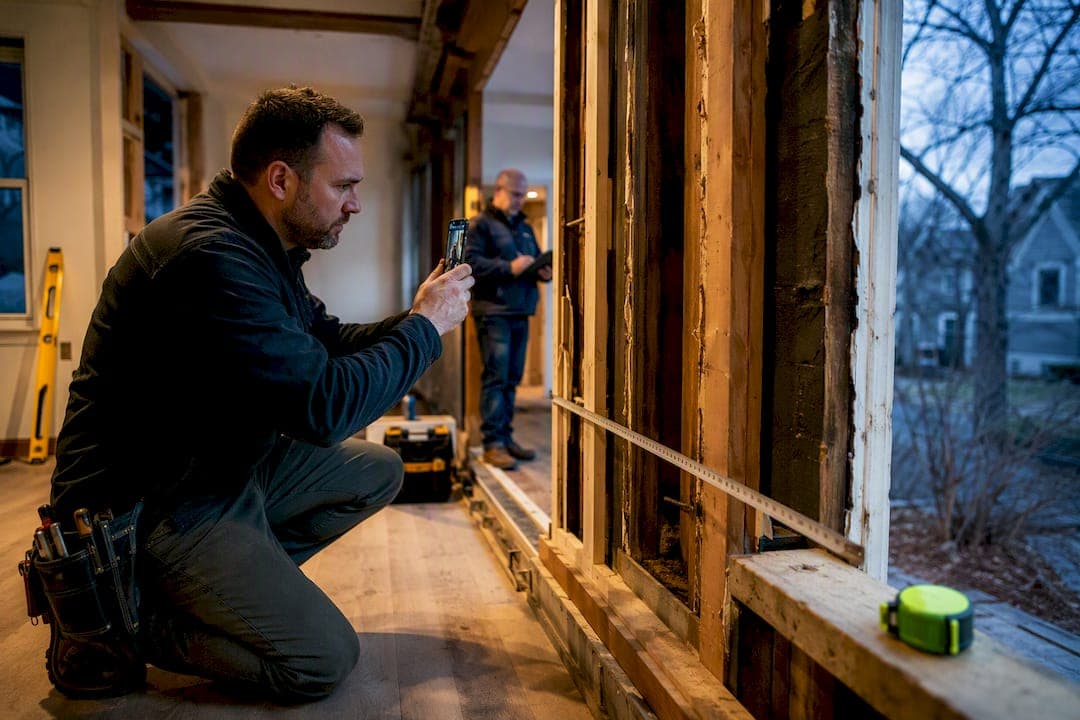
Ordinance or law coverage is an optional homeowners insurance endorsement that pays the extra cost of rebuilding to current building codes after a covered loss. Standard dwelling coverage only restores your home to its condition right before the damage, not to modern code. That gap matters most for older homes, where a small kitchen fire can trigger a mandatory rewire of the entire house.
TL;DR:
- Most policies default to 10% to 25% of dwelling coverage for ordinance or law protection, but pre-1980 homes or strict enforcement areas should consider higher limits like 50%.
- Coverage A handles the loss in value of the undamaged home part that must be demolished due to code requirements, while Coverage C covers the increased rebuild costs to current standards.
- Coverage activation depends on local enforcement thresholds, often around 50% damage, with older homes more likely to trigger full compliance costs.
- Claim preparation requires documentation like municipal orders, detailed contractor estimates, and before-and-after photos to separate standard repair from code-mandated upgrades.
- Adding this endorsement typically increases premiums modestly, but higher limits for old or heavily regulated homes can raise costs significantly, making pre-approval and contractor support critical.
Table of Contents
- What Does Ordinance or Law Coverage Include?
- When Does This Coverage Actually Kick In?
- How Much Ordinance or Law Coverage Should You Buy?
- How Do You Add This Endorsement and Prepare for a Claim?
- Three Examples of How This Coverage Changes a Payout
- How Contractors Support Ordinance-or-Law Claims
- How to File a Claim for Ordinance or Law Coverage
- Does This Coverage Raise Your Premium?
- A Contractor's View on Coverage for Older Homes
- How Am Exteriors Helps With Code-Upgrade Repairs
- Sources
- FAQ
What Does Ordinance or Law Coverage Include?
Insurers typically split ordinance or law coverage into three parts. Knowing which letter does what helps you read your policy declarations page without calling your agent three times.
- Coverage A pays for the loss in value to the undamaged portion of your home when local code requires it to be demolished along with the damaged section. If a code officer says half your house has to come down even though the fire only touched a quarter of it, Coverage A is what pays for that extra loss.
- Coverage B covers the cost of demolishing and hauling away the undamaged part of the structure, separate from the debris removal that comes with your standard policy.
- Coverage C, often the largest piece, covers the increased cost of construction. This is the money that pays for bringing wiring, plumbing, insulation, and structural elements up to current code during rebuild.
Insurers do not always use "Coverage A/B/C" labels. Some fold all three into a single "ordinance or law" limit; others name them differently in the endorsement language. This three-part structure comes from how The Horton Group explains ordinance or law insurance, and it is worth confirming which parts your policy actually includes before you assume you are covered.
When Does This Coverage Actually Kick In?
Ordinance or law coverage does not activate just because your town updated its building code last year. It triggers when a local building department enforces a code requirement tied to a covered loss, usually after damage reaches a set threshold.
Many municipalities require a full rebuild to current code once damage hits roughly 50% of the structure's value, though the exact percentage varies by city and county. Below that threshold, you may only need to bring the damaged section up to code. Above it, the whole house can be subject to modern requirements.
Older properties carry more of this risk by default. Knob-and-tube wiring, galvanized plumbing, undersized electrical panels, and load-bearing changes made without permits were all legal when installed but rarely meet today's code.
A quick self-check before you talk to your agent:
- Was your home built before 1980, when many current electrical and plumbing codes did not yet exist?
- Has your municipality updated its building code in the last 10 years?
- Do you know whether your local threshold is 50% or something different?
Pro Tip: Call your local building department directly and ask what damage percentage triggers a mandatory code upgrade in your area. That single phone call tells you more about your real risk than anything in your policy summary.
How Much Ordinance or Law Coverage Should You Buy?
Limits are usually written as a percentage of your dwelling coverage, not a flat dollar figure. That means the endorsement scales automatically when you increase your Coverage A limit, which keeps your ordinance or law protection from quietly falling behind as rebuilding costs rise.
Most policies default to somewhere between 10% and 25% of the dwelling limit, with many insurers offering the option to raise that to 50% or higher for an added premium.
A simple way to think through your own number:
- Check your home's age and confirm when it last had major systems (wiring, plumbing, HVAC) updated.
- Ask your local building department what code triggers apply in your municipality.
- If your home is pre-1980 or your city enforces strict rebuild rules, lean toward the higher end of the 10% to 25% range, or ask about 50%.
- Recalculate anytime you increase your dwelling coverage limit, since a bigger home means a bigger potential code-upgrade bill.
Cost is driven mainly by your home's age, how strict your local code enforcement is, and the limit you choose. A newer home in a municipality with lax enforcement might add only a small amount to the premium. A century-old home in a city with aggressive code enforcement can see a more noticeable increase for the same limit.
How Do You Add This Endorsement and Prepare for a Claim?
Ask your agent specifically for "ordinance or law coverage" or "law and ordinance coverage." Some carriers include a small amount automatically and let you buy up from there, while others sell it strictly as an add-on. Nationwide notes that this coverage is commonly offered as an increasable endorsement rather than a fixed built-in amount, so it pays to ask what your current policy already includes before assuming you need to add anything.
Before you ever file a claim, read your policy for two things: the trigger language that defines when the coverage applies, and the completion deadline for finishing repairs. Coverage C payments typically require you to actually complete the repair or rebuild, and insurers often set time limits to complete the work unless you request an extension in writing.
If a loss happens, start collecting documentation immediately:
- The written order or notice from your local building department requiring code upgrades.
- Permit applications and requirements tied to the rebuild.
- Itemized contractor estimates that separate standard repair costs from code-upgrade costs.
- Dated photos of the damage before any demolition begins.
Pro Tip: Ask your contractor to write two separate line items on the estimate: what it would cost to restore the home as it was, and what the code upgrades add on top of that. Adjusters move faster when the ordinance or law expense is isolated instead of buried in one lump sum.
Three Examples of How This Coverage Changes a Payout
- A kitchen fire in a 1962 ranch home damages one wall, but the local code office requires the entire house rewired because the existing wiring cannot be reconnected to code. Standard coverage pays for the wall. Coverage C pays for the rewire.
- A hail-damaged roof needs full replacement, and current code requires updated underlayment and ice-and-water shield the original roof never had. Without ordinance or law coverage, the homeowner pays that difference out of pocket.
- A house fire causes damage exceeding the local 50% threshold, and the city orders full demolition and rebuild to current code. Coverage A and B pay for the loss on the undamaged portion and demolition costs; Coverage C pays for the modern rebuild.
How Contractors Support Ordinance-or-Law Claims
A contractor's documentation often decides how smoothly a code-upgrade claim moves. Detailed, permit-ready estimates give adjusters something concrete to approve instead of a vague allowance.
- Before-and-after photos that isolate code-driven work from standard repair.
- Itemized estimates separating base repair costs from code-upgrade costs.
- Direct coordination with the local building department on permit requirements.
- Documentation timed to match the insurer's completion window.
Thorough documentation and permit-ready estimates from a contractor genuinely improve the odds an insurer approves code-upgrade costs without a drawn-out dispute. Sloppy paperwork, or none at all, is often what stalls these claims for months.
How to File a Claim for Ordinance or Law Coverage
Start the same way you would with any homeowners claim: report the loss to your insurer promptly and get a claim number before any demolition begins. The difference with ordinance or law coverage is what you need to prove afterward.
Once your adjuster inspects the damage, request a written copy of any code-compliance order from your local building department. This document is the backbone of the claim. Adjusters need proof that the upgrade is required by law, not something you or your contractor chose to do voluntarily. Progressive is direct on this point: ordinance or law coverage does not pay for discretionary upgrades, only work mandated by a covered loss and local code.
Next, get your contractor's itemized estimate broken into standard repair costs and code-upgrade costs. Submit both to your adjuster along with dated photos of the damage and any permit applications tied to the rebuild. If the adjuster's initial scope leaves out a code-required item, your municipal order and contractor documentation are what you use to push back.
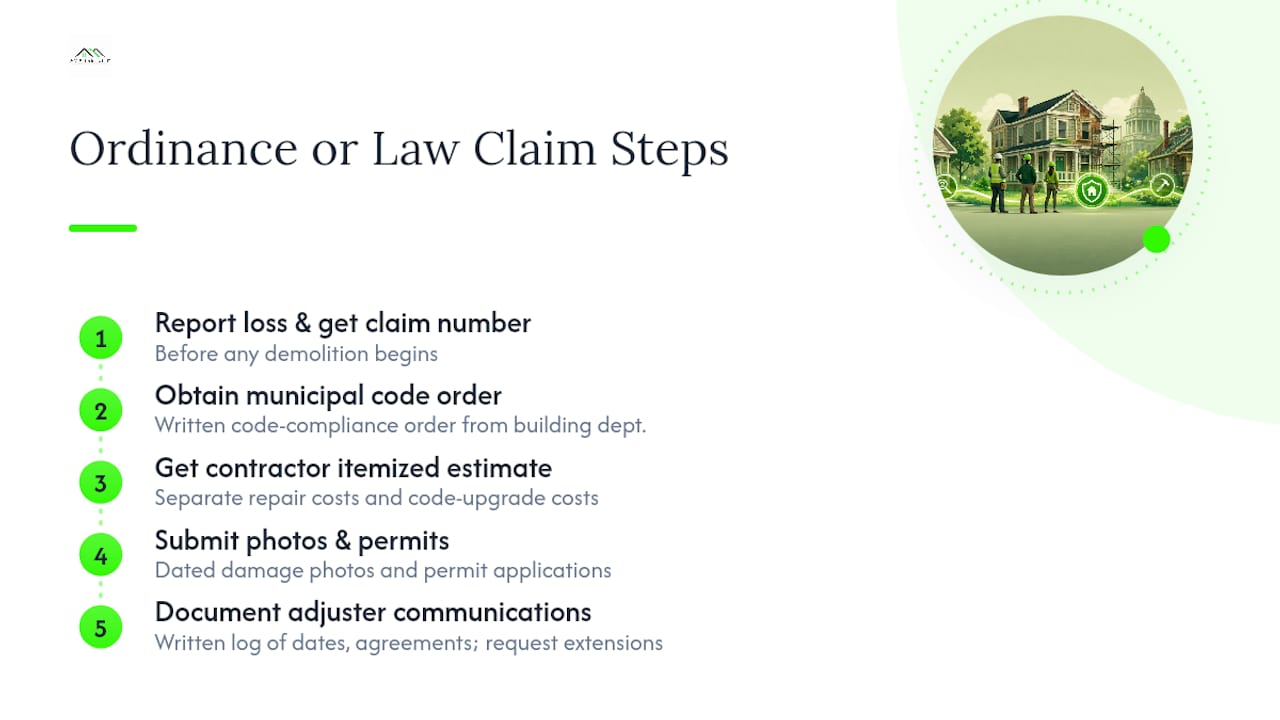
Keep a written log of every conversation with your adjuster, including dates and what was agreed to. Ordinance or law claims often involve more back-and-forth than a standard repair claim because the code-upgrade portion has to be separately justified. If your insurer requires the work completed within a set window, usually around two years, ask in writing for an extension well before that deadline if your rebuild is delayed by permitting or contractor availability. For a broader walkthrough of documenting storm-related damage claims in Wisconsin, see this guide to filing a storm damage claim.
Does This Coverage Raise Your Premium?
Adding ordinance or law coverage does increase your premium, but usually by a modest amount relative to the protection it provides. The size of the increase depends on the limit you select, your home's age, and how strict your local building code enforcement is.
Someone raising the limit to 50% on a pre-1970 home in a city with aggressive rebuild requirements will pay more, because the insurer's exposure is genuinely higher in that scenario.
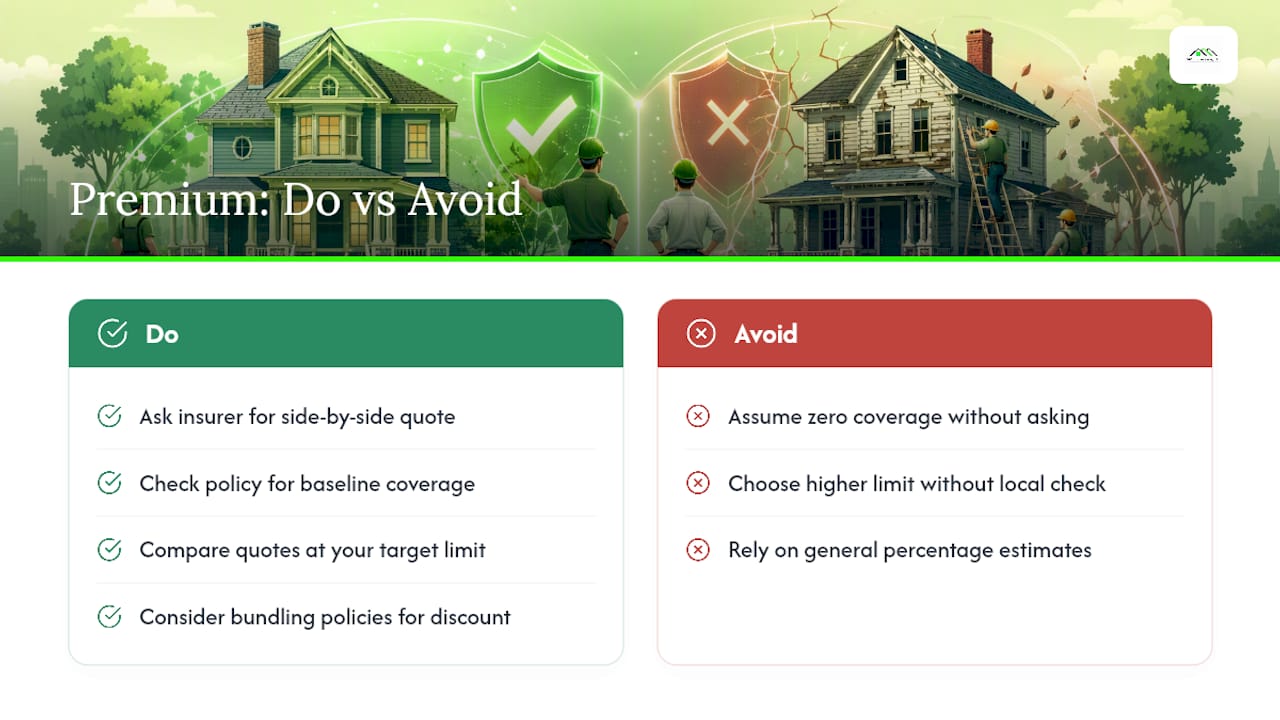
Some carriers already bundle a limited amount of ordinance or law coverage into their standard policy at no extra charge, then charge only for the amount you add above that baseline. This varies enough by insurer that it is worth asking directly what your current policy includes before assuming you are starting from zero.
Bundling your homeowners policy with auto or other coverage through the same carrier can offset part of the added cost, though the discount applies to your overall premium rather than to the ordinance or law endorsement specifically. If you are shopping policies for an older home, ask each insurer for a side-by-side quote showing the premium with and without the endorsement at your target limit. That comparison tells you more than any general percentage ever could, because code enforcement and pricing both vary by location.
A Contractor's View on Coverage for Older Homes
Owners of older homes consistently underinsure this risk because the premium bump feels avoidable until a claim proves otherwise. If your home was built before 1980, lean toward the higher end of the percentage range, closer to 25% or more, rather than the minimum your agent quotes by default. Loop in a licensed contractor early in the claims process. Their documentation often determines whether the code-upgrade portion gets approved cleanly or contested for months.
— Heather
How Am Exteriors Helps With Code-Upgrade Repairs
If a covered loss forces your home into code-upgrade territory, the difference between a smooth payout and a drawn-out dispute usually comes down to documentation, not luck. Am-exteriors builds that documentation into every project: before-and-after photos, itemized estimates that separate standard repair from code-required work, and direct coordination with local building departments on permits.
Am-exteriors provides exterior home improvement services including roofing, siding, window replacement, and gutter repair, and assists homeowners with insurance claims related to storm damage or code-triggered rebuilds. If a fire, hail storm, or wind event has your home facing a code-upgrade requirement, request a documented estimate through the insurance claims assistance page, or start with a roof replacement quote if your roof is the part of the house code officials flagged. Getting a permit-ready estimate in hand early makes the rest of the claims process move faster.
Sources
For primary details on limits and structure, see Liberty Mutual's ordinance or law coverage guide and Progressive's coverage explainer. For local code questions, check your state or municipal building regulations board.
- What Is Ordinance or Law Coverage? - Progressive
- Ordinance or law coverage - Liberty Mutual
- What Is Ordinance or Law Coverage? - The Horton Group
FAQ
Should I get ordinance or law coverage?
If your home was built before 1980 or sits in a municipality with strict code enforcement, adding this endorsement is generally worth the modest premium increase given how expensive uncovered code upgrades can be.
What does the ordinance or law coverage endorsement cover?
It covers the loss in value to an undamaged portion demolished by code order (Coverage A), demolition and debris removal (Coverage B), and the increased cost of rebuilding to current code (Coverage C).
What are the four types of coverage?
A standard homeowners policy typically includes Coverage A (dwelling), Coverage B (other structures), Coverage C (personal property), and Coverage D (loss of use); ordinance or law coverage is a separate endorsement layered on top, not one of these four.
Is an ordinance a law or policy?
An ordinance is a local law passed by a city or county government, distinct from state or federal statutes, and building code ordinances are what typically trigger this insurance coverage.