
Recoverable depreciation is the portion of your approved replacement-cost roof payout that your insurer withholds until repairs are done. You get it back by completing the roof replacement and submitting proof, usually a paid contractor invoice, within your policy's deadline. Expect two checks: an initial payment for actual cash value, then a second payment once you've proven the work is finished.
TL;DR:
- Recoverable depreciation is paid after completing a roof replacement and submitting proof within your policy's deadline, typically through two checks.
- Roof coverage type (RCV or ACV) determines if depreciation is recoverable, with RCV paying full replacement costs and ACV deducting depreciation permanently.
- Confirm your policy covers replacement cost value before repairs, and ensure your contractor provides detailed invoices, photos, and proof of payment to expedite final payment.
- Depreciation is calculated based on your roof’s age, expected useful life, and condition at the time of loss, often in the 20-25 year range for asphalt shingles.
- Most insurers release the final depreciation payment within a few weeks once proper documentation, including photos and invoices, is submitted and verified.
Table of Contents
- What Recoverable Depreciation Means vs. Permanent Depreciation
- ACV vs. RCV: Which One You Have and How It Changes Your Payout
- Step-By-Step: How Recoverable Depreciation Is Released During a Roof Claim
- How Insurers Calculate Depreciation (With a Worked Example)
- How to Get Recoverable Depreciation Released (And What to Do If It's Withheld)
- Contractor-Backed Checklist: How Am-exteriors Documents Jobs for Full Recovery
- What Homeowners Consistently Get Wrong About This Process
- Sources
- FAQ
What Recoverable Depreciation Means vs. Permanent Depreciation
Recoverable depreciation is money you can still collect. Permanent depreciation is money you cannot, and the difference comes down entirely to what kind of roof coverage sits on your policy.
If you carry Replacement Cost Value (RCV) coverage, your insurer pays what it actually costs to repair or replace your roof, without subtracting for age or wear, once you finish the job and prove it. If you carry Actual Cash Value (ACV) coverage, that same depreciation is gone for good. There is no second check coming. The Insurance Information Institute frames it simply: RCV pays to repair or replace without deducting for depreciation, while ACV pays replacement cost minus depreciation, full stop.
A few things determine which bucket your roof claim falls into:
- The coverage type listed on your declarations page (RCV or ACV)
- Whether your insurer classifies your roof as eligible for RCV based on age and condition
- Whether you complete the repair and submit proof within your policy's stated window
This is exactly the gap professional roofing contractors walk homeowners through on nearly every storm claim. Roofs that look fine from the ground often carry hidden granule loss or fastener damage that changes how an adjuster classifies the loss, and that classification is what decides whether depreciation is recoverable at all.
ACV vs. RCV: Which One You Have and How It Changes Your Payout
Your policy type determines the entire shape of your payout, and it's worth confirming before you file anything. Here's how to check and what it means financially:
- Pull your declarations page. Look for "Replacement Cost" or "Actual Cash Value" next to your dwelling coverage. If it's unclear, call your agent and ask directly.
- Ask about roof-specific endorsements. Some insurers apply ACV to roofs specifically, even when the rest of the dwelling is covered at RCV, especially on older homes.
- Confirm your dwelling limit covers a full rebuild. Coverage below roughly 80% of replacement cost can trigger reduced claim payments under many policies, according to the NAIC's consumer guide to home insurance.
Here's the math that makes this matter. Say your roof has a $15,000 replacement cost and your insurer calculates $4,000 in depreciation. With RCV, you'd eventually collect the full $15,000 across two payments. With ACV, you collect $11,000 total and the rest is simply gone. Replacement cost coverage typically runs about 10% more in premiums than ACV, which is a small price for avoiding a $4,000 loss on a single claim.
Step-By-Step: How Recoverable Depreciation Is Released During a Roof Claim
The release process follows a predictable sequence, and knowing it in advance keeps you from losing money to a missed deadline.
- Claim approval and initial payment. Your insurer approves the claim and issues a first check for the ACV amount, which is the RCV minus depreciation and your deductible.
- Contractor completes the work. Your roofer finishes the replacement per the agreed scope. Keep every invoice, receipt, and payment confirmation.
- Submit documentation to your insurer. You send the final paid invoice and proof of completion. Some insurers order a reinspection before releasing funds.
- Final payment is released. Once your insurer verifies the work matches the approved scope, it sends the recoverable depreciation check.
Insurers typically require proof that repairs were actually completed at the insured property before releasing that final check, though the Triple-I notes most policies allow a set window after the initial payment to finish the work and submit proof.
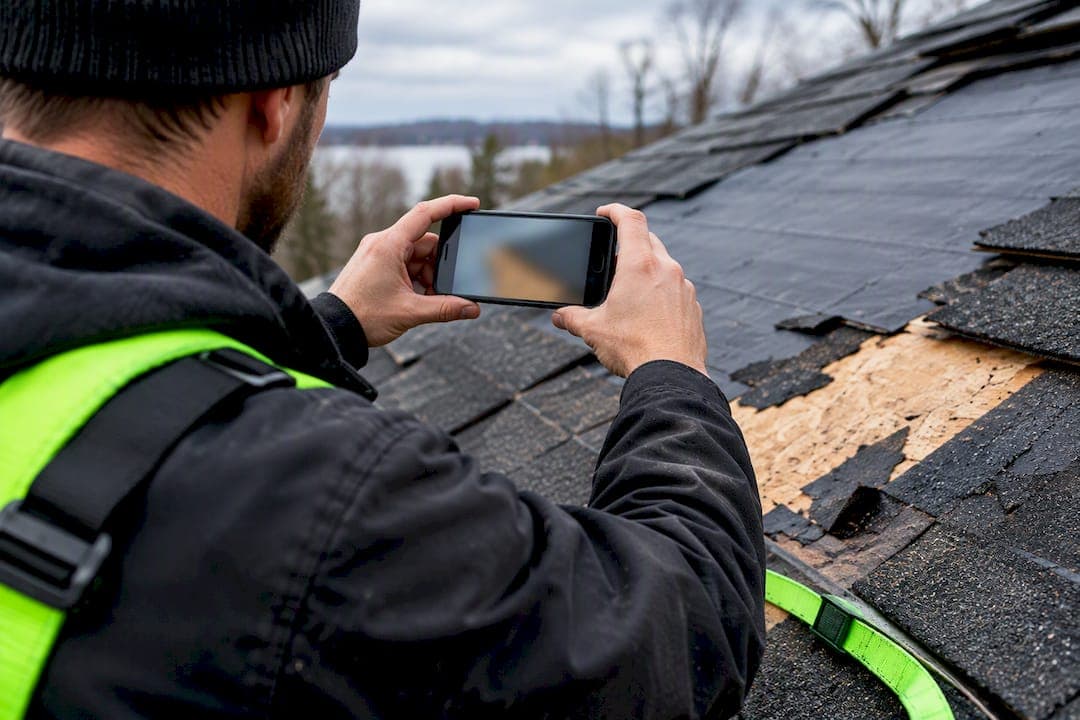
Pro Tip: Photograph your roof before, during, and after the tear-off. Adjusters often approve final payment faster when photos clearly match the line items on your contractor's invoice.
How Insurers Calculate Depreciation (With a Worked Example)
Depreciation isn't a flat percentage pulled from thin air. Insurers calculate it using three variables: your roof's age, its expected useful life for that material, and its condition at the time of loss. The NAIC's guidance on rebuilding after a storm lays out this formula and provides sample breakdowns homeowners can use to sanity-check their own claim.

A standard asphalt composite shingle roof is generally assumed to have a useful life in the 20 to 25-year range for depreciation purposes, though the exact figure varies by carrier and state.
Worked example:
- Approved RCV for full roof replacement: $18,000
- Roof age: 12 years, on a 20-year expected life
- Depreciation applied (60% of useful life consumed): roughly $6,000
- Initial ACV check (RCV minus depreciation minus deductible): $18,000 minus $6,000 minus $1,000 deductible = $11,000
- Recoverable depreciation held back: $6,000, released after proof of completed repair
It varies by carrier and state building code, so confirm it with your specific insurer rather than assuming it applies.
How to Get Recoverable Depreciation Released (And What to Do If It's Withheld)
Insurers release the holdback fastest when your paperwork leaves nothing to interpret. Gather these before you call your adjuster:
- Final paid invoice showing the total amount and payment date
- Proof of payment (canceled check, card statement, or bank record)
- Before and after photos of the completed roof
- Lien waiver from your contractor, if your state or insurer requires one
- Product warranty documentation for shingles or underlayment installed
Ask your contractor to itemize the invoice by labor and materials separately, and to list the actual shingle product and manufacturer by name rather than a generic line item like "roofing materials." Vague invoices are one of the most common reasons insurers delay or push back on final payment.
Pro Tip: If your insurer denies or delays the final release, ask your agent for a written explanation first. If that doesn't resolve it, a formal appeal letter referencing your original claim number and the specific denied line items usually moves things faster than a phone call alone.
If weeks pass with no movement, a licensed public adjuster can review the file, though most straightforward roof claims never need one. For claims that stall entirely, our guide to reversing a denied roof claim walks through the appeal process step by step.
Contractor-Backed Checklist: How Am-exteriors Documents Jobs for Full Recovery
Am-exteriors builds documentation into every job from day one, because the paperwork you generate during the project is what gets your final check released without a fight. Our crews take dated before, during, and after photos of every roof section, keep owner-supervised notes on scope and workmanship, and provide itemized invoices naming the exact shingle line, underlayment, and fastener specs used.
The most common issue we see holding up final payments isn't damage disputes. It's incomplete paperwork: missing proof of payment, invoices that lump labor and materials together, or no photo record of the tear-off. We also hand homeowners their manufacturer warranty paperwork at closeout, since insurers sometimes ask for it before releasing the last check on higher-value roofs.
What Homeowners Consistently Get Wrong About This Process
Most homeowners treat recoverable depreciation as paperwork friction the insurer invents to delay payment. That's backwards. The holdback exists because the insurer is fronting money based on a job that hasn't happened yet. Your documentation is the only thing that proves it did.

Where conventional advice falls short is in treating this as a one-time filing task. It's a coordination problem between you, your contractor, and your adjuster, and the homeowners who get their full check quickest are the ones who loop their contractor into the paperwork requirements before the tear-off starts, not after.
If you take one thing from this: confirm your policy is RCV, not ACV, before you assume any of this applies to you. Everything else, the invoicing, the photos, the timeline, only matters once that first condition is met.
— Heather
This article is general information, not a substitute for advice from a qualified financial advisor. Consult a qualified financial professional about your own circumstances before acting on anything here.
FAQ
What Is Recoverable Depreciation for a Roof?
Recoverable depreciation is the difference between your roof's actual cash value and its full replacement cost that your insurer withholds until you complete repairs. You collect it by submitting proof of completed work, typically a paid invoice, under a replacement-cost policy as described by the Insurance Information Institute.
What Is the Actual Cash Value of a 20-Year-Old Roof?
The ACV of a 20-year-old roof depends on its material's expected useful life, which for standard asphalt shingles typically falls in the 20 to 25 year range. A roof at or near the end of that range may be valued close to its salvage value alone, since most of its useful life has already been consumed.
What Is the 25% Rule for Roofing?
It isn't a universal insurance standard, and whether it applies depends on your state's building code and your specific carrier's claims practices.
Can a Roof Be Depreciated Over 15 Years?
Insurers can apply a 15-year useful-life assumption to certain roofing materials, though asphalt composite shingles are more commonly depreciated over a 20 to 25 year span. The exact schedule varies by carrier, so check your claim documentation or ask your adjuster which useful-life figure was applied to your roof.
How Long Does It Take to Receive the Final Depreciation Check?
Most insurers release the final payment within a few weeks of receiving your completed documentation, though this varies by carrier and whether a reinspection is required. Submitting a complete, itemized invoice with photos on the first attempt is the biggest factor in avoiding delays.
If you're ready to start the repair that unlocks your recoverable depreciation, Am-exteriors' roofing team documents every job with the photos, itemized invoices, and warranty paperwork insurers ask for, and a free hail damage inspection is a solid first step if you haven't filed your claim yet.