

Replacement Cost Value (RCV) pays to replace damaged property with new, equivalent materials, no deduction for age or wear. Actual Cash Value (ACV) pays that same replacement cost minus depreciation, which almost always means a smaller check. RCV coverage costs more in premium, but for your dwelling and roof, it's usually the better call because the premium gap tends to be small compared to the depreciation you'd absorb on a claim.
Here's the quick version: insure your home's structure and roof at RCV when your budget allows it. Personal property often defaults to ACV unless you've added an endorsement, so check that separately. The National Association of Insurance Commissioners and your state insurance department both publish consumer guidance on exactly this distinction, and both say the same thing: read your declarations page before you assume anything.
Key Takeaways
RCV pays full replacement cost with no depreciation deducted, while ACV pays that same cost minus depreciation, and the gap between the two grows every year your roof ages.
| Point | Details |
|---|---|
| Know the payout gap | RCV replaces at full cost; ACV subtracts depreciation, often leaving a much smaller check. |
| Check your declarations page | Confirm Coverage A, Coverage C, and any roof-specific endorsements before you assume your coverage type. |
| Understand the two-step RCV process | Insurers pay depreciated ACV first, then release recoverable depreciation after you submit proof of completed repairs. |
| Watch for aged-roof endorsements | Roofs can convert to ACV at trigger ages like 10, 15, or 20 years, even on an otherwise RCV policy. |
| Get contractor support | Am-exteriors documents inspections, estimates, and completion certificates to help homeowners in Southeast Wisconsin recover full RCV payouts. |
Document every conversation with your agent in writing, and keep repair receipts and completion certificates on hand. They're what stand between you and that second, recoverable depreciation check.
Table of Contents
- What Does ACV Mean and How Does Depreciation Work?
- What Does RCV Mean and How Does the Payout Process Work?
- How Do Insurers Calculate ACV and RCV Payouts?
- Where Does ACV vs RCV Apply on Your Policy?
- What Do ACV and RCV Look Like in Real Dollars?
- Is ACV or RCV the Better Choice for Your Home?
- How Do You Check Your Policy for ACV or RCV Coverage?
- How Does a Roofing Contractor Help With ACV vs RCV Claims?
- What Does 25 Years of Roofing Claims Teach You About ACV vs RCV?
- How Am Exteriors Supports Your Roof Insurance Claim
- Where Can You Find More on ACV vs RCV Rules?
- Sources
What Does ACV Mean and How Does Depreciation Work?
ACV equals replacement cost minus depreciation. That's the whole formula, but the depreciation part is where homeowners get surprised.
Insurers calculate depreciation based on your roof or item's age, its condition, and its expected useful life. A 25-year asphalt shingle roof depreciates differently than a 50-year metal roof, because the carrier assumes asphalt wears out faster. Most companies use a straight-line model, deducting a percentage of value for every year of the item's expected lifespan, though some use accelerated schedules that front-load the depreciation in early years.
What this looks like in practice:
- Age: older roofs and appliances have less value left to lose, so they get hit harder.
- Wear and tear: storm scarring, granule loss, and prior repairs can push depreciation higher even before age would normally justify it.
- Material type: asphalt shingles depreciate faster than standing seam metal or synthetic slate, which carriers expect to last decades longer.
- Remaining useful life: a roof at year 20 of a 25-year expected life has little value left, no matter how well it was maintained.
Quick fact: State-published consumer guides, including Texas's Department of Insurance, show sample payout tables where a roof's ACV settlement drops sharply between year 5 and year 20, even though the replacement cost itself barely changes. That gap is the entire argument for RCV.
You'll often see ACV language buried in specific line items rather than the whole policy. Personal property sections and roof endorsements are the most common spots where ACV shows up even when the rest of your dwelling coverage is RCV.
What Does RCV Mean and How Does the Payout Process Work?
RCV pays to repair or replace damaged property with new materials of similar kind and quality, without subtracting for age or wear. That's the definition. The mechanics of getting paid are where it gets more interesting.
Most RCV claims settle in two stages. Your insurer typically pays out the depreciated, ACV amount first. Once you complete the repair or replacement and submit proof, usually contractor invoices or a completion certificate, the carrier releases the "recoverable depreciation" as a second check. Skip the repair, and you never see that second payment.
Pro Tip: Ask your contractor upfront whether they'll wait for the recoverable depreciation check before final billing. Many will structure payment in stages specifically because they know how this process works.
One wrinkle worth flagging: even a dwelling policy marked RCV can carry a roof-specific ACV endorsement. Insurers attach these to older roofs at renewal, sometimes without much fanfare, which means your roof could be settled at ACV even though your siding and interior are covered at full replacement cost.
How Do Insurers Calculate ACV and RCV Payouts?
The math differs enough between the two that it's worth walking through step by step.
ACV calculation:
- The adjuster determines the full replacement cost of the damaged item or structure.
- The insurer applies depreciation based on age, condition, and material.
- Your deductible gets subtracted from what's left.
- You receive that final number as your one and only check.
RCV timeline:
- The insurer pays the depreciated (ACV) amount as an initial payment.
- You complete the repair or replacement, often coordinating permits and contractor scheduling.
- You submit receipts, invoices, or a completion certificate.
- The insurer releases the recoverable depreciation as a second payment.
Timing depends on a handful of variables you can't fully control: how quickly the adjuster inspects the damage, whether the scope of work gets disputed, permit turnaround with your municipality, and your contractor's schedule. Recovery windows for submitting proof and collecting that second check commonly run anywhere from 180 days to a full year, depending on the policy.
- Watch for non-recoverable depreciation endorsements, which convert your policy so that second check never comes, no matter when you finish the work.
- Scope disputes between your contractor and the adjuster's estimate are the single biggest cause of delayed final payments.
Where Does ACV vs RCV Apply on Your Policy?
Your homeowners policy isn't one uniform coverage type. Different sections often use different payout bases, and that's exactly where confusion sets in.
- Coverage A (dwelling): usually RCV by default on standard homeowners policies, covering your home's structure.
- Coverage C (personal property): frequently ACV unless you've paid for a replacement cost endorsement, meaning your furniture, electronics, and belongings depreciate.
- Roof coverage: increasingly singled out for ACV treatment through endorsements, especially in states with heavy hail or wind exposure and on roofs past a certain age.
Quick fact: Insurers commonly trigger these aged-roof endorsements at 10, 15, or 20 years, converting roof coverage from RCV to ACV specifically, while leaving the rest of the dwelling untouched.
Marketing brochures and agent summaries aren't your contract. The declarations page and any attached endorsements are the only documents that legally define your coverage basis, so that's what you check, line by line, not the glossy insert that came with your renewal notice.
What Do ACV and RCV Look Like in Real Dollars?
Numbers make this concrete faster than definitions do.
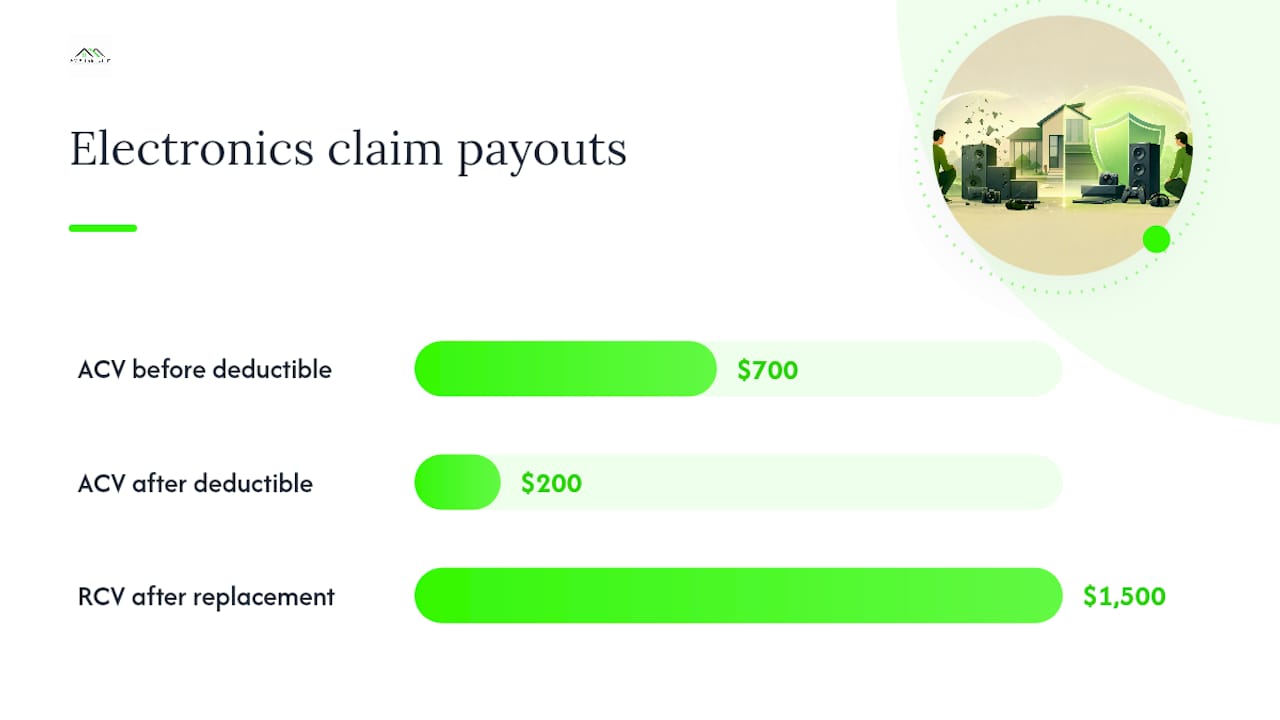
Example 1: Personal electronics. Say a laptop and television damaged in a covered loss would cost $2,000 to replace today. If they're four years into an expected six-year useful life, the insurer might apply roughly two-thirds depreciation, leaving an ACV payout near $700 before your deductible. Subtract a $500 deductible and you're left with $200. Under RCV, you'd eventually collect closer to the full $2,000 minus your deductible, once you buy the replacement and submit the receipt.
Example 2: Roof replacement. Assume your roof would cost to replace new. If it is partway through its expected life, depreciation can reduce the value significantly. Your insurer issues an initial ACV payment, subtracts your deductible, and holds the remainder as recoverable depreciation until repairs are completed and documented. Once you hire a contractor, complete the job, and submit the invoice, that held amount gets released as a second payment.
| Step | ACV-only policy | RCV policy |
|---|---|---|
| Initial payment | Full ACV check, final | Depreciated ACV check, initial only |
| After repair completed | No further payment | Recoverable depreciation released |
| Homeowner's cash flow need | None beyond deductible | Must front the depreciation gap until reimbursed |
Run your own numbers against your policy's stated deductible and your roof's actual age. Save the math. It becomes useful the moment you're on the phone with your agent or an adjuster.
Is ACV or RCV the Better Choice for Your Home?
Neither option is universally right, but the trade-offs are clear enough to make a fast decision.
ACV costs less in premium and can be a reasonable choice for a low-value secondary structure, a very new item you'd replace out of pocket anyway, or contents in a low-risk area where you've built a replacement reserve. RCV costs somewhat more but closes the gap between what your home costs to replace and what you'd actually receive, which matters enormously for your primary residence, an aging roof, or a property in a hail or wind-prone region like much of Wisconsin.
| Comparison | ACV | RCV |
|---|---|---|
| Payout basis | Depreciation applied | No depreciation deducted |
| Common policy section | Personal property, aged roofs | Dwelling (Coverage A) by default |
| Premium difference | Lower | Modestly higher |
| Out-of-pocket exposure | Higher, especially on older items | Lower, but requires fronting funds until final payment |
| Claim payment timing | Single, final payment | Two payments: initial, then recoverable depreciation |
Pro Tip: If your budget only stretches to RCV on one part of your policy, put it on the dwelling and roof first. Contents coverage is easier to supplement with a reserve fund than a $15,000 roof is.
How Do You Check Your Policy for ACV or RCV Coverage?
You don't need an insurance license to figure this out. You need your declarations page and about fifteen minutes.
- Pull your current declarations page, not the summary brochure that came in the renewal envelope.
- Locate Coverage A (dwelling) and confirm whether it says "replacement cost" or "actual cash value."
- Locate Coverage C (personal property) and check the same language.
- Search specifically for roof-related endorsements, since these override the general dwelling terms.
- Note the effective date, since coverage terms can shift at renewal without a phone call.
Bring these questions to your agent or carrier, and get the answers in writing:
- Is my roof covered at RCV or ACV, separate from the rest of the dwelling?
- Is any depreciation on my policy recoverable, and if so, what's the window to submit proof?
- Do I have an aged-roof endorsement, and at what age does it trigger?
- What documentation do you require to release recoverable depreciation?
Red flags worth taking seriously: vague or contradictory language across sections, an endorsement that appeared at your last renewal without explanation, or different coverage types applying to your roof versus your dwelling with no clear reason. Keep every renewal document and save your agent's written answers. If you ever file a claim, that paper trail becomes your leverage.
How Does a Roofing Contractor Help With ACV vs RCV Claims?
A contractor's job during an insurance claim goes well beyond swinging a hammer. Documentation determines whether you collect the recoverable depreciation you're owed.
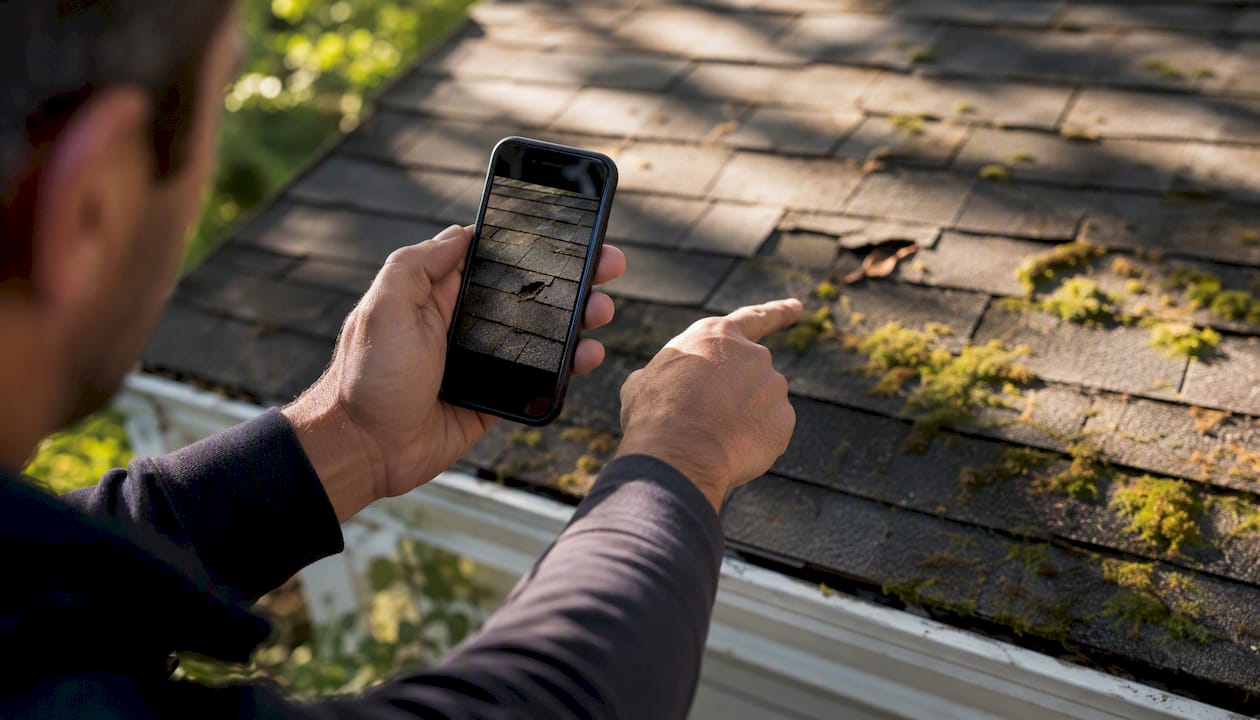
A thorough roof inspection report, dated photos of the damage, an itemized material list, and a line-item estimate that mirrors the adjuster's own scope all speed up the process considerably. Contractors who submit clean, itemized invoices and handle permit paperwork directly tend to see fewer disputes and faster releases of that second payment.
For homeowners going through this, AM Exteriors typically provides:
- A detailed inspection report documenting the damage.
- A written replacement estimate broken down by material and labor.
- A certificate of completion once the work is finished, the exact document most carriers require to release recoverable depreciation.
Pro Tip: If cash flow is tight, ask your contractor directly whether they'll stage payment and wait for the recoverable depreciation check before collecting the final balance. Many roofing contractors, including AM Exteriors, structure jobs this way specifically because they understand the two-step RCV process.
Homeowners dealing with storm damage should also read through the step-by-step claim filing guidance covering how documentation and adjuster timing interact in Wisconsin specifically.
What Does 25 Years of Roofing Claims Teach You About ACV vs RCV?
Homeowners rarely ask about ACV or RCV until they're staring at a claim check that's thousands less than they expected. By then, the coverage decision was already made, usually years earlier, at renewal, without much thought. What I've seen repeatedly is that the gap between ACV and RCV feels abstract right up until a hailstorm makes it concrete, and then it's the single biggest factor in whether a homeowner can afford to fix their roof without dipping into savings.
AM Exteriors has spent more than 25 years as an owner-operated roofing and exterior company in Southeast Wisconsin, working directly with homeowners and adjusters on exactly this kind of claim. That experience shapes a simple bias: push for RCV on your roof whenever you can, and know your documentation requirements before disaster strikes, not after.
How Am Exteriors Supports Your Roof Insurance Claim
If your roof claim just settled at ACV and the number came in lower than you hoped, you're not stuck. Am-exteriors handles the parts of the process that determine whether you collect full replacement value: a documented inspection, a line-item estimate that holds up against an adjuster's scope, and direct communication with your insurance company from start to finish.

Am-exteriors serves homeowners across Dodge County, Washington County, Fond du Lac County, and Ozaukee County, handling everything from storm-damaged roofs to full roof replacements with certified installation and a completion certificate ready the moment your insurer asks for one. Free inspections and written estimates are available before you file, so you know your numbers before the adjuster shows up. If a recent storm damaged your roof, request an inspection today and get a clear, documented estimate to bring straight to your insurance company.
Where Can You Find More on ACV vs RCV Rules?
- NAIC's consumer guidance on replacement cost and actual cash value walks through the two-step RCV payment process in plain language.
- Texas's Department of Insurance publishes sample payout tables showing how ACV settlements shrink as a roof ages.
- NAIC's product listing tool lets you look up filed insurance products and standards if you want to dig into your specific carrier.
- Check your own state insurance department's website for localized rules, since coverage defaults and endorsement practices vary by state.
- For Southeast Wisconsin homeowners navigating a live claim, AM Exteriors' insurance claims assistance page outlines how documentation and adjuster communication work together on a real roofing project.
Above all, your declarations page is the final word on what you're covered for. Everything else, brochures, agent summaries, even this article, is a guide to help you read it correctly.
This article is general information, not a substitute for advice from a qualified financial advisor. Consult a qualified financial professional about your own circumstances before acting on anything here.
Sources
- Rebuilding After a Storm: Know the Difference Between Replacement Cost and Actual Cash Value When It Comes
- Home policies: Replacement cost or actual cash value?