

For most homeowners with 15% or more equity, a home equity loan or HELOC is the lowest-cost way to finance a roof. No equity? A personal loan gets you funded fast with no collateral risk. Government programs like FHA Title I and USDA Section 504 serve low-to-moderate-income households. Credit cards are a last resort.
Use this rubric to pick your starting point:
- You have 15%+ home equity: Start with a HELOC or home equity loan. Lower APR, longer terms, and the interest may be tax-deductible.
- You need funding in days or have little equity: A personal loan or contractor financing is faster. Watch for deferred-interest traps.
- You qualify as low-to-moderate income or rural: Check FHA Title I and USDA Section 504 before anything else. Grants may cover part of the cost.
- Insurance may cover the damage: File the claim first. You may only need financing for the deductible or code-upgrade costs.
The right roof financing depends on four variables: equity, credit score, urgency, and loan amount. Get those four numbers in hand before you talk to any lender.
Key Takeaways
| Point | Details |
|---|---|
| Equity determines your best rate | HELOC and home equity loans offer the lowest APR for homeowners with 15%+ equity and a 680+ credit score. |
| Personal loans fund the fastest | Approval and funding in 1–5 business days with no collateral risk, though APRs run 10%–25%+. |
| Contractor promos carry hidden costs | Dealer fees of 8%–12% and deferred-interest clauses can make 0% offers expensive; compare against independent loan quotes. |
| Government programs serve eligible homeowners | FHA Title I covers up to $25,000; USDA Section 504 offers 1% loans up to $50,000 and grants up to $10,000 for qualifying rural homeowners. |
| Am-exteriors handles estimates and claims | Am-exteriors provides detailed estimates, attends adjuster inspections, and connects homeowners with financing partners in Southeast Wisconsin. |
Table of Contents
- What are the main roof financing options side by side?
- How does a home equity loan work for roof repairs?
- Is a HELOC a good way to finance a roof replacement?
- When does a cash-out refinance make sense for a roof?
- Are personal loans a good fit for roof repair financing?
- When do credit cards make sense for roof costs?
- What should you know about contractor financing offers?
- Which government programs help pay for roof repairs?
- How do you choose and apply for the right roof financing?
- What do typical roof jobs cost, and what are the monthly payments?
- How does insurance affect your roof financing plan?
- A note from our founder on how Am-exteriors approaches financing
- Am-exteriors makes the financing process straightforward
- Helpful official resources for your application
- Sources
What are the main roof financing options side by side?
APR ranges reflect mid-2026 market conditions and vary by lender, credit profile, and loan amount. Verify current rates directly with lenders before applying.
How does a home equity loan work for roof repairs?
A home equity loan is a second mortgage. You borrow a fixed lump sum against your home's equity, repay it at a fixed interest rate over a set term, and your house secures the debt. For a planned roof replacement where you know the exact cost upfront, that fixed structure is an advantage.
The APR is typically lower than an unsecured personal loan, and the term can stretch to 15 years, which keeps monthly payments manageable on a $10,000–$20,000 job.
The trade-offs:
- Your home is collateral. Miss payments and you risk foreclosure.
- Closing costs run 2%–5% of the loan amount, which adds real money to smaller jobs.
- An appraisal is usually required, adding time and cost.
- Approval and funding typically take 2–6 weeks, so this is not an emergency option.
Documentation you'll need:
- Recent pay stubs and W-2s (last two years)
- Bank statements (last 2–3 months)
- Proof of homeownership and current mortgage statement
- Government-issued ID
- Contractor estimate for the project
Pro Tip: Interest on a home equity loan used to improve your primary residence may be tax-deductible under IRS rules, but the deduction has conditions and income limits. Talk to a tax professional before assuming you qualify.
Is a HELOC a good way to finance a roof replacement?
Instead of a lump sum, you get a revolving credit line you draw from as needed, which suits projects where the final cost is uncertain or where you plan multiple repairs over time.
The mechanics matter here. A HELOC has two phases: a draw period (typically 10 years) where you borrow and pay interest only, followed by a repayment period (typically 20 years) where the balance amortizes. The CFPB's HELOC guidance explains these phases clearly and covers the variable-rate risk that catches many borrowers off guard. The rate floats with the prime rate, so your payment can rise.
A practical example: you finance a full roof replacement for $12,000 in year one, then draw another $3,000 in year two for gutter work. A HELOC handles both draws from one credit line without a new application.
Questions to ask a HELOC lender before signing:
- What is the margin above the index rate, and what is the floor rate?
- Are there annual fees, inactivity fees, or early-termination penalties?
- What is the minimum draw amount?
- Can the lender freeze or reduce the line if home values drop?
- What triggers the repayment period, and what happens to the rate?
Funding typically takes 2–6 weeks. Fees are generally lower than a home equity loan's closing costs, though some lenders charge an origination fee or annual maintenance fee. Compare the full cost, not just the starting rate.
When does a cash-out refinance make sense for a roof?
A cash-out refinance replaces your existing mortgage with a new, larger one. The difference between the old balance and the new loan amount comes to you as cash, which you use for the roof. It makes sense in one specific scenario: your current mortgage rate is higher than today's rates, or you need a large loan amount and the monthly savings from a lower rate offset the closing costs.
The math is straightforward. On a $224,000 loan, that's $4,480–$11,200 in upfront costs.
Break-even check: Divide total closing costs by your monthly payment savings. If closing costs are $6,000 and you save $150/month, break-even is 40 months. If you plan to stay in the home well past that point, the refinance can pay off. If you're close to paying off your mortgage or plan to move soon, it usually doesn't.
The timeline is the other constraint. Cash-out refinances take 4–8 weeks to close, which rules them out for emergency repairs. Use this option for planned replacements when the rate environment supports it.
Are personal loans a good fit for roof repair financing?
Personal loans are the right call when you have no home equity, need funding in days, or want to avoid putting your house on the line. There's no appraisal, no lien on your property, and many lenders fund within 1–5 business days after approval.
The cost is the trade-off. The term usually runs 2–7 years.
Eligibility checklist and documents most lenders require:
- Proof of income: W-2s, recent pay stubs, or tax returns if self-employed
- Bank statements from the last 2–3 months
- Government-issued ID
- Credit score of 620+ for most lenders (680+ for the best rates)
- Debt-to-income ratio below 40%–45%
Pre-qualify before you apply. Most lenders offer a soft-pull pre-qualification that shows your likely rate and term without affecting your credit score. NerdWallet's roof financing guide recommends comparing at least three lenders this way before submitting a formal application. Loan amounts are typically capped around $50,000, which covers most residential roof jobs.
When do credit cards make sense for roof costs?
Credit cards work as short-term bridge financing for one specific situation: you can realistically pay the full balance before the promotional period ends.
The danger is deferred interest. With deferred interest, interest accrues from day one on the full original balance. If you carry even $1 past the promo end date, the card issuer charges you all that accumulated interest retroactively.
The math test: Take the total balance and divide by the number of promo months. If it's tight, a personal loan with a fixed rate and longer term is safer.
Manageable. For a $12,000 roof replacement on the same card, you'd need $800/month. Most households can't sustain that, which is where the trap closes.
What should you know about contractor financing offers?
Contractor financing is fast and convenient. You sign the contract, the contractor arranges the loan through a lending partner, and work starts quickly. No separate lender application, no waiting weeks for approval. For homeowners who need the roof done now and don't want to shop lenders, that speed has real value.
The cost, though, is often hidden. Contractor financing frequently advertises 0% APR but embeds an 8%–12% dealer fee in the project price. That fee is paid by the contractor to the lender and passed to you through a higher project cost.
Deferred-interest clauses are the other risk.
Before signing any contractor financing offer, ask:
- Is this true 0% APR or deferred interest?
- What is the dealer fee, and is it included in my project price?
- What is the APR after the promo period ends?
- Are there prepayment penalties?
- Who is the actual lender, and are they NMLS-registered?
Compare the contractor's offer against a personal loan or HELOC quote. A lower project price from a different contractor plus an independent personal loan may cost less overall.
Which government programs help pay for roof repairs?
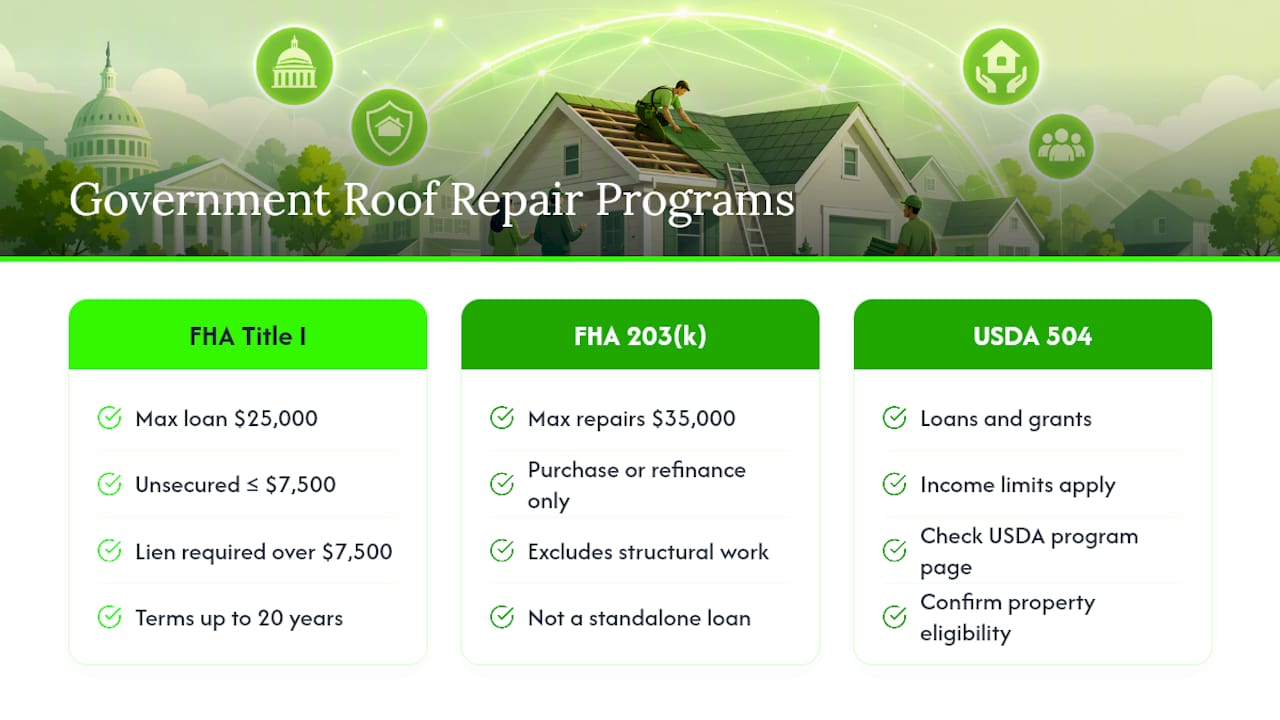
Government programs serve homeowners who lack equity or income to qualify for conventional financing. They're not fast, but the rates and terms are often far better than anything available through private lenders.
FHA Title I Property Improvement Loans
HUD's Title I program allows homeowners to borrow for home improvements, including roofing, without requiring equity up to a lower loan cap. For a single-family home, the maximum is $25,000. Loans up to $7,500 are unsecured; above that, a lien on the property is required. Terms run up to 20 years. You apply through an FHA-approved lender, not directly through HUD.
FHA 203(k) Limited Streamline
The 203(k) limited streamline is a purchase-or-refinance loan that rolls renovation costs into the mortgage. It's most useful when you're buying a home that needs a new roof, or refinancing and want to include repair costs. The limited version caps repairs at $35,000 and excludes structural work. It's not a standalone repair loan.
USDA Section 504 Repair Loans and Grants
Income limits apply. Check the USDA program page for current eligibility thresholds.
Practical tip: Government programs require more documentation and take longer to process than private loans. Start the application early, gather income verification and property documentation upfront, and confirm your property's eligibility before counting on these funds for a scheduled project.
How do you choose and apply for the right roof financing?
Start with a firm estimate, not a lender. You can't compare financing options without knowing the actual project cost. Get estimates from at least two or three reputable contractors before approaching any lender. See how to choose a roofing contractor in Wisconsin for a practical checklist on vetting bids.
Step-by-step process for a planned replacement:
- Get 2–3 written contractor estimates with full scope of work.
- Check your home equity (current value minus mortgage balance).
- Pull your credit score and review your debt-to-income ratio.
- Pre-qualify with 2–3 lenders using soft pulls to compare APR, term, and fees.
- Calculate total cost of each option: (monthly payment × term) + origination fees.
- Confirm funding timeline against your project start date.
- Submit the formal application with the lender offering the best total cost.
- Coordinate loan closing with your contractor's schedule.
For emergency repairs: Skip steps 1–3 and go straight to a personal loan pre-qualification or contractor financing. Speed matters more than rate when water is coming in. An emergency roof repair situation calls for a different priority order.
Checklist of questions to ask any lender:
- What is the APR, including all fees?
- Is the rate fixed or variable?
- What are the origination or closing costs?
- How long from application to funding?
- Are there prepayment penalties?
- Is this true 0% APR or deferred interest?
Red flags: Any lender who pressures you to skip pre-qualification, won't disclose the APR in writing, or quotes a monthly payment without stating the term is one to avoid. Verify lender registration at NMLS Consumer Access before submitting personal financial documents.
What do typical roof jobs cost, and what are the monthly payments?
Roof replacement costs average around $9,500 but vary widely by material, roof size, and region. Wisconsin homes with steeper pitches or premium materials can run significantly higher. Here are three representative job sizes with worked payment examples.
Assumptions: monthly payment estimates are approximate, calculated on simple amortization. HELOC payment shown is interest-only during draw period. Rates are illustrative mid-2026 ranges; your actual rate depends on credit profile and lender. Use a loan calculator such as the one at Bankrate for exact figures based on your numbers.
To pay off $20,000 in 18 months, you'd need $1,111/month. For most homeowners, the equity-backed option is the better deal on a job this size.
For Wisconsin-specific cost benchmarks, the roof replacement cost guide breaks down material and labor ranges by project type.
How does insurance affect your roof financing plan?
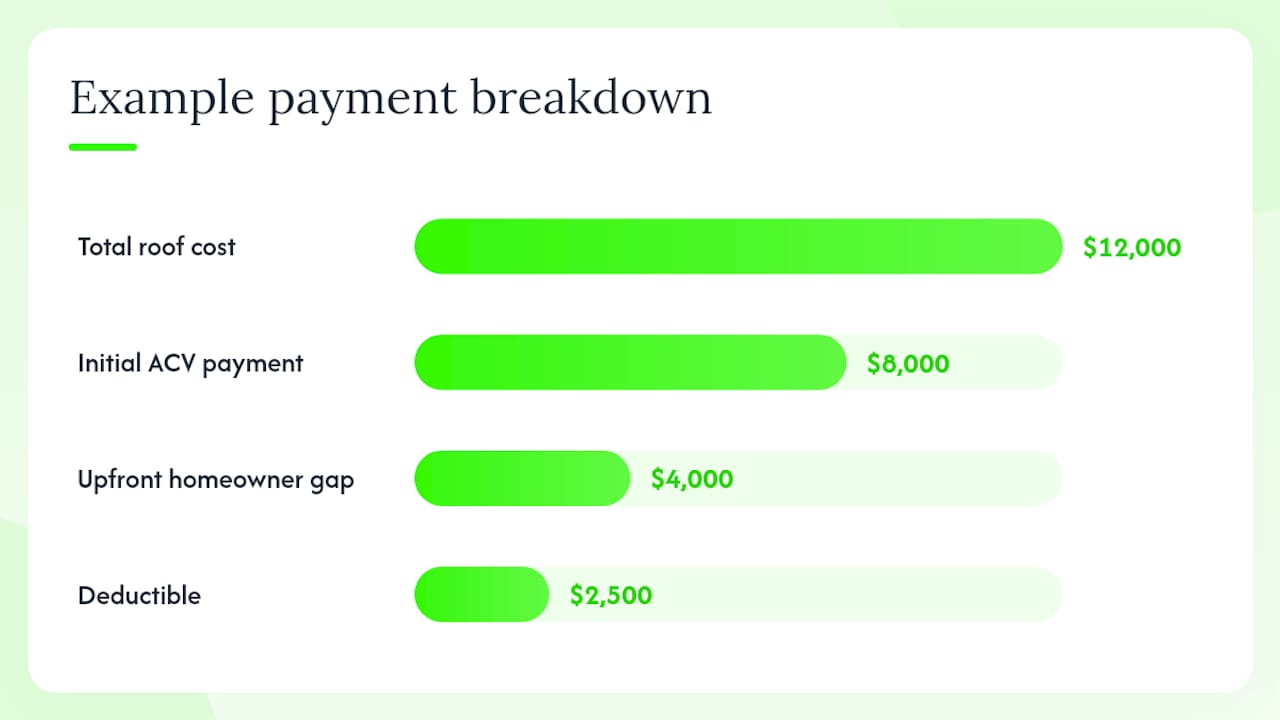
File the insurance claim before you arrange financing. If the damage is covered, insurance typically pays far more than you'd expect, and financing may only be needed for the deductible, code-upgrade costs, or the gap between the actual cash value (ACV) payout and the recoverable depreciation.
How the claim process works:
- Document the damage with photos immediately after the storm.
- Call your insurer and open a claim. They'll schedule an adjuster inspection.
- Have your contractor present at the adjuster inspection. A contractor who attends the inspection and submits clean Xactimate-format supplements can materially increase claim recoveries by identifying code upgrades and hidden damage the adjuster might miss.
- Review the adjuster's estimate. If it's lower than your contractor's scope, your contractor can file a supplement.
- Receive the ACV payment. This is the initial check, reduced by depreciation.
- Complete the work. Once done, submit proof to the insurer to release the recoverable depreciation.
How this affects financing: The ACV check often arrives within days of claim approval. Recoverable depreciation follows after the work is complete. If your deductible is $2,500 and the ACV check is $8,000 on a $12,000 roof, you need to cover $4,000 upfront. A personal loan or short-term credit card can bridge that gap while you wait for the depreciation release.
For storm-damage situations in Wisconsin, Am-exteriors handles the full insurance claim process, from adjuster attendance to supplement filing, which reduces the financing burden for most homeowners.
A note from our founder on how Am-exteriors approaches financing
Over 25 years of owner-operated work in Southeast Wisconsin, the financing conversation comes up on almost every project. Hail storms, ice dams, and wind damage don't wait for a convenient time, and most homeowners haven't budgeted for a $10,000–$20,000 roof replacement.
The advice we give every homeowner is the same: check your insurance first, then your equity, then your credit. In that order. Most storm-related replacements in Wisconsin are at least partially covered by insurance, and a contractor who knows how to document damage and file supplements properly can recover thousands more than a homeowner filing alone. That changes the financing picture entirely.
For homeowners who do need financing, we work with lending partners and walk through the options with you before the project starts. No pressure, no upselling. The goal is a roof that lasts 30 years and a payment you can actually make.
Am-exteriors makes the financing process straightforward
Getting a new roof in Southeast Wisconsin doesn't have to mean weeks of lender calls and paperwork confusion. Am-exteriors works directly with homeowners on roofing projects from the first estimate through final installation, and that includes helping you sort out how to pay for it.
Here's what that looks like in practice: Am-exteriors provides a detailed written estimate you can take to any lender, attends the insurance adjuster inspection to maximize your claim, connects you with financing partners for point-of-sale options, and walks you through the paperwork. For emergency situations, the emergency repair workflow gets a crew on-site fast while you sort out the financing side.
Ready to get started? Request a free estimate at Am-exteriors or call directly to discuss your project and financing options. The estimate is free, there's no obligation, and you'll have the numbers you need to compare any lender's offer.
Helpful official resources for your application
- USDA Section 504 Repair Loans and Grants: Income limits, rural eligibility maps, and application instructions for USDA repair loans and grants.
- NMLS Consumer Access: Verify that any lender or loan originator you work with is properly licensed before submitting personal financial documents.
- NerdWallet Roof Financing Guide: Independent comparison of lenders and financing types with pre-qualification guidance.
- SoFi Roof Financing Overview: General framework for comparing personal loans, home equity products, and contractor financing by equity, credit, and urgency.
This article is general information, not a substitute for advice from a qualified financial advisor. Consult a qualified financial professional about your own circumstances before acting on anything here.