
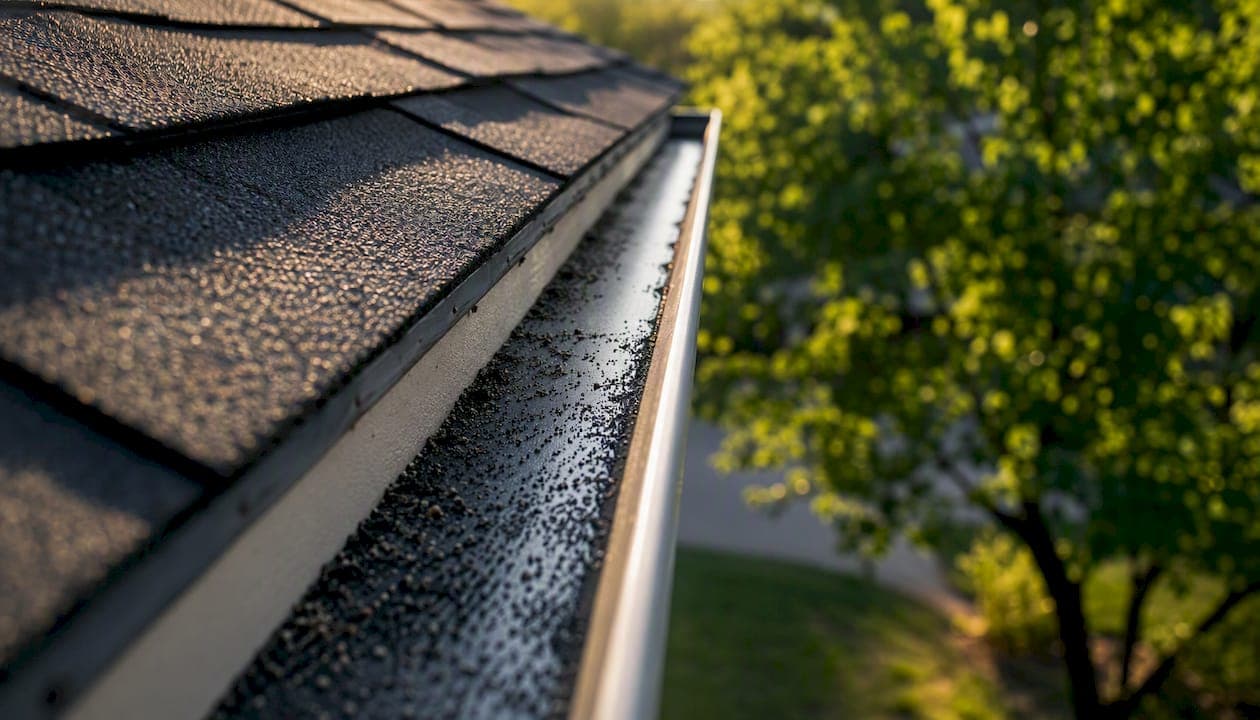
Finding granules in your gutters is usually normal. Whether it signals a problem depends on three things: your roof's age, the timing of the loss, and the pattern of accumulation. A light dusting after the first rainstorms on a new roof is expected. A sudden pile after a hailstorm on a 12-year-old roof is a different story.
Here's how to read what you're seeing:
- New roof (under 12 months): Light granule shedding is factory excess. Monitor it. It should taper off after a few rainstorms.
- Sudden surge after a storm: Photograph your gutters and downspouts immediately. Document the storm date and contact your insurer or a roofer.
- Heavy, recurring accumulation on an aging roof: Schedule a professional inspection. If your roof is 15 or more years old and you're scooping gritty sediment from your downspouts, plan for replacement.
Key Takeaways
Granule loss is diagnostic data: timing, pattern, and quantity together tell you whether to monitor, document, or act.
| Point | Details |
|---|---|
| New roof = monitor | Factory excess shedding tapers within 1–12 months; light loss on a new roof is expected. |
| 0.5 inch threshold | Scooping 0.5 inch or more of gritty sediment at the downspout signals protective loss and warrants inspection. |
| Storm surge = document fast | Photograph gutters and roof within 24 hours of a storm; dated photos and inspection reports support insurance claims. |
| 15+ years = plan replacement | Widespread bald spots on an aging roof rarely justify spot repairs; budget for a full reroof. |
| Am-exteriors inspections | Wisconsin homeowners can get written, insurance-ready inspection reports from Am-exteriors for storm damage or aging concerns. |
Table of Contents
- What are granules in gutters, and why do they matter?
- Why do granules end up in your gutters?
- When finding granules in gutters is completely normal
- When granule loss becomes a red flag
- Common causes of excessive granule loss
- How to assess how much granule loss is too much
- Safe checks you can do before calling a roofer
- Storm damage, insurance, and how to document a claim
- Can granule loss be repaired?
- When to schedule a professional roof inspection
- What roofers actually see on inspection
- Wisconsin homeowners: get a documented inspection from Am-exteriors
- Sources
What are granules in gutters, and why do they matter?
Asphalt shingles are coated with mineral or ceramic granules pressed into the surface during manufacturing. These granules do more than give shingles their color. They block ultraviolet radiation, add fire resistance, and cushion the impact of hail and debris. The granule layer is the shingle's primary UV shield. Remove it, and the asphalt underneath begins to oxidize, crack, and fail.
Pro Tip: Run your hand along a shingle edge (from ground level or a safely positioned ladder). If it feels smooth and slightly shiny rather than gritty, that section has lost meaningful granule coverage.
Factory-fresh shingles always carry some loose, unbonded granules from the manufacturing process. These wash off in the first rainstorms and show up as the initial wave of gutter debris. That's expected. Long-term granule loss is a different mechanism: it signals binder breakdown, UV degradation, or physical damage, all of which accelerate the shingle's aging clock.
Why do granules end up in your gutters?
Water is the main transport. Rain hits the roof surface, picks up dislodged granules, and carries them down the slope into the gutter trough. Gravity does the rest, moving them toward downspouts where they collect in concentrated piles. That's why gutter debris removal at downspout elbows often reveals the heaviest accumulation.
Loose factory granules wash off during the first storms after installation. This is manufacturing residue, not a sign of failure. But physical forces also dislodge granules from older shingles: hail impacts crack the bond between granule and asphalt; foot traffic grinds granules loose; leaf and branch abrasion wears the surface over time. Wind repeatedly flexing a shingle can crease it, breaking the granule bond along the crease line. Each of these mechanisms produces a distinct pattern in the gutter, which is useful diagnostic information.
When finding granules in gutters is completely normal
Not every handful of gritty sediment in your gutter is a warning sign. Three situations produce granule loss that doesn't require immediate action:
- New roof, first 1–12 months: Factory excess shedding is expected and tapers off within the first several rainstorms. If you had a new roof installed this year and see granules in your gutters, watch the trend. It should decrease, not increase.
- Mid-life roof, low steady loss: A small, consistent amount of granules in the gutter after heavy rain is part of normal aging on a roof in its middle years (roughly 7–14 years old). The key word is consistent. Steady and low is different from sudden and heavy.
- After routine heavy rainfall with no visible shingle damage: A single heavy rain event can move granules that were already loose. If there's no visible bald spot on the shingles and the accumulation is light, track the trend over the next few storms rather than reacting to one event.
The pattern and timing matter as much as the quantity. A single post-rain dusting means something different than the same amount appearing every week.
When granule loss becomes a red flag
Heavy or sudden granule accumulation changes the calculation. These are the patterns that call for documentation and likely a professional inspection.
Threshold and pattern cues
| Signal | What it looks like | What it suggests |
|---|---|---|
| Heavy accumulation | A measurable depth of gritty sediment scooped from the downspout trough | Significant protective loss; inspection advised |
| Bald or shiny spots on shingles | Visible dark patches where asphalt is exposed | Granule bond has failed; accelerated aging underway |
| Sudden surge after a storm | Large volume appearing immediately after hail or high winds | Possible storm damage; document and contact insurer |
| Concentrated piles at one downspout | Granules pooling under a single discharge point | Localized damage on that roof section |
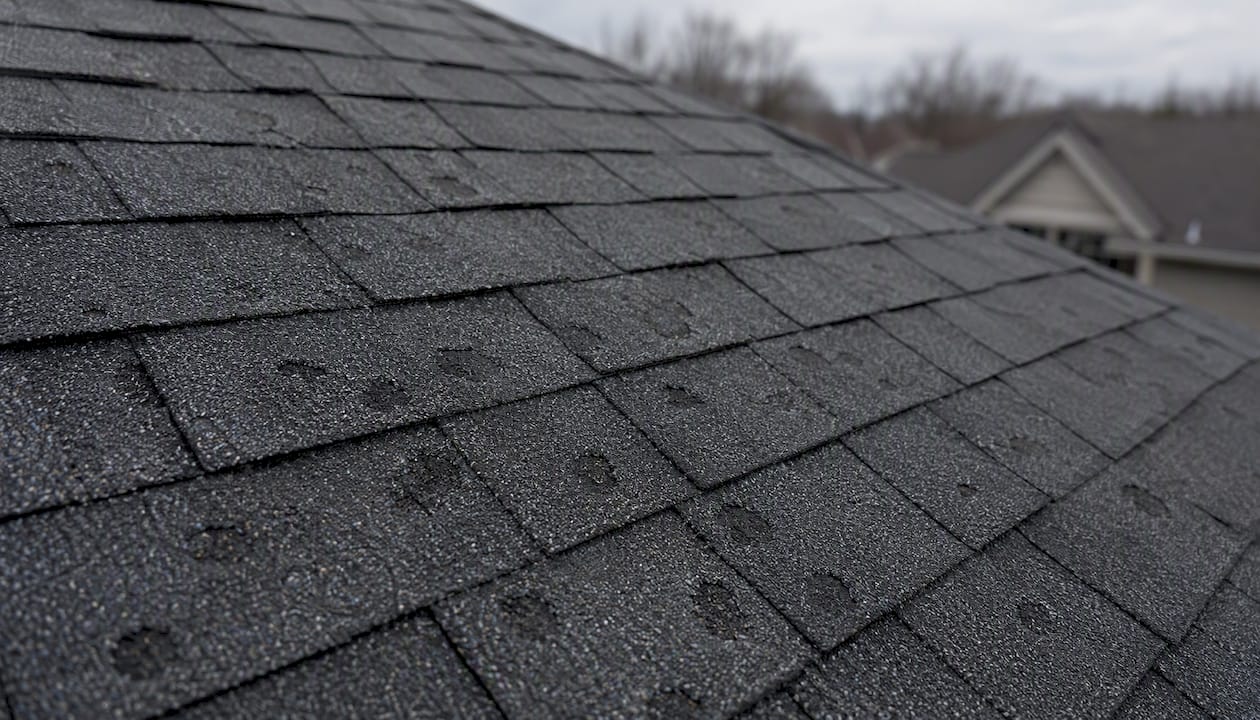
| Circular bruise patterns | Peppered, round depressions on shingle surface | Consistent with hail impact |
| Creases or linear loss | Damage concentrated on windward slopes with fold lines | Consistent with wind uplift and shingle flexing |
Once exposed asphalt is visible, the shingle ages much faster. Industry guidance indicates that significant granule loss on older roofs signals approaching end of service life, with exposed asphalt accelerating degradation to the point where replacement may be needed within a few years.
- Sudden storm-related surge: Photograph everything, record the storm date, and contact your insurer and a roofer promptly.
- Heavy, persistent loss on a roof 15 or more years old: Start budgeting for roof replacement. Spot repairs won't restore granule coverage.
Common causes of excessive granule loss
Aging and UV breakdown
Steady granule loss tends to accelerate after a roof reaches 10–15 years. The asphalt binder softens and hardens through seasonal temperature swings, gradually releasing its grip on the granule layer. This produces uniform, distributed loss across the whole roof surface rather than concentrated patches.
Hail impact
Hail is the most abrupt cause. Each impact creates a small circular bruise where the granule bond fractures. After a significant hailstorm, you may find a sudden, heavy accumulation in your gutters within 24 hours. Hail damage patterns appear as peppered circular depressions, often visible from the ground on low-slope sections.
Wind uplift and shingle flexing
Repeated wind loading lifts shingle tabs, creases the material along the fold line, and breaks the granule bond at that point. The IIBEC/Haag guidance on wind damage is clear: granule loss alone doesn't prove wind damage. Adjusters and inspectors look for creases, folds, tears, or missing tabs as pattern evidence. Linear granule loss concentrated on windward slopes, combined with visible creasing, is the combination that supports a wind-damage finding.
Installation and sealant issues
Poor workmanship can cause premature granule loss. Inadequate sealant strip bonding, improper nailing, or shingles installed over an uneven deck all create stress points where granules release earlier than they should. Signs of poor installation quality often show up within the first few years rather than at end of service life.
How to assess how much granule loss is too much
- Scoop the downspout discharge. After a rain, collect the sediment at your downspout outlet. A light dusting that barely coats your palm is normal. A gritty layer 0.5 inch or deeper in the trough indicates serious protective loss and warrants an inspection.
- Scan the roof from the ground with binoculars. Look for color changes: healthy shingles are uniformly textured and consistent in color. Bald spots appear darker or shinier. Check for curling edges or visible asphalt.
- Track the trend over multiple storms. One heavy-rain event can move loose granules without indicating failure. Three consecutive storms producing increasing accumulation is a trend worth acting on.
- Note the pattern. Uniform loss across the whole roof suggests aging. Concentrated loss at one downspout or on one slope suggests localized damage.
Pro Tip: Keep a simple log: date, storm description, and a rough estimate of granule volume (light dusting, half a cup, a full cup or more). Three data points tell you far more than one.
Safe checks you can do before calling a roofer
Safety comes first. Never walk on a wet or steep roof. Most of what you need to assess granule loss can be done from the ground or from a safely positioned ladder at the gutter line.
What to photograph:
- Wide shots of each roof face from ground level
- Close-ups of any visible bald or discolored patches, taken through binoculars if needed
- The gutter trough and downspout discharge area, with a ruler or coin for scale
- A dated photo of post-storm accumulation taken within 24 hours of the event
What to record in writing:
- Roof installation date or approximate age
- Date and description of any recent storms (wind speed estimates, hail size if known)
- Location of concentrated granule piles (which downspout, which side of the house)
- Any prior roof work, repairs, or warranty information
Pro Tip: Use your phone's timestamp feature and turn on location data before photographing storm damage. Insurers and contractors both use photo metadata to verify timing, and a timestamped photo taken the day after a storm carries more weight than one taken a week later.
Storm damage, insurance, and how to document a claim
Insurers draw a clear line between normal weathering and storm damage. Uniform, age-related granule loss is treated as weathering, which is generally not covered. Sudden, significant loss after a documented hail or wind event can qualify as storm damage, depending on your policy and the roof's age at the time of the storm.
What typically determines coverage:
- Whether the loss is sudden and concentrated (storm) vs. gradual and uniform (aging)
- Whether an inspection report documents impact marks, creases, or other pattern evidence
- The roof's age and remaining useful life at the time of the event
Documentation steps after a storm:
- Photograph gutters, downspouts, and any visible roof damage within 24 hours
- Save a sample of granules in a labeled bag with the date
- Record the storm date, time, and any local weather service data (hail size, wind speed)
- Request a written inspection report from a contractor that identifies specific damage patterns
Homeowner documentation after a storm, including photos, dates, and an inspection report, materially improves the outcome of an insurance claim for hail or wind damage. Prompt action matters: evidence degrades, and insurers note the gap between a storm event and a filed claim.
Pro Tip: Contact your insurer to open a claim before scheduling a contractor inspection. Many policies require the insurer to send their own adjuster first. A contractor's inspection report then serves as supporting documentation, not the primary assessment.
For Wisconsin homeowners, Am-exteriors provides storm damage inspection services with written reports formatted to support insurance claims.
Can granule loss be repaired?
Granule loss itself cannot be reversed. No product restores granules to an asphalt shingle once they've washed away. What can be done depends on how widespread the damage is.
Spot shingle replacement works when loss is localized to a small section, the surrounding shingles are in good condition, and the roof is under 15 years old. Replacing individual shingles stops further water infiltration at that point but doesn't address underlying aging across the rest of the roof.
Full reroof becomes the practical choice when bald spots are widespread, the roof is 15 or more years old, or granule loss is accelerating. Patching a roof that's approaching end of service life typically costs more over five years than replacing it. The repair-or-replace decision usually comes down to the percentage of affected area and the roof's remaining warranty life.
Gutter maintenance is a separate but related task. Clean granules from your gutters to prevent clogs and downspout blockages. Granules causing clogs can back up water against the fascia and cause rot. But cleaning the gutters doesn't slow granule loss from the roof. Use what you find in the gutter as diagnostic data, then address the source.
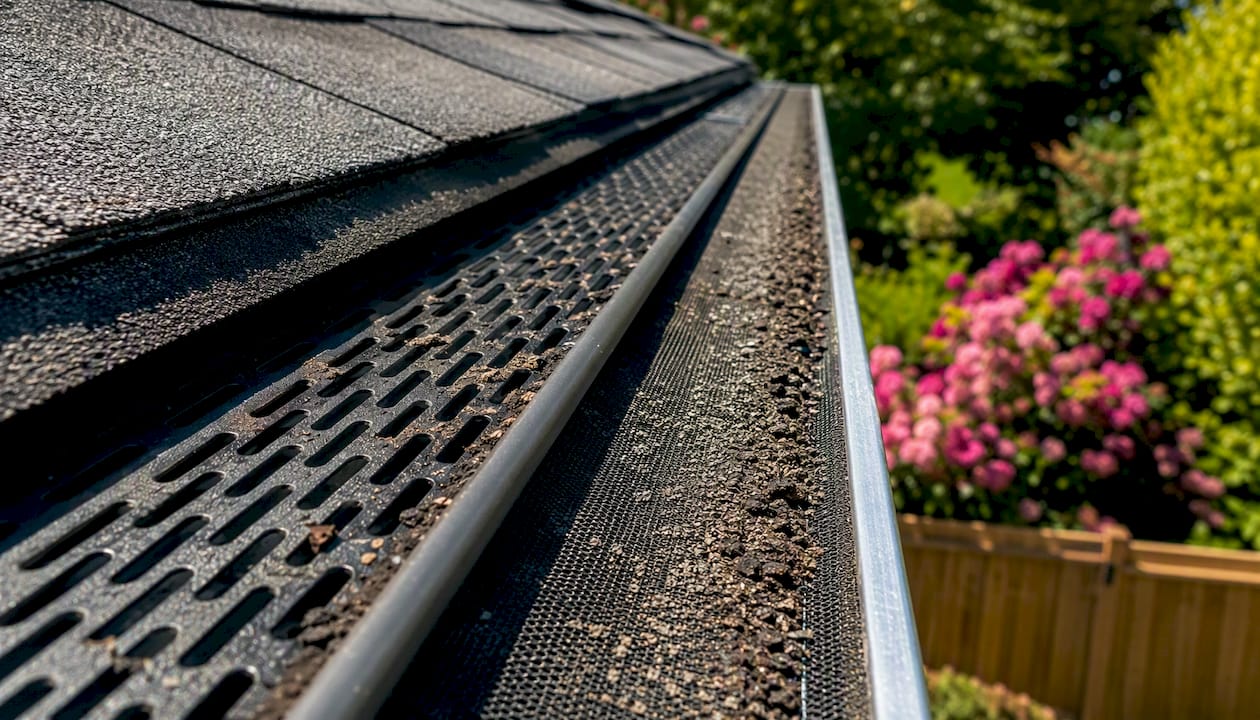
Pro Tip: If you're considering gutter guards, choose a style that allows granule sediment to pass through or flush out rather than trapping it. Mesh guards with fine openings can accumulate granule grit and require more frequent cleaning than open-face styles.
When to schedule a professional roof inspection
Call a roofer when any of these apply:
- You scoop 0.5 inch or more of granule sediment from the downspout trough
- You can see bald or shiny spots on shingles from the ground
- Granule accumulation spiked suddenly after a documented storm
- You notice shingle deformation: curling, creasing, or missing tabs
- Your roof is 15 or more years old and showing steady, increasing loss
What a qualified inspector will check
A reputable contractor's inspection covers more than a visual scan. Expect them to assess the percentage of roof area with exposed asphalt, check for hail bruising and impact patterns, test sealant bond integrity along tabs and seams, look for wind-uplift evidence (creases, tears, lifted edges), inspect the attic for moisture or leak signs, and photograph all findings with location references.
The deliverables from a solid inspection include a written report, photo documentation of specific damage patterns, a clear repair-versus-replace recommendation, and, if storm damage is present, documentation formatted for your insurer. InterNACHI's inspection standards outline what a qualified inspector documents to differentiate storm damage from normal wear.
What roofers actually see on inspection
Most homeowners either overreact or underreact to granule loss. The two most common errors: assuming any granules in the gutter mean the roof is failing, and walking on the roof to check, which dislodges more granules and can crack brittle shingles.
Contractors prioritize pattern over quantity. A cup of granules concentrated under one downspout after a hailstorm tells a different story than a cup of granules spread evenly across four gutters on a 20-year-old roof. The first may support a claim. The second is normal aging.
Wind damage is frequently misread. Pattern evidence is what adjusters require: creases, folds, tears, or missing tabs on windward slopes. Granule loss alone, without those structural markers, usually doesn't meet the threshold for a wind-damage finding. Homeowners who document the storm timing and avoid disturbing the debris give inspectors the clearest picture.
The most useful thing you can bring to an inspection: your roof's installation date, any prior repair records, and dated photos taken right after the storm. That paperwork shortens the inspection and strengthens any claim.
Wisconsin homeowners: get a documented inspection from Am-exteriors
Granule loss in Wisconsin gutters often follows hail and high-wind events that hit Southeast Wisconsin hard. Am-exteriors provides documented roof inspections for homeowners in Dodge, Washington, Fond du Lac, and Ozaukee counties, with written reports that identify damage patterns, support insurance claims, and give you a clear repair-or-replace recommendation.

The process is direct: schedule an inspection, share your storm dates and any photos you've taken, and receive a written report you can hand to your insurer. If storm damage is confirmed, Am-exteriors handles the documentation side so you're not navigating the claim process alone. For roofs that need replacement, the team installs Malarkey shingles and other premium products built for Wisconsin weather, backed by manufacturer warranties.
Schedule a roof inspection or review Am-exteriors's full storm damage repair services to get started.
Sources
The following resources were used to define thresholds, inspection practices, and insurance guidance in this guide:
- Mastering roof inspections: Asphalt composition shingles, Part 34 - InterNACHI®
- Misconceptions of wind damage to asphalt composition shingles | IIBEC / Haag
- What Is Covered by Insurance After Roof Damage? | Gerken Roofs